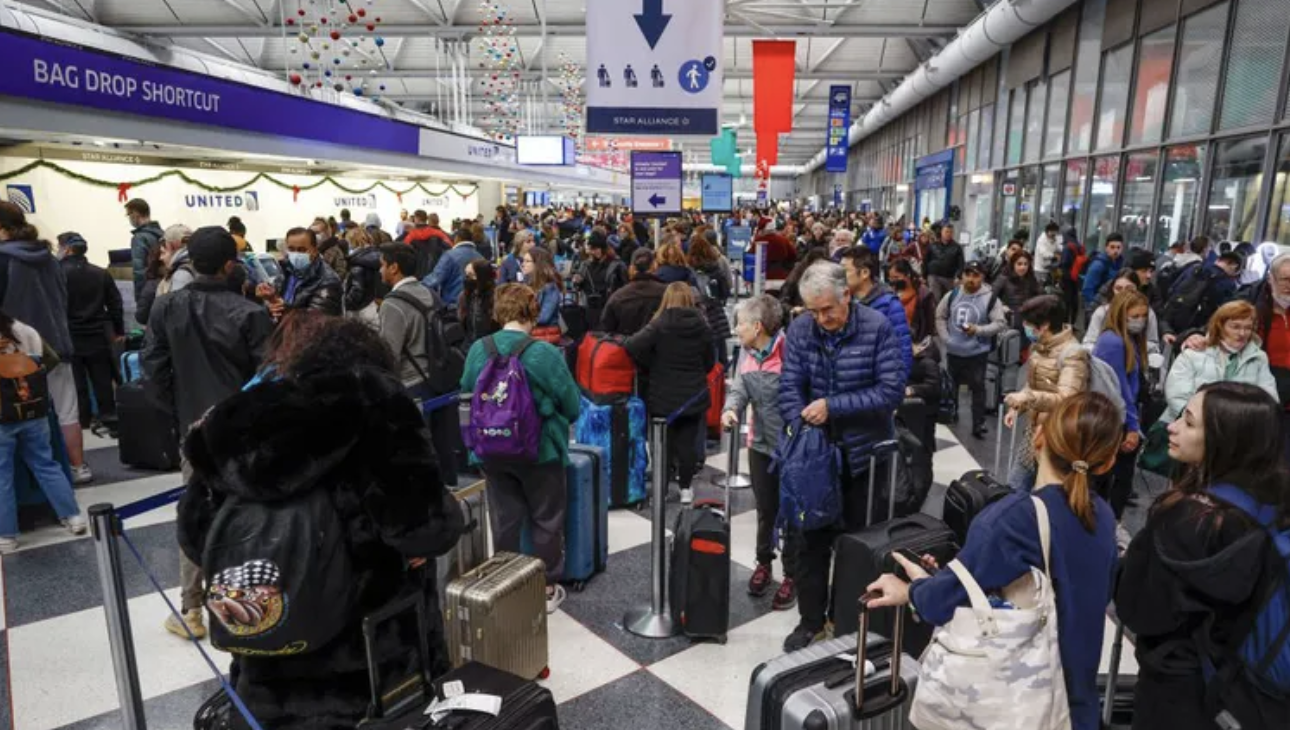
Designing for Security Uncertainty
A multi-year study to develop a mobile security wait-time feature for pre-arrival planning.
Role
Research lead, Customer Strategy & Innovation
Partners
Digital Products
Airport Operations
Scope
Multi-year research program culminating in live feature
* Certain details have been omitted or modified for proprietary reasons.
3.1M
no. passengers screened
on June 22, 2025 —
the busiest day in TSA history.
59%
of global travelers say
they prefer to arrive at the airport earlier than they need to.
23%
of passengers actually wait
more than 20 minutes
to clear security.
Sources: Transportation Security Administration, June 2025; Opodo Travel Habits Survey, 2026; J.D. Power 2025 North America Airport Satisfaction Study.
Summary
Security is one of the most consequential stages of the day of travel, yet one that lies largely outside of airline jurisdiction. Yet, while airlines don't operate TSA checkpoints, travelers' security experiences can have outsized influence on their overall day-of-travel experience, and ultimately on their perception of their airline itself. Security wait-time uncertainty also poses immense operational challenges. When travelers can't predict the length of their security experience, they compensate by arriving early, resulting in greater airport congestion — a problem that will only intensify as travel volumes grow in the years ahead.
I led a multi-phase research program to understand how security wait-time uncertainty shapes the day-of-travel experience, and how pre-arrival awareness through a mobile feature can alter both travelers' behavior and their overall experience. The foundational research findings showed why, in the absence of reliable information, travelers arrive earlier than necessary, perpetuating conditions of unpredictability and perceived unfairness. Subsequent concept testing showed that, while different groups of travelers require wait-time information at different stages leading up to airport arrival, one need was constant across all groups — not certainty about security times, but credible expectation-setting to support planning patterns. After several rounds of further content testing, the wait-time feature was piloted within the United app over a 21-day period, during which travelers on piloted flights arrived 17 minutes later on average than travelers on non-piloted flights.
The feature has since rolled out across the United app, and further evaluative research is ongoing to refine core aspects around transparency, reliability, and personalization.
Problem
From the customer perspective, security poses a distinct challenge for airline experience design. Alongside delays, it's one of the strongest drivers of day-of-travel satisfaction. It shapes when travelers decide to leave for the airport and how they experience arrival. Yet it's the one stage of the journey airlines don't control directly. It sits between parts of the experience the airline does influence — check-in, bag drop, boarding — but travelers don't separate those boundaries when evaluating their experience. Stress at security produces a halo effect that the airline ultimately absorbs.
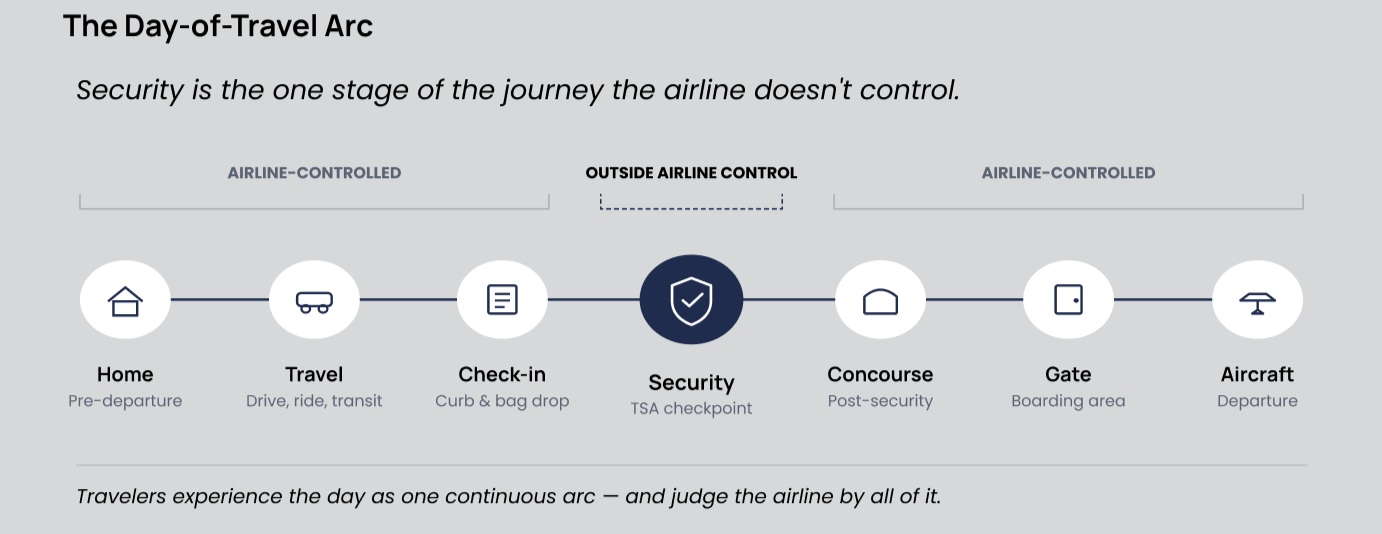
The challenge is also intensifying. As passenger volumes continue to rise, the physical capacity of major hubs cannot keep pace. Adding lanes, expanding pre-security spaces, and restructuring the security footprint can only do so much. As infrastructure approaches its limits, the most promising lever for managing pressure at security increasingly sits upstream — in how travelers prepare for and time their arrival at the airport.
The research and design challenge was clear. If airlines are to increase customer confidence and reduce operational pressure without relying solely on infrastructure change, they need ways to influence customer behavior upstream, before airport arrival. That requires understanding how travelers plan around security, and whether providing credible wait-time information before arrival could change that behavior — encouraging later, more distributed arrivals while making the security experience feel more predictable.
This raised a set of strategic questions:
How do travelers currently plan around security, and where in the journey does that planning take place?
What kinds of wait-time information would they trust enough to act on?
When in the planning window does that information matter most?
Could a mobile-app feature actually shift arrival behavior at scale?
Answering these questions required a multi-phase research approach — first observing how travelers currently plan around security, then testing whether pre-arrival wait-time information could change that behavior.
Design
The work became a multi-phase research program over the course of two years:
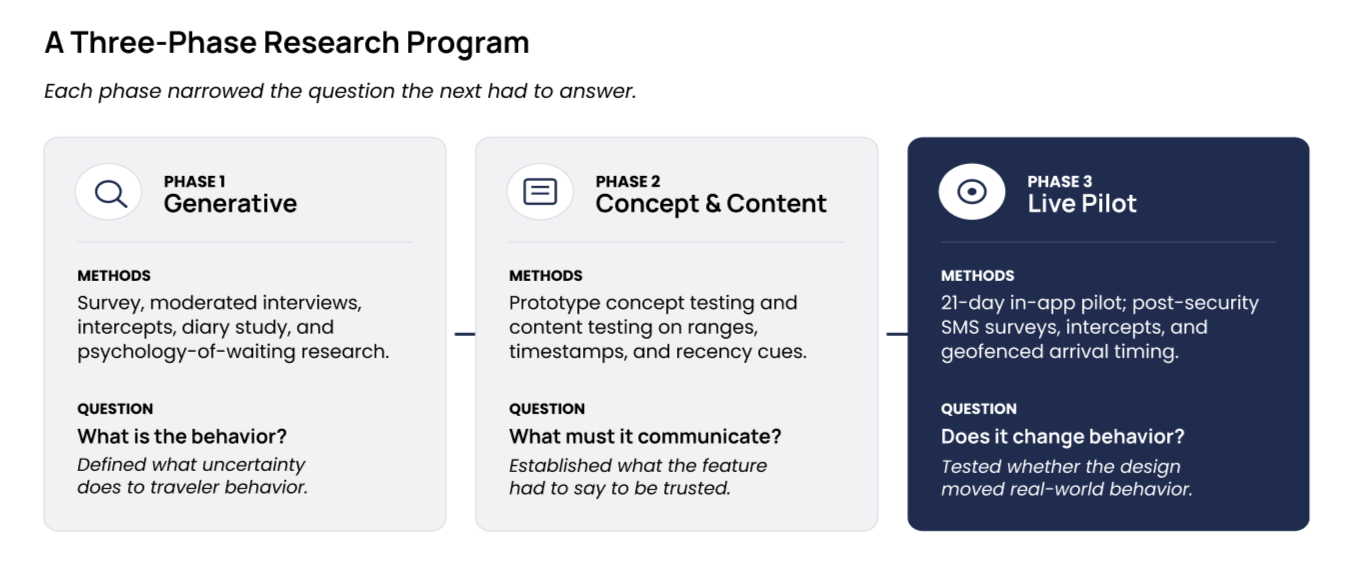
Phase 1: Generative research. Foundational work examining how uncertainty around security shapes traveler emotions, planning behavior, and perceptions of fairness. The phase combined a survey, moderated interviews, intercept conversations, a diary study, and academic and industry research on the psychology of waiting.
Phase 2: Concept and content testing. Exploratory research on prototypes to learn what customers want to see in a security wait-times feature. Content testing then refined how that information had to be presented — the language, ranges, timestamps, and recency cues travelers needed in order to trust it enough to act on.
Phase 3: Live pilot evaluation. Following design refinement, the feature was evaluated in live conditions on selected pilot flights over a 21-day interval to assess real-world impact on satisfaction, arrival behavior, and use of the app during the pre-arrival window. The phase combined post-security SMS surveys, intercept interviews, and geofencing-based arrival timing.
Generative research defined what uncertainty was doing to traveler behavior; concept and content testing established what the feature had to communicate to address it; the live pilot tested whether the resulting design actually changed behavior in the field. Each phase narrowed the question the next phase had to answer.
Insight
The study yielded three core takeaways:
Uncertainty about security, not the length of the wait itself, was driving precautionary arrival behavior.
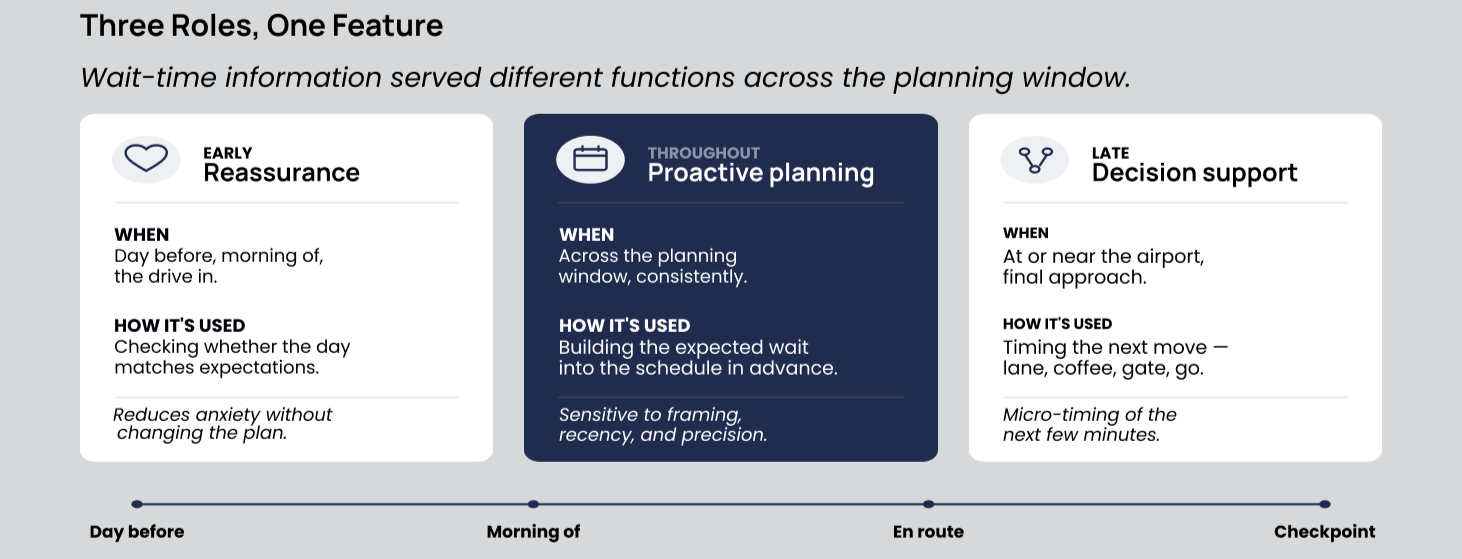
Wait-time information served different functions across the planning window — reassurance early, timing decisions late, and ongoing reference for some travelers throughout.
In live pilot use, the feature produced observable behavior change: travelers on pilot flights arrived 17 minutes later on average than travelers on comparable non-pilot flights.
1. Uncertainty, Not Wait Time, Was Driving Behavior
What emerged from generative research was a behavioral cycle driven by wait-time and procedural unpredictability. When travelers lacked credible expectations, they compensated by arriving early. Earlier arrival increased dwell time and sensitivity to delay. As waiting stretched without explanation, frustration escalated and was interpreted as unfairness or neglect. That experience reinforced precautionary behavior the next time, restarting the cycle.
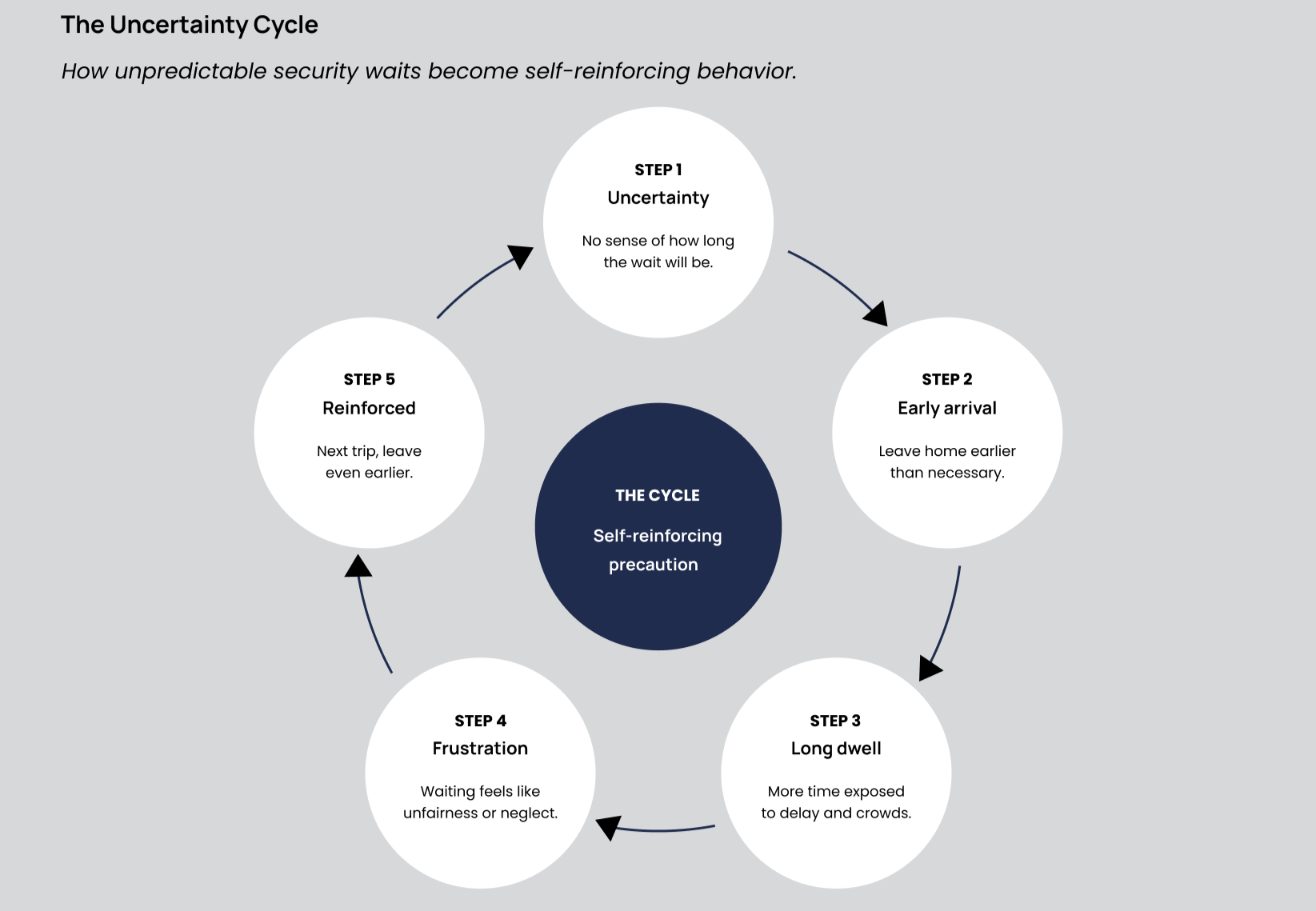
The research also showed a clear pattern around confidence and planning. Travelers who didn't feel confident about what to expect at security arrived earlier and rated the security experience more negatively — even when their reported wait times were similar to travelers who felt knowledgeable and unconcerned. The driver of the behavior wasn't how long the wait actually was. It was how predictable the wait felt.
That same pattern explained something participants raised in interviews: even travelers who said the airport's existing wait-time signage no longer changed how they'd planned their day still valued it. They valued it because it let them reset expectations about the next few hours — not because it shaped the decision to leave home early.
From the standpoint of the psychology of waiting, this is understandable. Predictability and explanation often matter more for perceived control than absolute duration. When travelers can see how a situation is unfolding and understand why it looks the way it does, they can judge risk, time their actions, and decide what to do next.
The major implication of the generative research was that travelers don't need certainty. They actually value messaging that sounds sincere even when it can't offer definite information. What they need is to have their expectations set, and updated, in ways that let them act with confidence.
2. Wait-Time Information Served Different Functions Across the Planning Window
Testing different wait-time prototypes through unmoderated interviews not only confirmed the desire for such a feature, but shed light on how people would use it — which revealed not one but a diversity of ways. Its value to travelers depended on when they might encounter it and the type of planner they tended to be.
Some participants said they would predominantly use it 48–24 hours in advance of their flight, underlying a need for reassurance — checking wait times to reduce uncertainty without necessarily changing their intended arrival. Others said they would predominantly use it 8–3 hours in advance, indicating an emphasis on efficiency; wait-time information now informed concrete timing decisions about when to leave. A third group indicated they would use the feature across intervals, with heightened sensitivity to framing and precision.
Content testing then focused on how travelers could best understand and act on the estimate. What the study showed was that exact estimates were a trust-factor risk and that ranges were more credible but required careful formatting to remain actionable. More important to participants than exact estimates vs. time ranges was strong indicators that the information being provided was being updated in real time.
This is where the work moved from "surface a number" to designing how a piece of information would be read. A wait-time feature that travelers don't trust doesn't reduce precautionary arrival; it just becomes another piece of noise they screen out.
3. Pilot Evaluation Showed Observable Behavior Change
Live pilot evaluation tested the feature on selected pilot flights, combining post-security SMS surveys and intercept interviews with geofencing-based arrival timing. Results indicated clear awareness and behavioral impact. 78% of survey respondents noticed the feature, and among those, 55% reported using it to help decide when to leave for the airport.
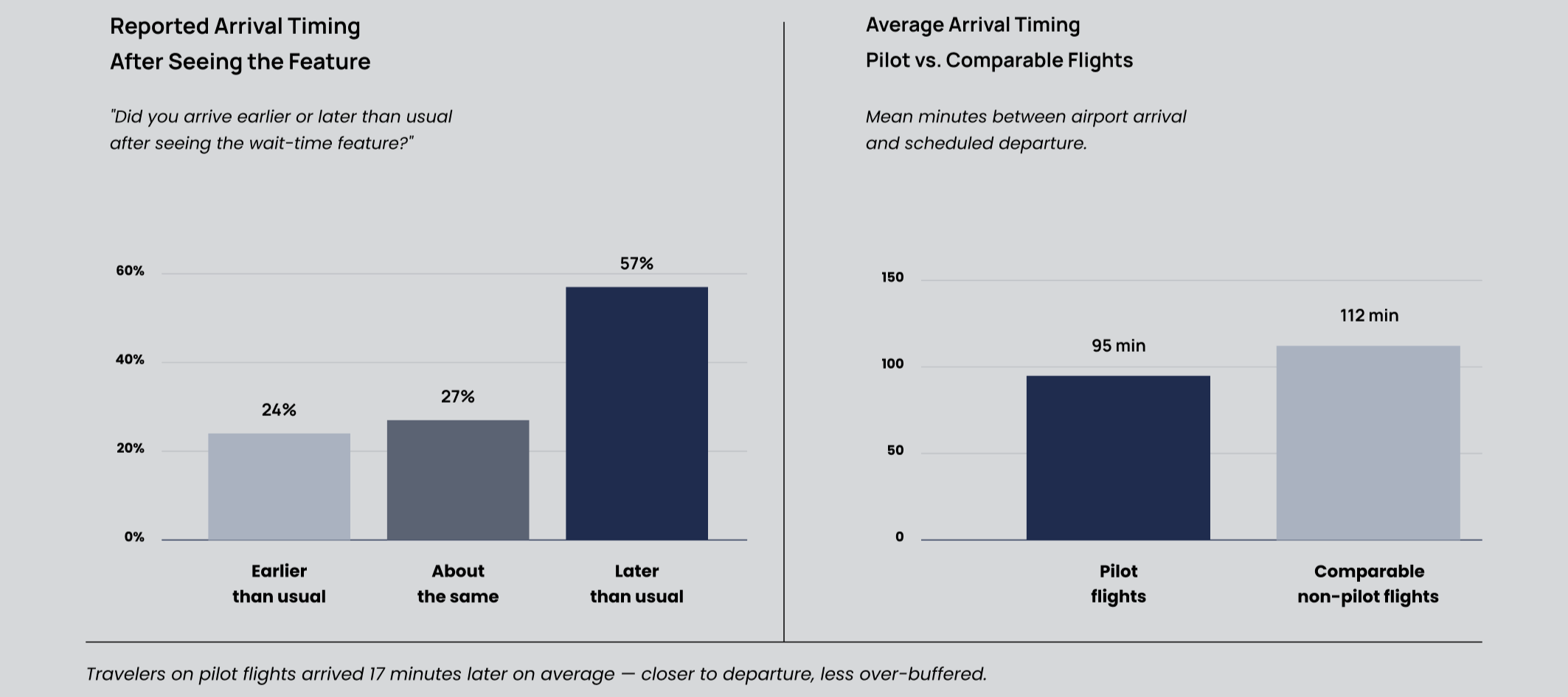
Geofencing analysis provided behavioral corroboration: arrival times for customers on pilot flights were 17 minutes later on average compared to travelers on comparable flights at the same terminals and departure windows who did not receive the feature. While the sample size was relatively small, the direction of the shift aligned with both survey responses and the underlying behavioral model.
Impact
The Security Wait Times feature is now live in United's app. The feature represents one of the clearest examples in the day-of-travel experience of research moving from behavioral foundation, to product intervention, to measurable behavior change — and into customers' hands.
The work produced four substantial outcomes:
Strategic readiness during a moment of unprecedented disruption. The work was accelerated as a top priority from the highest leadership level following a period of heightened security disruption. Senior leadership had a behavioral model and a tested concept ready to inform development.
Ongoing refinement of the live product. Active evaluative work continues, with a focus on how messaging adapts when conditions change, how accuracy is signaled to travelers, and how the feature should evolve as it scales (e.g., personalization to traveler clearance level).
A reference for adjacent product questions. The framework has become a reference for how the airline can support travelers upstream from airport arrival, how consent-based location services can provide timing guidance, and how AI might help travelers synthesize fragmented signals during the pre-arrival window.
A strategic reference at the leadership level. Presented to senior leadership across Digital, Product, Operations, Airport Experience, and Customer Experience over the program's two years, the work now serves as a reference for how the organization thinks about influencing customer behavior upstream of the airport for both essential and discretionary digital products.
A broad takeaway from this research, for customer experiences more generally, is that the most useful intervention is not eliminating variability but making variability intelligible — letting customers form and revise expectations with confidence, so they rely less on precautionary behavior and more on information.