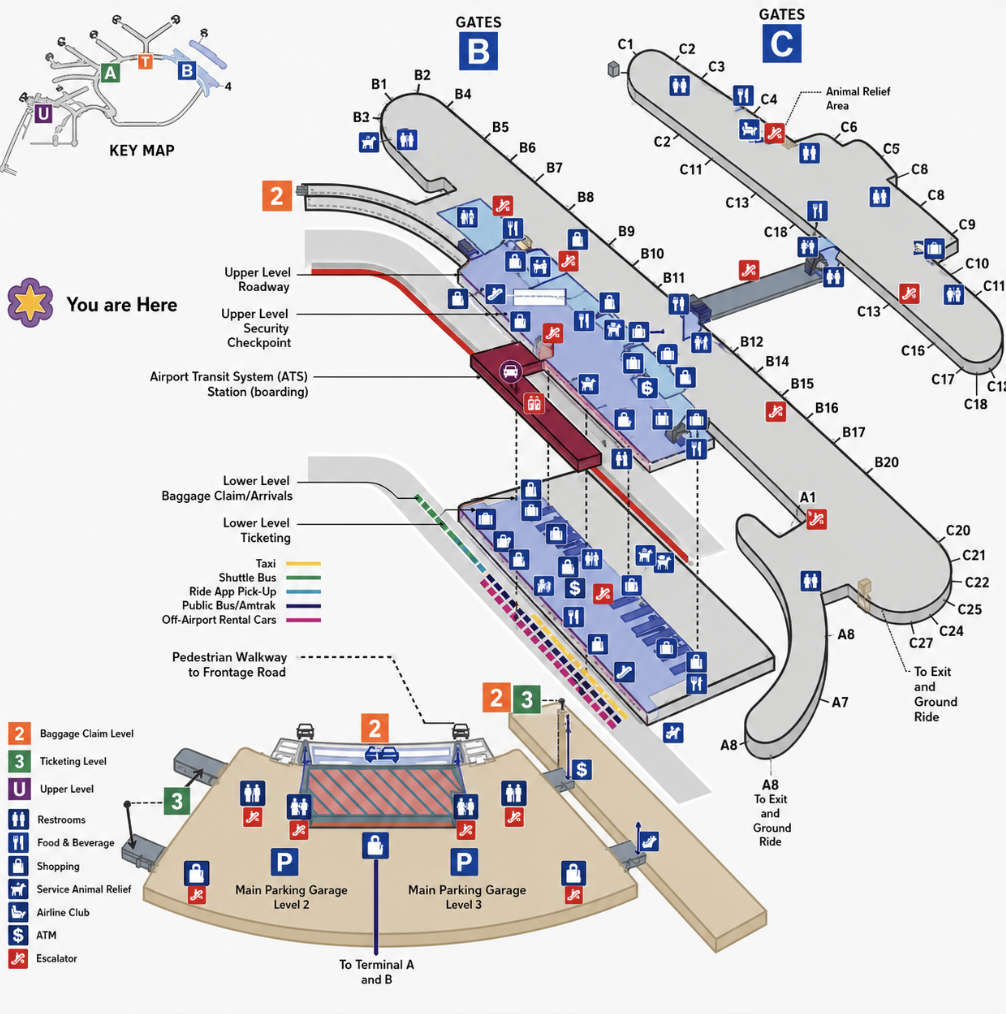
Redesigning ORD's Departure Terminal
Mixed-methods research on designing for speed, ease, and scale
Role
Research lead, Customer Strategy and Innovation
Partners
Lobby Experience
Airport operations
Scope
Current-state evaluation for
2027 rebuild and redesign
* Certain details have been omitted or modified for proprietary reasons.
266K+
travelers passing through
ORD on a single peak day
in July 2025.
+6.4%
year-over-year growth
in ORD passenger volume
through mid-2025.
9 of 10
busiest TSA screening days
in ORD history occurred
in summer 2025.
Sources: Chicago Department of Aviation; TSA, 2025.
Summary
Airport departure lobbies are transitional spaces that have to absorb rising passenger volumes inside fixed footprints. As demand grows, the challenge for airports going forward will be not only how to add capacity to existing structures, but how to make the space already in use work better.
I led a research project to support the redesign of Chicago's O'Hare Airport (ORD). The task was to evaluate its current state to assess the scope of required intervention. This evaluation involved assessing its main sources of friction and how the lobby could support more throughput, segmentation, and self-service without proportional increases in staffing or footprint.
Combining day-of-travel app data, operational data, and in-situ observation, the research documented how congestion is created upstream. Uneven inflow concentrates travelers early, steering them toward the economy/security core. Spillover lines and ride-hailing cross-traffic amplify clustering and suppress use of other stations. Inconsistent or unclear signage also increases interpretation costs during busy periods, and travelers default to visible queues — shifting work back to agents and undermining self-service.
The research established orientation principles for ongoing rebuild efforts throughout the lobby.
Problem
Air travel is entering a period defined by higher passenger volumes, tighter operational margins, and rising expectations for clarity and self-service — especially at hub airports, where small frictions compound quickly into systemwide delays.
In the space of the departure lobby, that entails redesigning lobby environments so they can support greater volume with clearer service segmentation, stronger self-service, and more reliable throughput — without relying on proportional increases in staffing or footprint.
As part of United's effort to meet this challenge, O'Hare International Airport (ORD) was selected as a priority hub for this redesign work. From both a research and product standpoint, it presented a rare opportunity to step back from incremental fixes and examine foundational elements of the day-of-travel experience — elements that are difficult to change at scale once built.
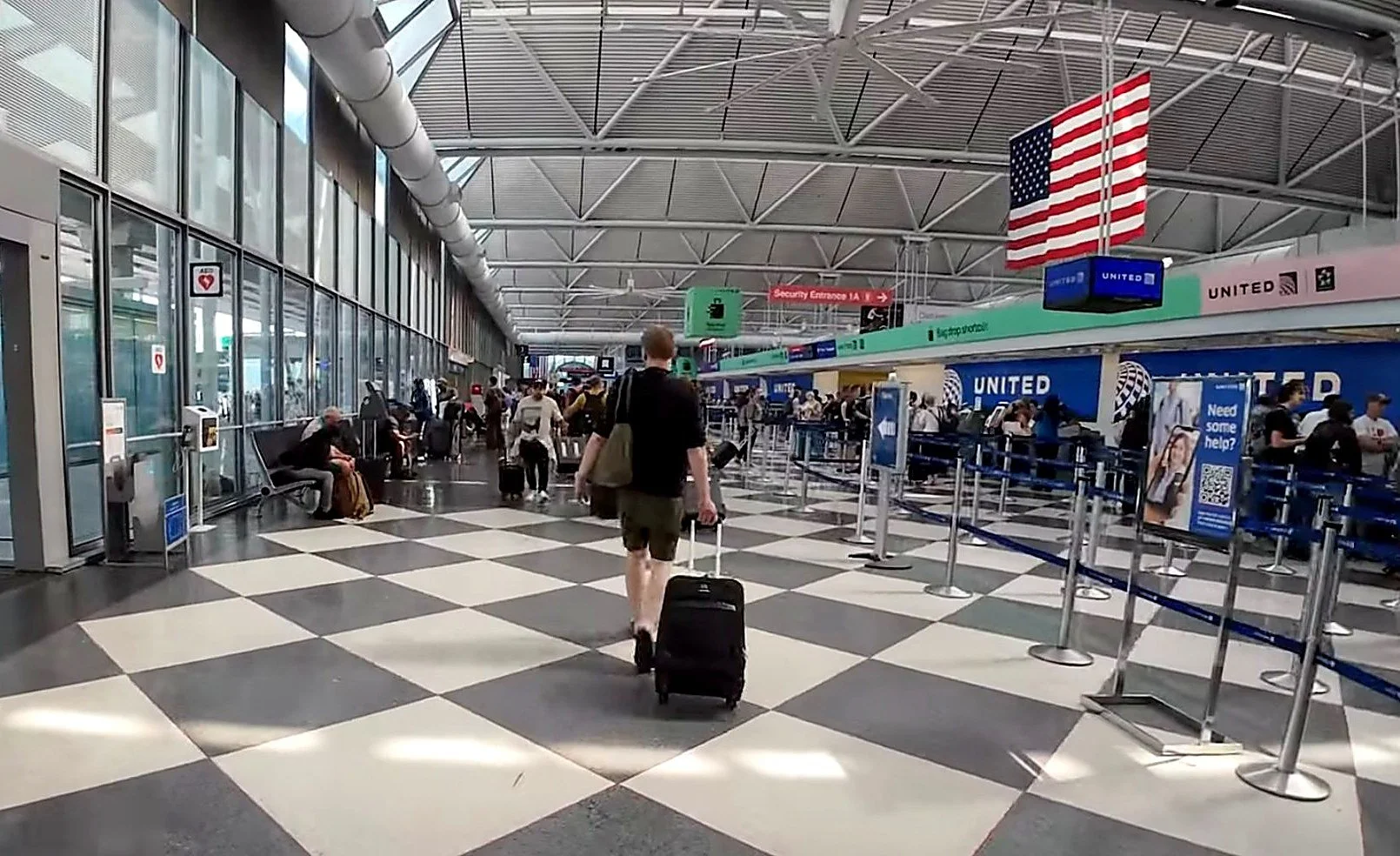
Rather than optimizing individual features in isolation, the project called for a deeper evaluation of how the lobby functions as a system, and how business goals and customer experience must be harmonized over the long term.
To guide that evaluation, the Lobby team articulated a set of core principles — translating United Next priorities into concrete criteria for how traffic should enter, distribute, and progress through the space:
Forward – creating clear entry points and pathways that support continuous forward movement without backtracking.
Distributed – segmenting services and pathways to balance demand across the lobby while supporting different customer needs, including accessibility and privacy.
Consistent – promoting clarity through uniformity in signage, naming, and sequencing, within ORD and across airports where possible.
Flexible – enabling layouts and service positioning that can adapt to short-term operational needs and remain durable over time.
Self-service – expanding effective use of mobile and kiosk-based tools while minimizing non–value-add behaviors and unnecessary agent interactions.
The role of research was to evaluate the current-state ORD lobby using these principles from a customer experience perspective, identifying where the existing environment supported the intended mode and where it fell short. These findings would inform architectural and operational decisions in the redesign execution.
Each principle gave rise to a set of questions grounded in one central concern: whether the lobby's design makes the intended flow legible and workable for customers in security-adjacent, time-pressured contexts in which they must act quickly with limited deliberation.
Design
The work was conducted over a multi-week period and combined four elements:
Quantitative analysis of existing digital and operational data — including day-of-travel app usage (especially check-in and checked bags), traffic volumes across lobby entry points, kiosk and bag drop utilization across the lobby, and security throughput across checkpoints — to establish where demand concentrated, where capacity went underused, and how patterns varied by location and touchpoint.
On-site behavioral observation — focused on customer entry-point choice, initial orientation, navigation, backtracking, queuing, and social herding behaviors — to document how travelers actually committed to pathways and options under time pressure, particularly near kiosks, bag drop areas, and security.
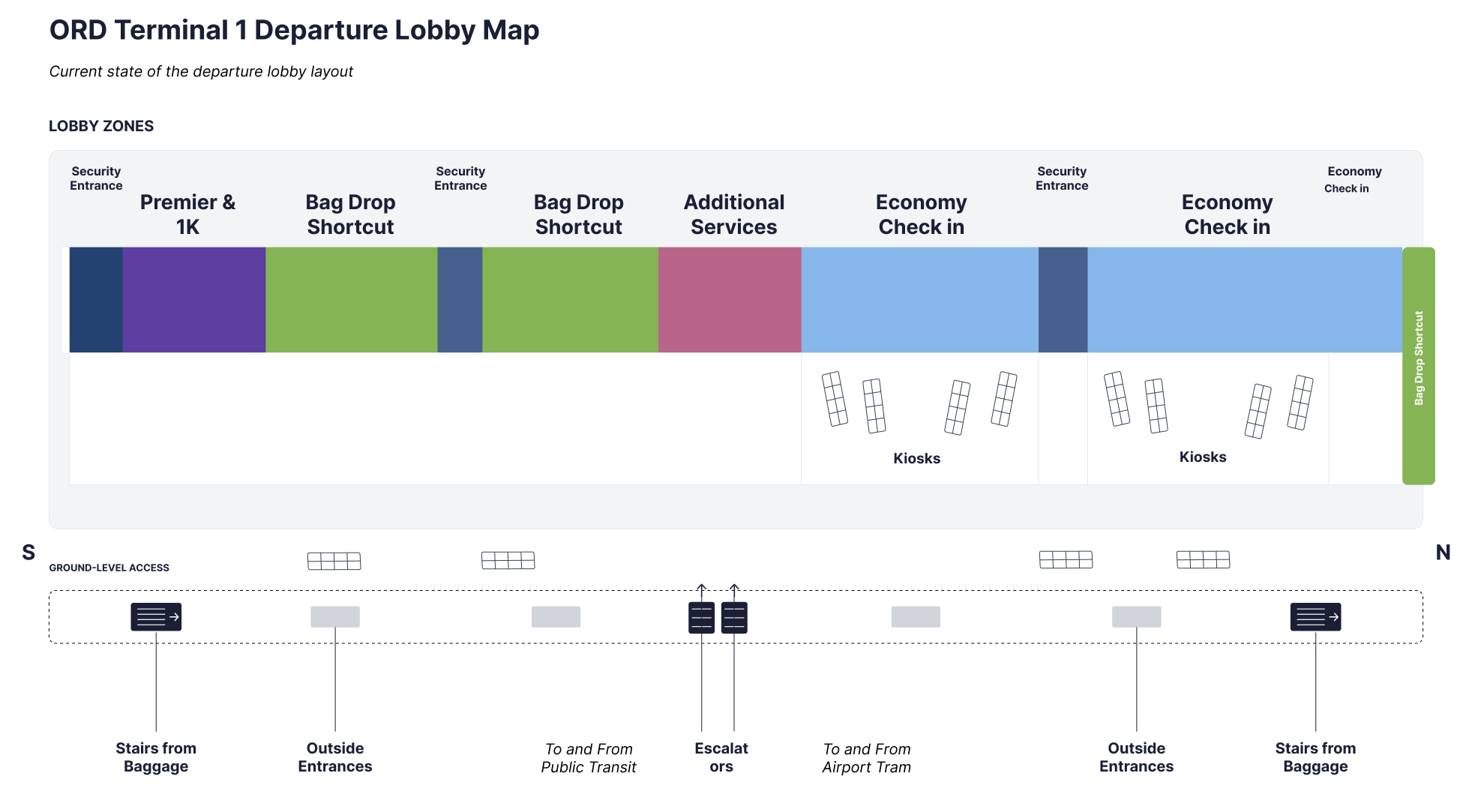
Evaluation of lobby layout and service organization — examining how entry points, signage, the placement and orientation of kiosks and counters, security checkpoint positioning, and circulation paths influenced movement patterns and traffic distribution.
Literature review — spanning customer experience, self-service adoption, service design, social psychology of uncertainty and social proof in high-pressure settings, and anthropology of transitory "non-places" (e.g., Marc Augé) — used to contextualize observed behavior and strengthen interpretation without relying on speculation.
Together, these inputs were used to evaluate the current-state ORD lobby against the Lobby team's principles and to frame the questions addressed in the research insights that follow.
Insight
Three patterns emerged across the diary entries and follow-up interviews. Each one shifted how the airline app sits across the day of travel.
Lobby throughput is co-created — the airline shapes conditions, travelers complete the system, and work shifts back when the two sides aren't aligned.
Inflow geography concentrates traffic at the economy/security core; stations off the main path go underused regardless of capacity.
Signage and station design break down under load — travelers default to visible queues, and work shifts back to agents.
1. Throughput as Co-Creation
Before turning to location-specific research, the study called for a bedrock-first approach: examining our most basic assumptions about the departure lobby space and how travelers interact with it.
Within anthropological contexts, airports have sometimes been treated as textbook "non-places": transient spaces organized around circulation and compliance rather than identity, history, or relationship. Much discussion has been devoted to an apparent tension between these spaces and their effects on those interacting with them: efficiency at the price of de-personalization.
The broader research landscape complicates this picture. Social and environmental psychology suggest less a dynamic of alienation than of tacit agreement about autonomy under constraint. When travelers enter the lobby, they effectively consent to strict behavioral constraints in exchange for an environment that reduces functional decisions. Travelers trade one kind of freedom (open-ended choice) for another: freedom from functional choice so they can move confidently and direct their attention toward more discretionary aims (food, purchases, comfort, time).
This dynamic is not "customer behavior" layered on top of infrastructure. Rather, lobby throughput is a value co-creation ecosystem: the airline shapes conditions through layout, signage, tool placement, and service design, while travelers complete the system through attention, interpretation, and follow-through. When those conditions support fast recognition and low-friction action, movement stays distributed and forward. When they don't, work shifts back onto travelers (second-guessing, backtracking) and onto agents (intervention, assistance).
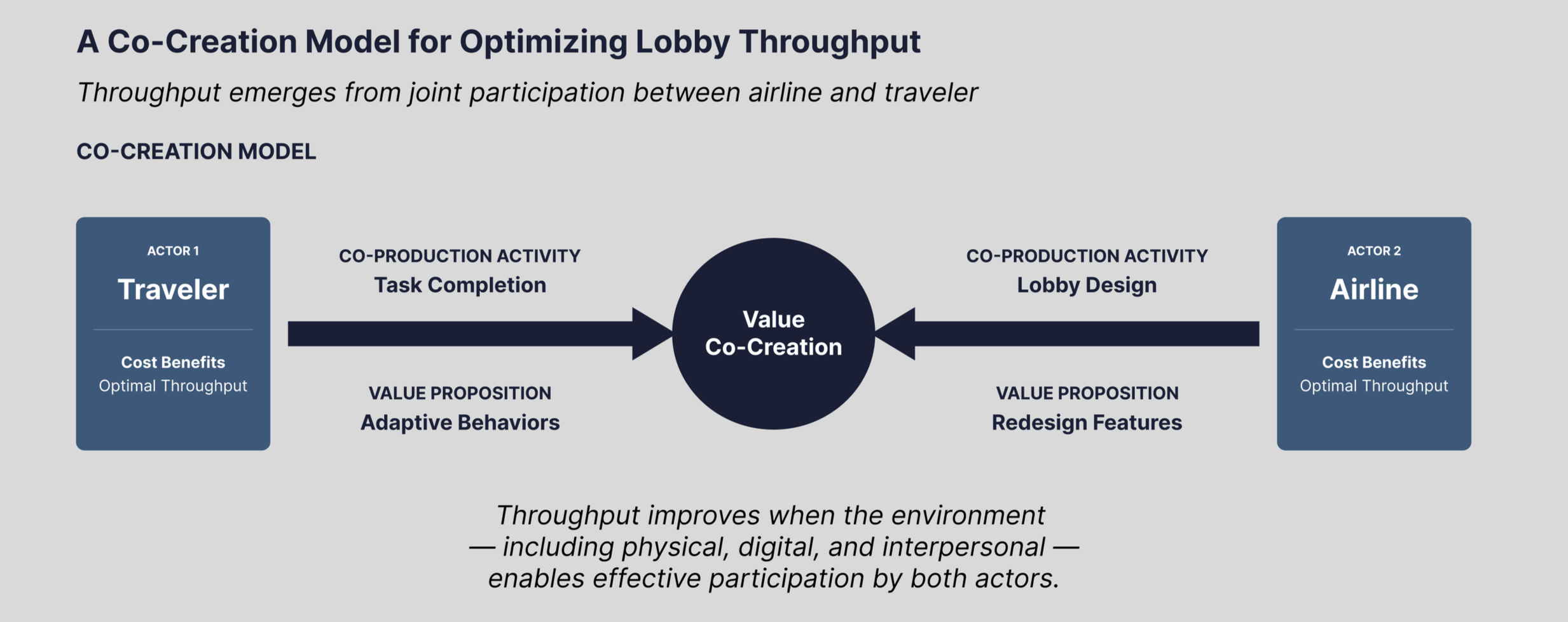
This co-creation lens offered a more concrete way to evaluate the lobby against the Lobby team's principles; namely, by asking to what extent the space provides the conditions for participation: conditions that eliminate deliberation, making functional decisions low-effort and fast and reserving "choice" for discretionary aims. We applied the model heuristically at ORD by tracking where the environment facilitates or hinders participation across the elements that influence forward movement, distribution, consistency, flexibility, and self-service.
2. Traffic Inflow, Distribution, and Self-Service Breakdown
Traffic within the lobby enters from three sources: (i) curbside drop-off along the terminal, (ii) central escalators directing traffic from public transit and the airport tram, and (iii) north and south escalators from the level below.
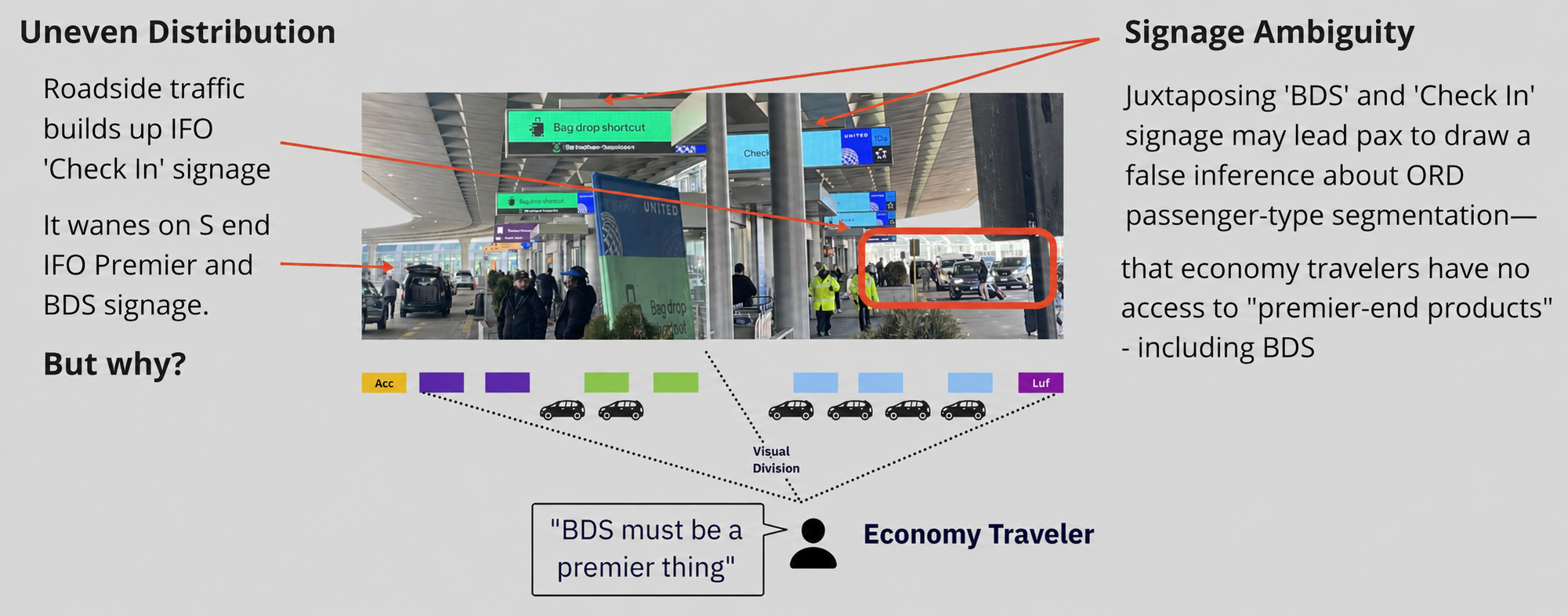
Roadside traffic is disproportionately heavy on the north end, in front of the economy area. Vehicles queue most densely in front of the blue "Check-In" (i.e., economy) signage, while traffic thins near Premier and Bag Drop Shortcut signage. This pattern suggests that curbside signage is shaping misleading expectations about eligibility. The juxtaposition of "Check-In" with Premier invites a false inference: that all south-end interior services are reserved for premium travelers only.
Travelers arriving from public transit and the airport tram enter the lobby through central escalators that deposit passengers directly into the middle of the lobby. The majority of traffic from there flows to the right, towards the economy kiosks and standard security touchpoint. This flow meets the traffic entering from the north end of the curb, creating congestion around the economy kiosks. This is exacerbated by the fact that the busiest security checkpoint intersects the kiosk area, creating a pinch point when security lines spill into the lobby.
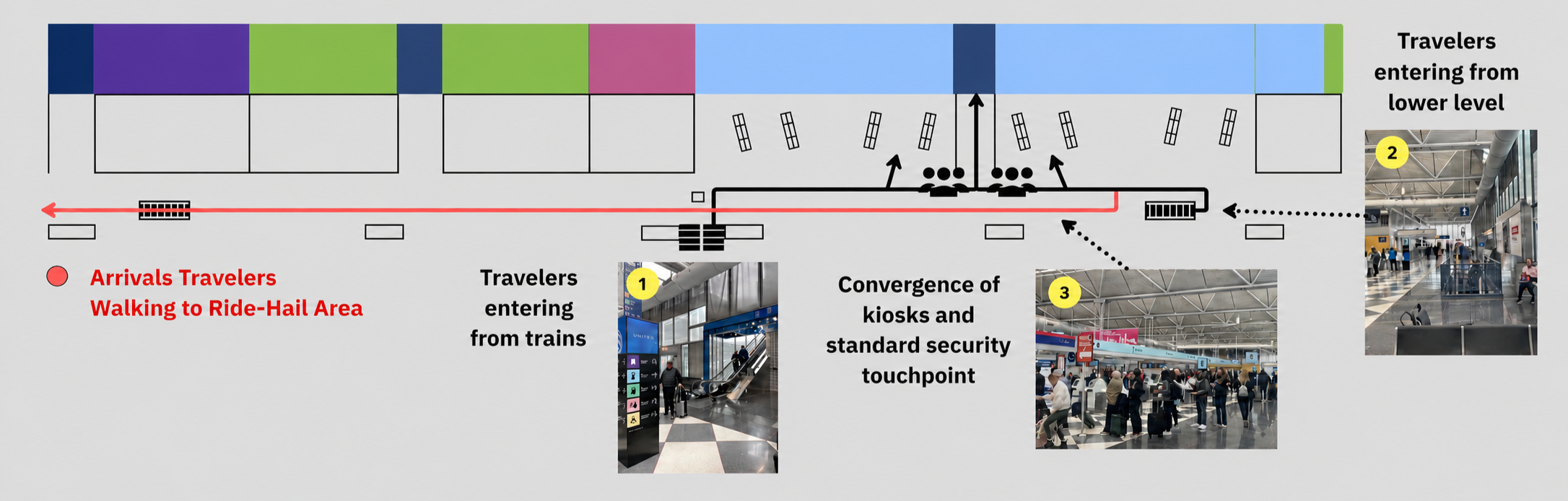
Congestion around the north-end economy section is exacerbated still further by the location of a central ride-hailing pickup area at the south end of the lobby. The departures lobby sits directly on top of the baggage-claim area, located on the floor below. Many travelers who arrive at ORD and intend to hail a ride after picking up their bags must go upstairs and south. Those who ascend via the north escalator must traverse the entire departure lobby floor (or walk outside). This creates a steady stream of non-departing traffic moving laterally through active departure zones, contributing to the head of congestion created by those attempting to check in or reach security.
The kiosk and station usage patterns mirror these flow dynamics. Kiosks and stations located along main paths see high usage, while stations that require lateral movement or backtracking are avoided.
3. Consistency and Flexibility Break Down Under Load
Given these inherent congestion patterns, the lobby's ability to manage throughput effectively depends especially on effective signage and the lobby's ability to adapt to periods of peak demand.
At ORD, travelers who enter from the central escalators are immediately confronted by the central signage monument. Other adjacent signage, like the Bag Drop Shortcut entry sign, assumes prior actions ("already added your bags") that many travelers cannot easily place in time or channel. But most problematic is the security nomenclature ("Pre-Check," "Security 1," "Security 1A"), which is functionally opaque, especially for travelers at ORD for the first time.
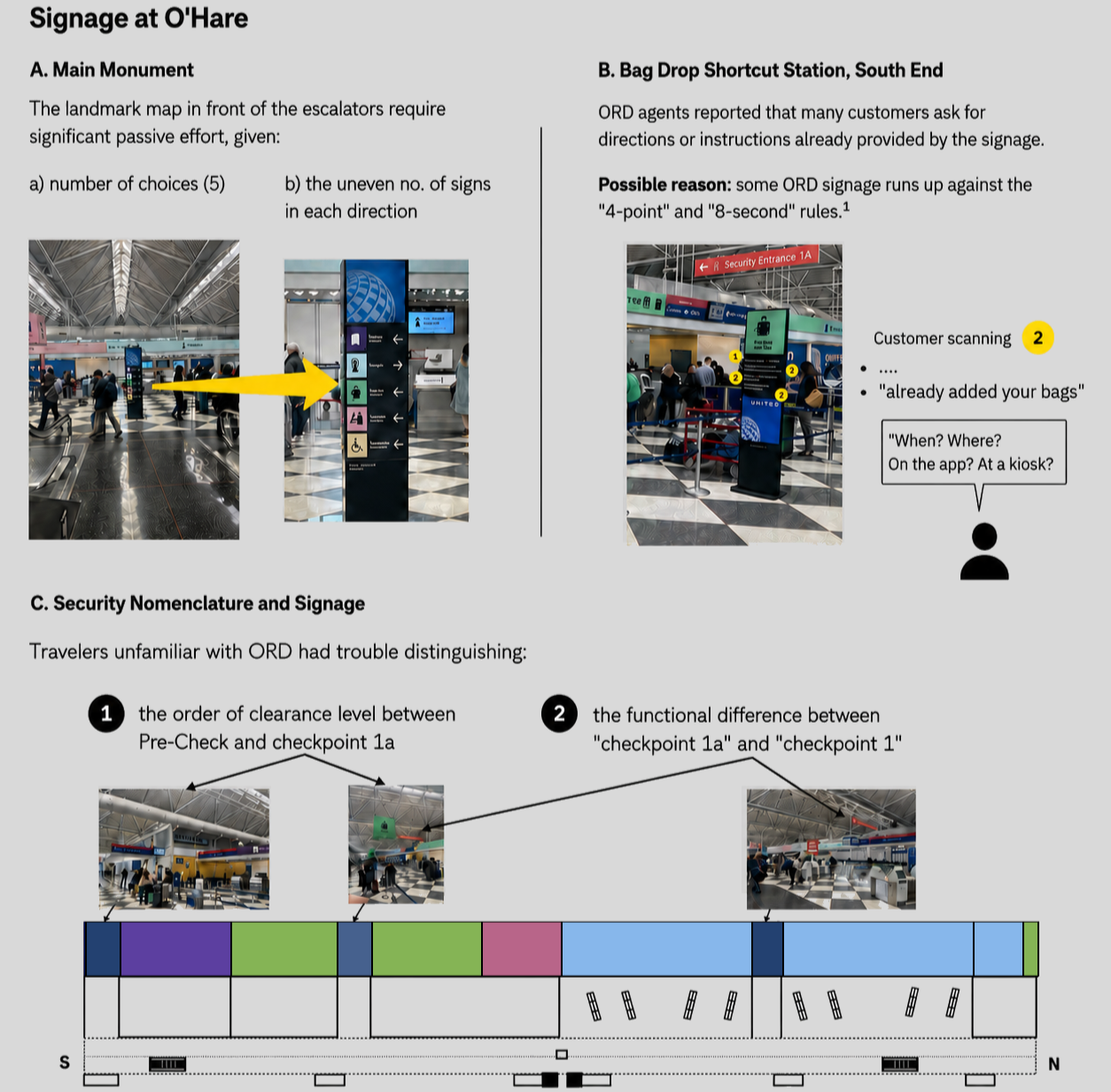
While by no means poor, and while monuments like this in general undoubtedly have to have some level of complexity in a large, fast-moving place like ORD, key elements arguably increase that complexity rather than decreasing it.
Like most airports, distribution at ORD relies almost entirely on travelers self-selecting alternatives. This does not always work in practice, and Additional Services illustrates this tension most clearly.
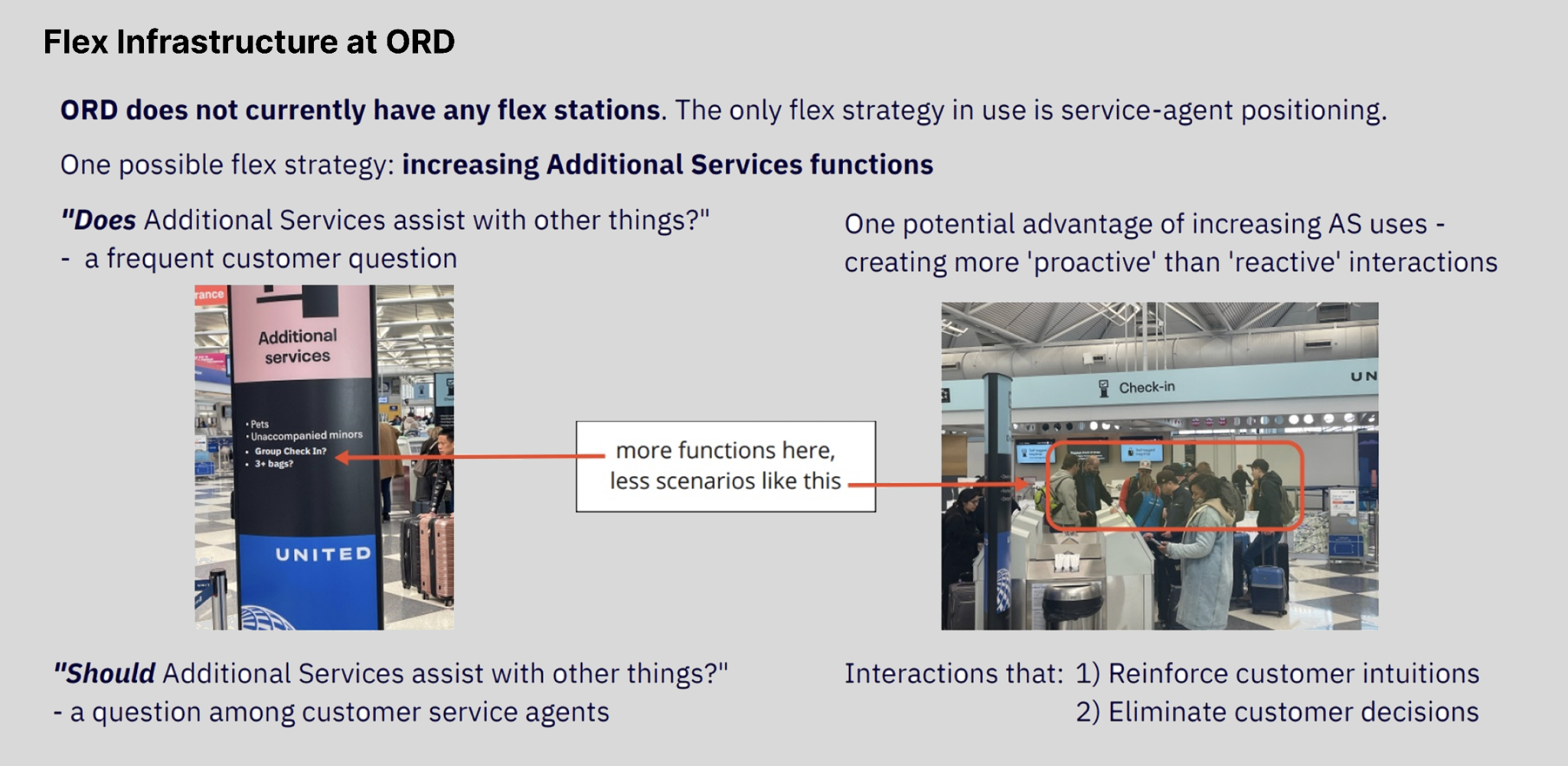
The station's function is so defined that, instead of absorbing demand, it often redirects travelers back into the very queues they are trying to avoid.
Impact
The work was translated into a set of shared evaluation criteria to inform concept development for the 2027 ORD rebuild. Because the redesign had to balance multiple constraints — including commercial real estate considerations around potential expansion or resizing of the lobby — the research was not treated as a prescriptive blueprint for one "correct" layout. Instead, it became a durable set of criteria for whether any proposed layout makes participation easy under load, i.e., whether it reduces functional decision burden in the moments where travelers are least able to deliberate.
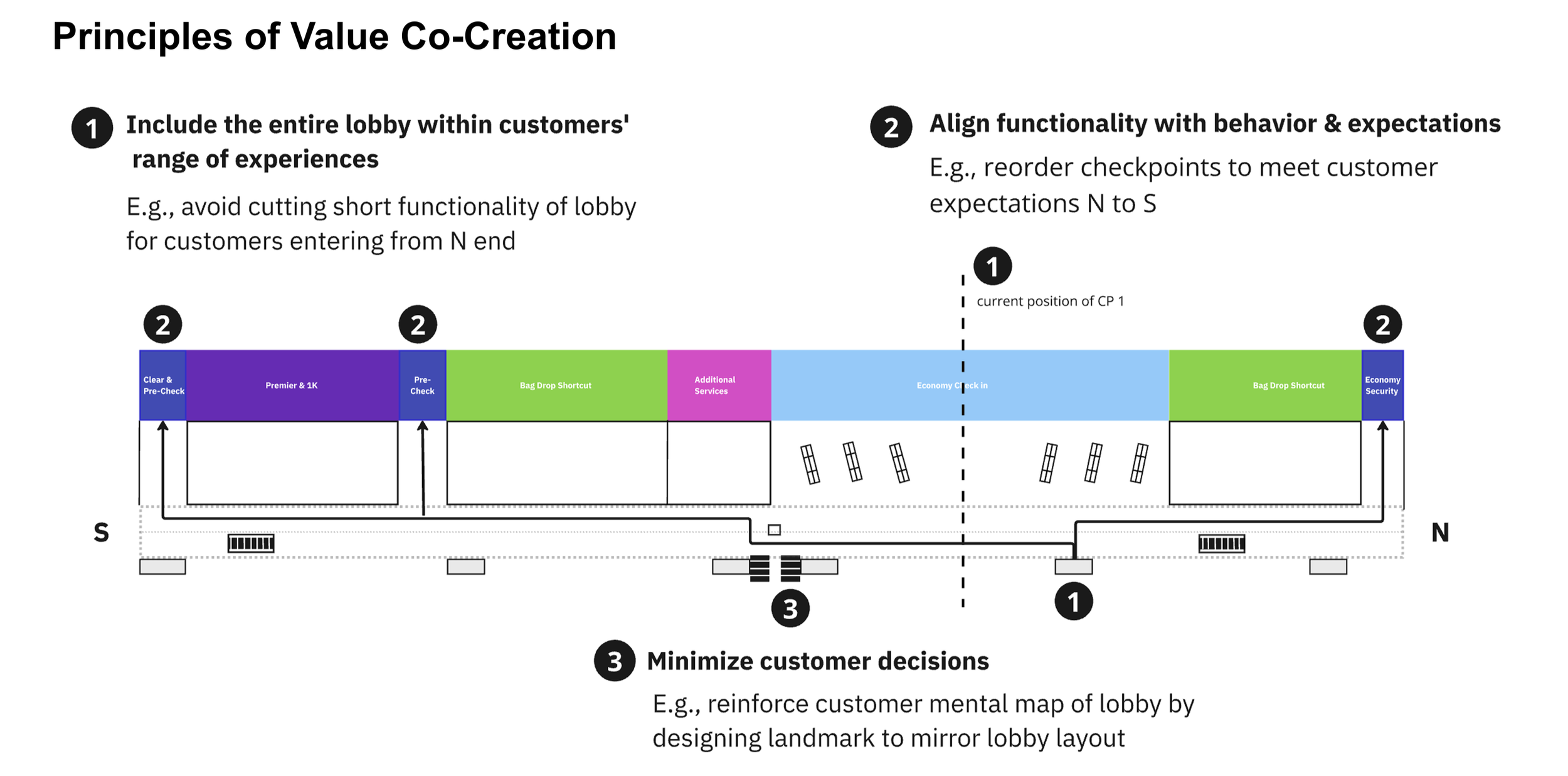
Those criteria were consolidated into three principles, now serving as a shared reference across the Lobby team and architectural planning:
Include the full lobby within customers' range of experiences. Ensure travelers entering from the north end are not effectively cut off from usable options or forced into long, conflicting cross-traffic just to access core functions.
Align functionality with behavior and expectations. Make sequencing and naming reflect how travelers actually interpret clearance levels and progression (e.g., checkpoint ordering that matches an intuitive N→S progression rather than forcing interpretation).
Minimize customer decisions. Reduce moments where travelers must stop, compare options, or infer what applies to them; use landmarks and information structures that mirror the lobby's physical logic so orientation and selection happen quickly.
In practice, these principles supported decisions and tradeoffs around entry experience, checkpoint strategy, kiosk alignment, station placement, and where human presence should reduce uncertainty rather than manage preventable confusion. More broadly, the work provided a repeatable way to evaluate throughput so the same criteria can be applied beyond ORD as hub lobby modernization continues.