Designing for the Day of Travel
Creating an integrated app experience for travelers from departure prep through arrival.
Role
Research lead, Customer Strategy & Innovation
Partners
App team
Operations
Scope
Foundational research for Travel Mode, now live in the United app
* Certain details have been omitted or modified for proprietary reasons.
7–8
no. of apps the average
U.S. leisure traveler uses across
searching, booking, and the trip itself.
~25%
of U.S. domestic flights
failed to arrive on time
in Q2 2025.
38%
of travelers say their biggest
day of travel anxiety is
not reaching their gate on time.
Travelport Global Digital Traveler Research; USAFacts (U.S. DOT/BTS data), 2025; airport traveler anxiety survey, 2024.
Summary
To better address the unique confluence of challenges inherent to the day-of-travel experience, a major United initiative was to define a dedicated app mode designed to support customers within the 24–48 hour journey from pre-departure through arrival.
To inform that effort, I led a cross-airline generative study of over 20 U.S.-based travelers across major carriers, combining a diary study, journey mapping, and moderated interviews. The research documented how day-of-travel breakdown stems less from a lack of information than from the difficulty of coordinating that information across fragmented sources, including those for traffic, ride-share planning, lobby tasks, security, delays, and boarding. The research showed that cognitive load peaks before the airport, with security and delays emerging as the dominant worries and the strongest drivers of overall travel-day judgment; that at arrival, most travelers want their airline to supplement physical wayfinding; and that after security, travelers want guidance on food, entertainment, and destination opportunities.
These findings informed later evaluative testing, and established product direction for future capabilities including security wait times, delay communication, partner integration, location-supported alignment, and AI-assisted coordination of multiple time windows.
Problem
The 24 hours leading up to a flight pose a distinct challenge for airline apps. During this window, travelers shift from planning to execution. As departure approaches, engagement narrows and intensifies — check-in, seat confirmation, weather, traffic, security preparation, and boarding timing become tightly linked. After arrival, engagement shifts toward closure: confirmation that bags arrived, connections are clear, or no further action is required. Within this window, travelers need support that helps them stay oriented as conditions change and timing becomes increasingly consequential.
Creating a dedicated "travel mode" experience for this window was a multi-year United initiative.
The research set out to take a more comprehensive view of the day-of-travel experience — one that challenged assumptions about how and when information should appear, and could support ongoing learning and refinement over time. To guide this effort, it defined criteria for what information should earn immediate priority in the travel mode experience, and what opportunity areas the app structure could incorporate over time.
The project focused on a set of strategic questions:
Where do travelers supplement the airline app with other tools — and why?
Which stages of the day of travel carry the greatest cognitive load?
Where is the airline app already succeeding, and where could it better support the most demanding stages?
Where could the app expand to support travelers' more discretionary choices later in the trip — where to eat, what to explore, how to orient at the destination?
The aim was to support a time-sensitive app mode that could address the full spectrum of travelers' priorities in the 24-hour day-of-travel window, freeing customers from the need of juggling multiple sources of information by providing a single source of truth and opportunity.
Design
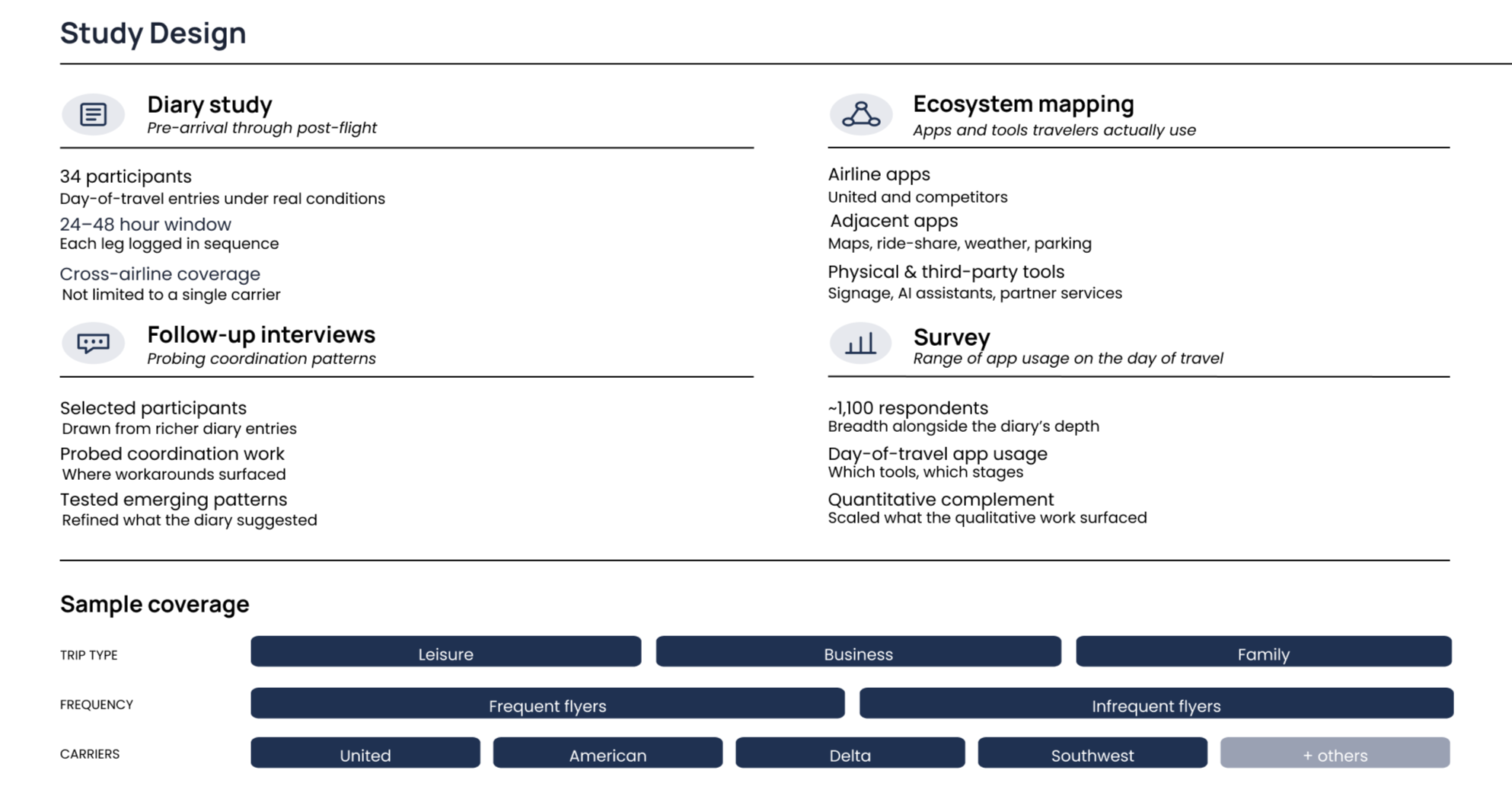
The study took a cross-airline approach to understand the lived experience of airline app usage across key traveler segments, including leisure, business, and family travelers, as well as frequent and infrequent flyers. Methods included:
Cross-airline day-of-travel diary study (34 participants) spanning pre-arrival through post-flight
Engagement mapping across airline apps, maps, ride-share tools, wallets, signage, and third-party services
Moderated follow-up interviews with selected participants
Survey (n = ~1100) to understand range of app usage during day of travel
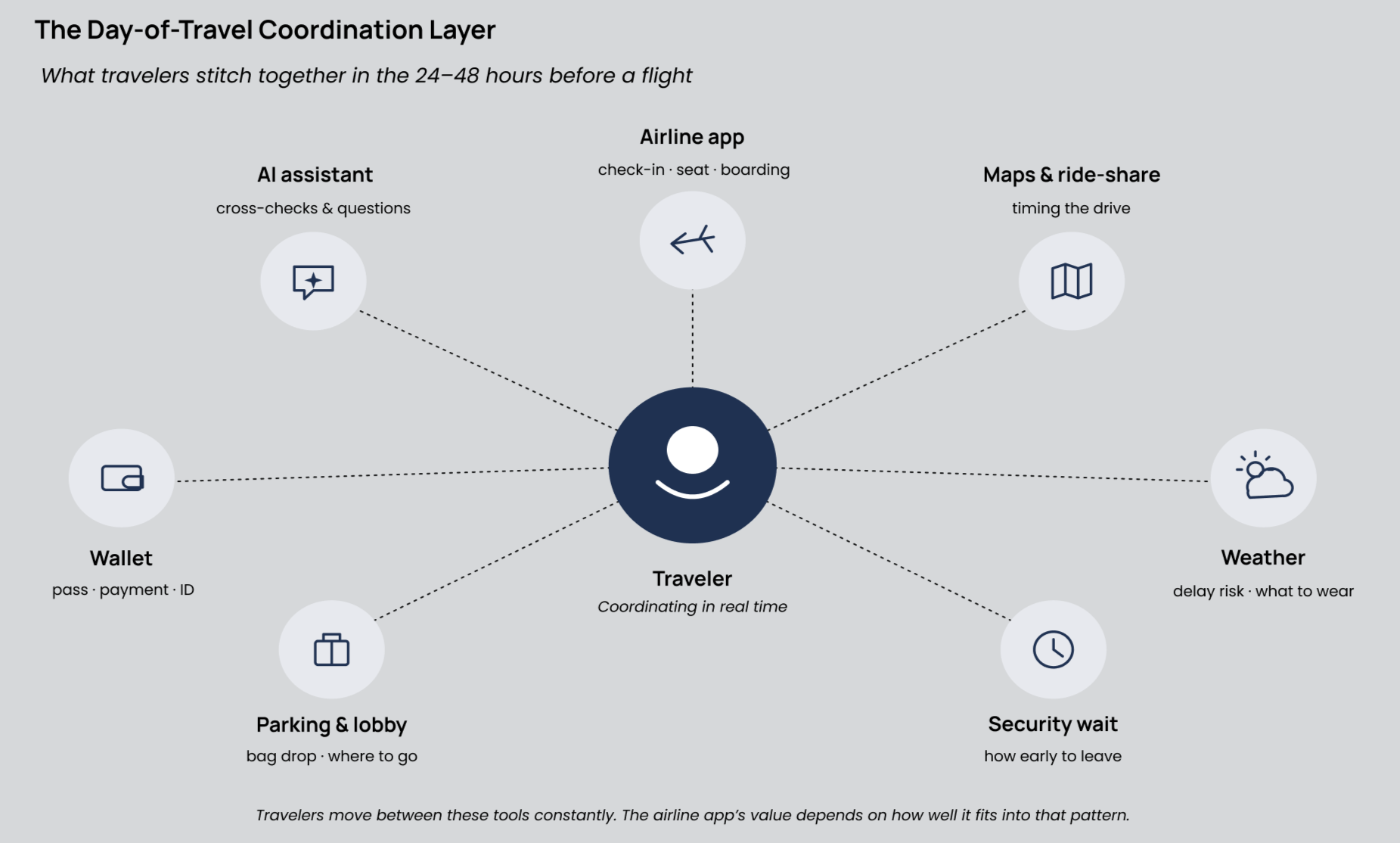
The research sought to understand how airline apps are used within the broader app ecosystem that travelers use to manage the day of travel. A cross-airline lens provided scope for comparing how well different airline apps support customers during the day of travel, and to map out their respective strengths and weaknesses.
Capturing real-time participant testimonials during the day of travel in a journey-map frame surfaced patterns that a feature-by-feature evaluation could not identify. The frame allowed for a diachronic record — tracking how travelers' needs shifted across the window: where orientation held, where it broke down, and where travelers left the app for other tools. Seen this way, the day of travel is a connected sequence, where each stage shapes the next, rather than a set of separate tasks.
Insight
Three patterns stood out across the journey.
The most demanding coordination work happens before travelers reach the airport.
Travelers prioritize the app before the terminal, not while moving through it.
Security and delays are travelers' main worries, and the strongest drivers of how they judge the whole travel day.
After security, traveler attention shifts from coordination to discretionary choices — a window no carrier in the study fully supported.
1. The Coordination Burden Peaks Before the Airport
The most cognitively demanding moments in the day of travel experience occurred before travelers ever entered the airport.
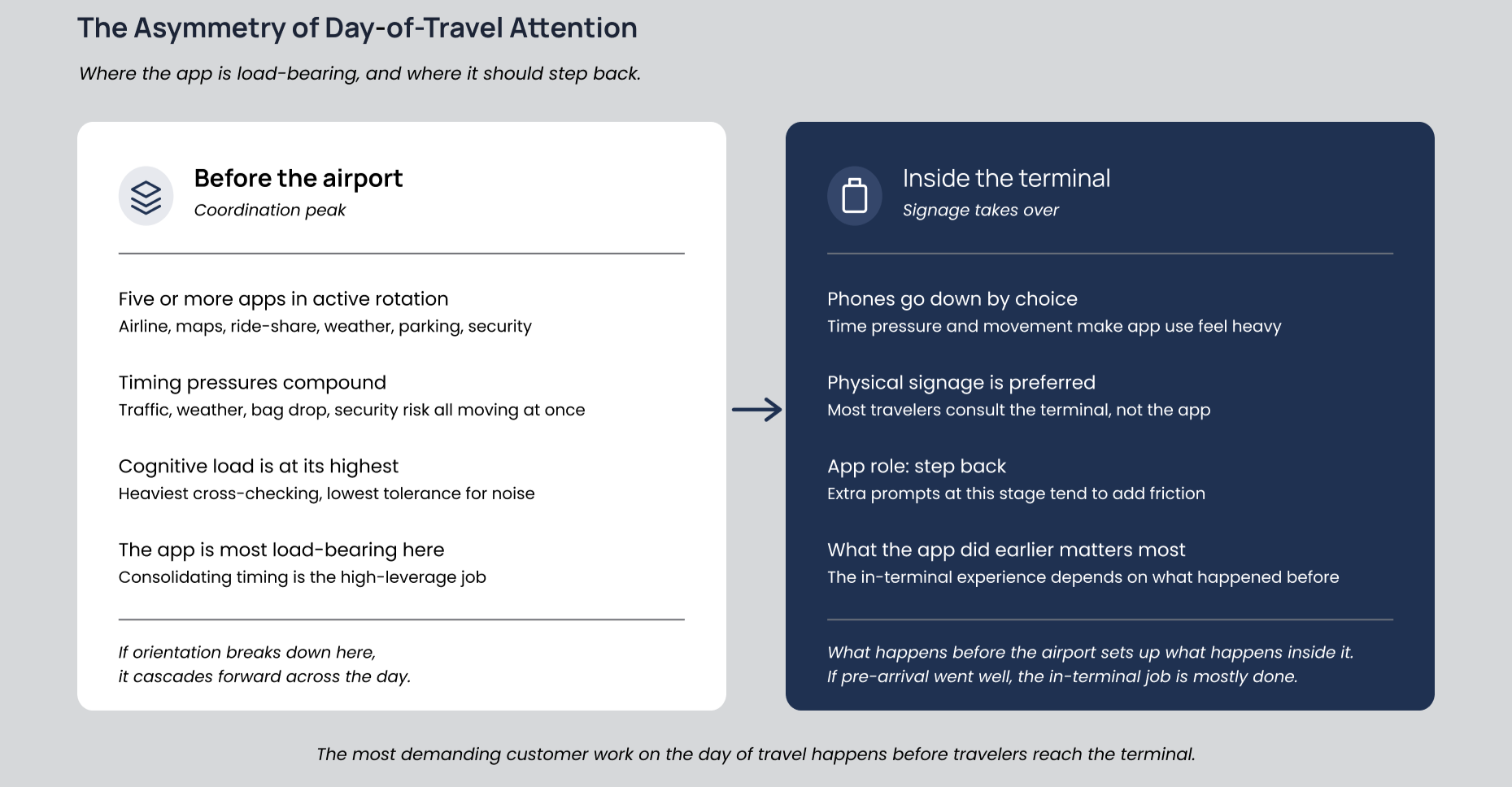
During pre-arrival, travelers were simultaneously factoring in traffic conditions, ride-share timing, weather risk, lobby tasks like bag drop, and security wait times. Travelers routinely moved between as many as five apps—and including an AI chatbot, as many as six apps—to balance timing, often while in transit.
When the airline app's signals were insufficient, delayed, or inconsistent updates, travelers compensated by cross-checking additional sources. The airline app's value during this stage depended on whether it helped align and consolidate timing and sequence, or whether it just added another signal to reconcile. When orientation broke down during pre-arrival, it often cascaded forward. Likewise, when travelers felt oriented early, downstream moments were and felt more manageable.
2. Travelers Prioritize App Engagement Before the Terminal, Not While Navigating It
Many travelers explicitly described not wanting to consult their phones once they entered the terminal. Time pressure, physical movement, and environmental demands naturally make in-airport app usage feel burdensome or impractical. Moreover, many if not most travelers expressed preference for consulting physical signage rather than for app-related directions. Wayfinding research points the same way — once travelers are moving through the terminal, the limiting factor is their own cognitive state, not the amount of information available.
"The best things about the app was how readily it had my gate, my terminal, my seat, boarding time... right there when I walked in." — Keli
"I've never really got the time to go into the app and actually find things within it as opposed to looking around physically as I'm in the airport." — Sahdyah
App success for this stage of the journey is largely determined by how well it prepares travelers prior to it by orienting them for their physical experience in the terminal and coordinating with signage. Successfully doing so allows customers to think ahead to post-security activities, opening up opportunities for them to make more discretionary decisions like whether to upgrade their seat or where to eat.
3. Security and Delays Are Customers' Main Worries and Have the Biggest Impact on Travel Evaluation
The two largest concerns for travelers throughout the day-of-travel are security wait times and potential delays. Likewise, those two factors can largely determine customer overall satisfaction with their day-of-travel experience and with the airline. This fits a well-documented pattern in how people judge experiences — weighted toward the most intense moments, not the average.
"My biggest concern by far is the wait time at the airport... On top of that, I need to go to the gate agent and get my documents verified." — Aditya
Because I was constantly checking the app at home, I didn't come here a lot ahead of time... that's a sweet amount of time to be here without getting too annoyed." — Barbara
Building app continuity and trust from pre-arrival to post-security is central to not only improving customers' experiences in the moment, but also to influencing their earliest decision making in ways that determine the entire success or failure of those experiences. Pre-security, participants wanted their airlines' apps to all but eliminate functional decisions when it comes to timing and navigation (e.g., not just which security touchpoint, but which lane to queue).
4. After Security, Attention Opens Toward Discretionary Choice
Once travelers cleared security, the character of their attention changed. The intense coordination of traffic, timing, bags, and boarding gave way to something looser. Beyond necessities like restrooms or charging, travelers began thinking about food, lounge access, or simply how to pass time. A similar pattern appeared at arrival. The immediate moment was task-heavy — baggage retrieval, ground transport, connections — but travelers were already thinking ahead to choices beyond the airport.
"I will also frequently go to the website of the specific airport to see what food options there are... But I'll do it in the app if that's an option." — Isabel
The similar pattern appears again after landing. While more task heavy—travelers must retrive baggage, locate ground transportation, understand connection status—they may be thinking ahead to choices beyond the airport.
"When I got to the Barcelona airport the app was just not correct in terms of... picking up bags... It would be kinda helpful if it could kinda, like, better geolocate you." — Anya
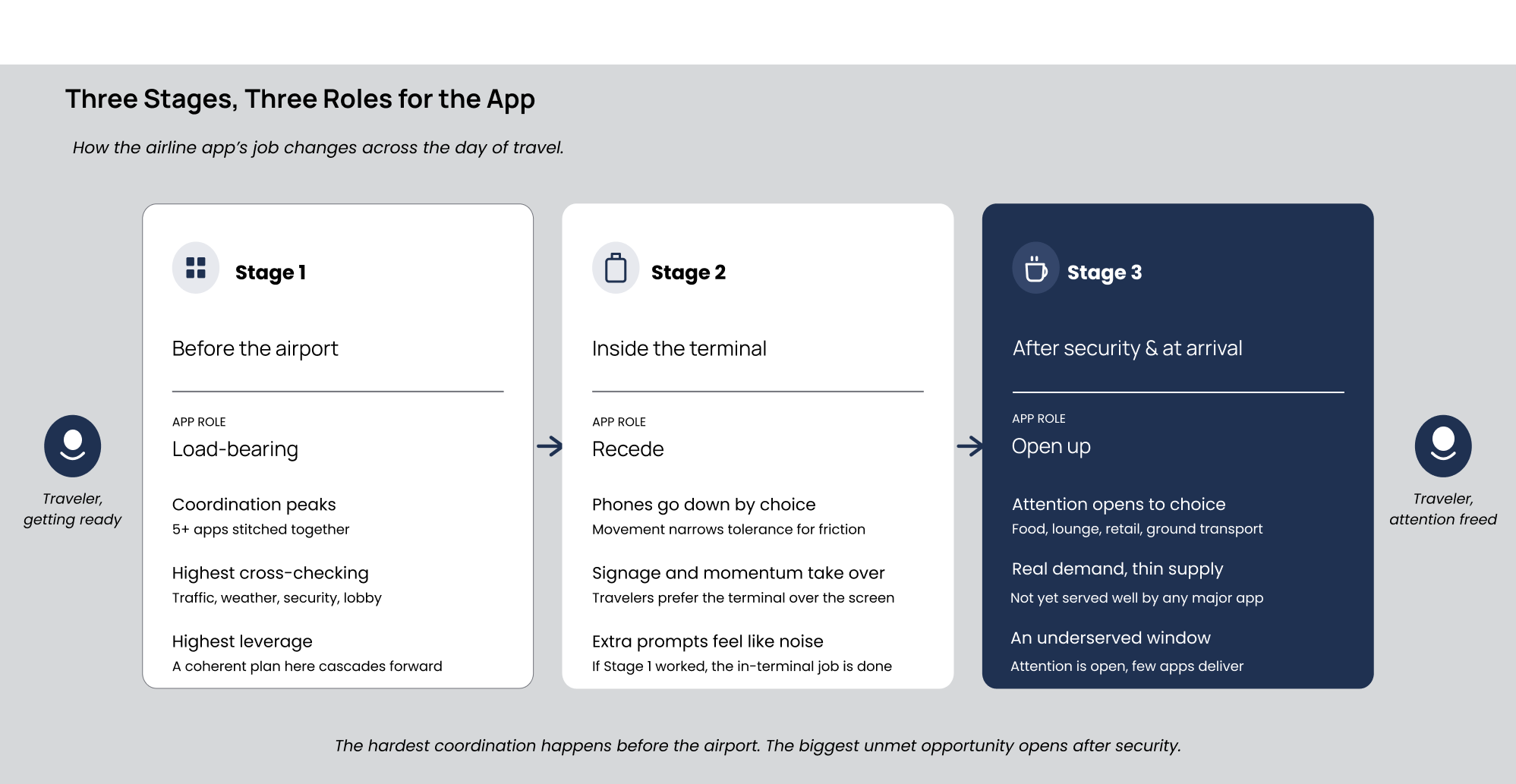
These post-security and arrival windows revealed opportunities for Travel Mode enhancements. Food discovery, airport retail, lounge prompts, post-arrival guidance, and partner integrations are spaces of customer demand that every main carrier in the study did not yet fully or adequately support.
Impact
The research resulted in four outcomes: two that now live in the app, and two future directions:
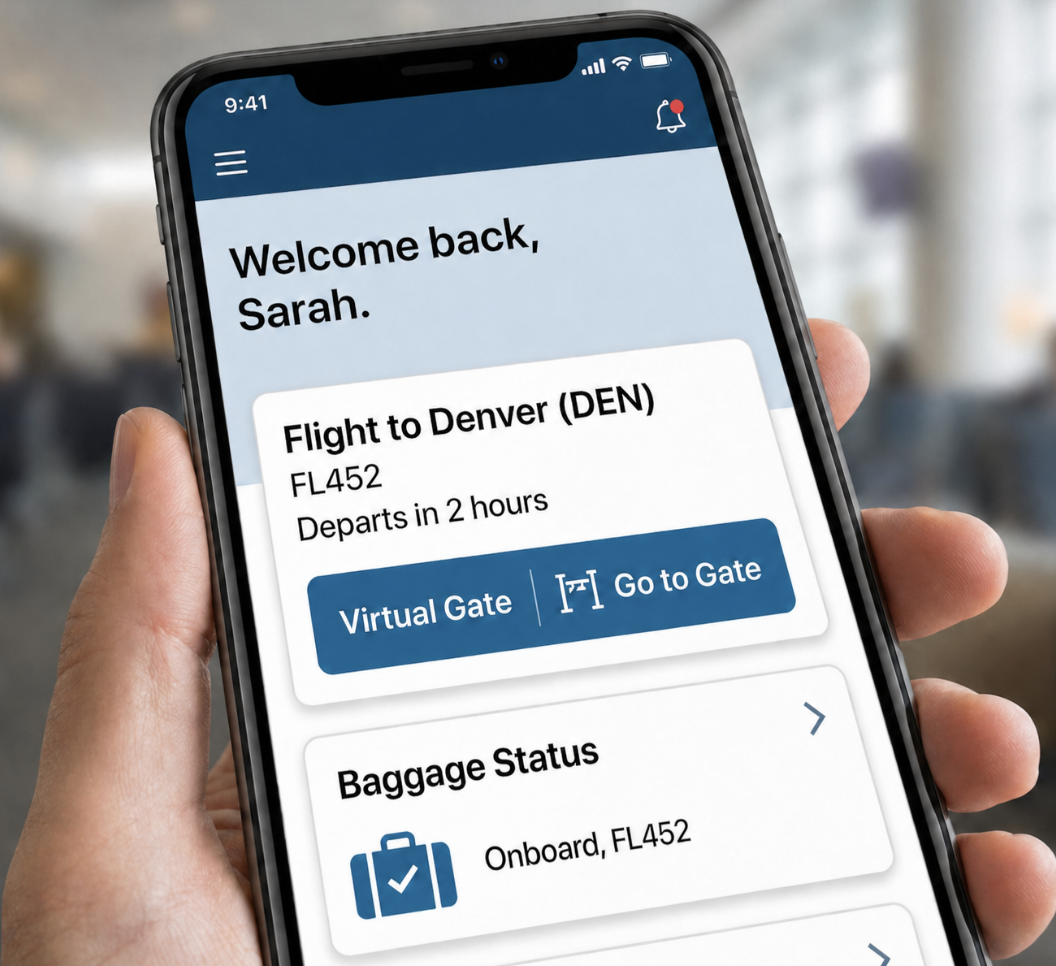
Informed the development of Travel Mode. The research helped establish what should earn priority in the day-of-travel experience — security wait times, boarding progress, bag location, and arrival details like destination weather and rideshare pickup — the signals travelers work hardest to coordinate. These same principles are being applied to partner integrations like Lyft and Uber — using them to help customers complete travel tasks at the right moment, rather than to surface offers.
Informed the security wait times feature and delays communication. The research supported surfacing predicted checkpoint wait times so travelers can time their arrival, and informed more specific intervals for delay communication across the day rather than a single generic update. Security and delays are travelers' main worries, and the strongest drivers of how they judge the whole day — which is why they were priorities for clearer, earlier communication.
Location opt-in as a way to align the app with the traveler's situation. The research opened a new avenue here: how consent-based location sharing might better align the app with where the traveler actually is, and make more discretionary opportunities possible later in the trip. Used well, location could sharpen timing guidance across departure, security, post-security, and arrival. The open question is keeping it assistive rather than intrusive.
AI as a coordination layer. Research has already begun looking at how AI might integrate information across timing signals — traffic, security, delays, boarding, connection risk — without becoming another layer travelers have to manage. Travelers already reach for AI tools to do this synthesis themselves across multiple time windows.