Rethinking Space in the Premium
Day-of-Travel Experience
How a question about lobby footprint turned into a question about perception —
and what GS members actually want from the start of the journey.
Role
Research lead, Customer Strategy & Innovation
Designed and led mixed-methods study
Partners
Operations
Airport Experience & Real Estate
CX leadership
Scope
Mixed-methods study of GS reception lounges at ORD and SFO
Framework now informing lobby redesigns at ORD and EWR
Summary
Problem
Design
Insight
Impact
66%
of travelers say airports feel more crowded year over year.
Summary
Premium experiences carry a particular kind of design problem: they have to deliver real value to the customers who receive them while fitting inside a system that serves a much broader base. At hub airports, that tradeoff plays out in physical space — and Global Services reception lounges, the dedicated pre-security check-in areas reserved for United's invitation-only top tier, raised the question directly. As lobby space becomes more constrained, leadership wanted to know whether the footprint itself was essential to the GS experience or whether the same value could be delivered differently. I led a mixed-methods study to find out. The research showed that GS members rarely use the lounges to spend time — they use them as a controlled, low-uncertainty path to expedited security. But the lounges still produced meaningfully higher satisfaction than line stations offering the same security privilege without one. The reframe was that the lounge's value lay in an "oasis effect" — a brief, calm, predictable start to the journey — not in its size or amenities. That distinction now informs lobby redesigns underway at ORD and EWR.
62%
are willing to pay for premium services to ease the squeeze in crowded terminals.
97%
of lounge-program members say they would not give up lounge access if it were removed.
Source: Airport Dimensions AX25 Global Airport Experience Research, 2025.
Problem
Global Services is United's invitation-only tier for its most loyal customers. At both hubs and line stations, GS members receive controlled access to dedicated agents and expedited routing through security. At major hubs, that access is paired with a separate physical reception lounge — an enclosed pre-security check-in space that has become a defining GS benefit.
As customer volumes rise and lobby space becomes more constrained, leadership and lobby teams faced a strategic question: was the footprint devoted to GS reception lounges delivering value commensurate with the space, or could that space be reallocated to support broader throughput while preserving the GS promise?
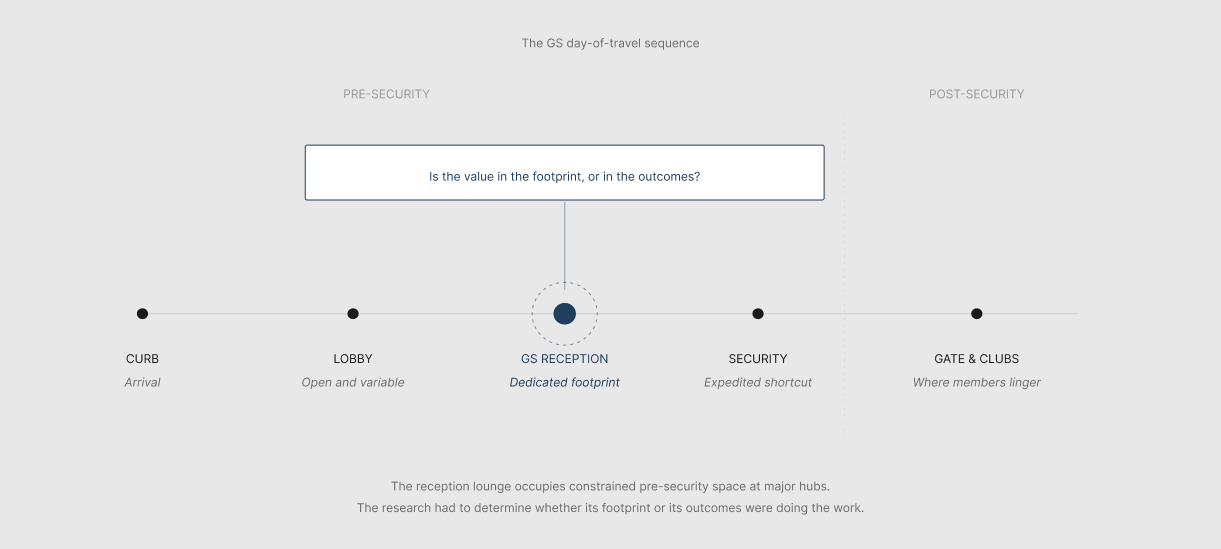
The research had to answer something more specific than "do GS members like the lounges." It had to separate two things customers tend to blend together — what they cite as valuable and what reliably drives their satisfaction. If the lounge's value came from its physical configuration, the footprint was load-bearing and reallocation would erode the experience. If the value came from the outcomes the lounge enabled — certainty, speed, insulation from congestion — those outcomes might be deliverable in other configurations.
This raised a set of strategic questions:
where the GS lounge sits in members' actual day-of-travel patterns;
what members cite as valuable about the lounge, and whether those things track with satisfaction;
whether the lounge's value is in its footprint or in the outcomes it produces; and
whether the underlying needs could be met with a different configuration without degrading the GS promise.
This was, in other words, a footprint question that turned on a perception question. And the answer mattered well beyond GS, because the same logic applies to most premium pre-security space across the industry.
Design
The study used a mixed-methods design to compare what GS members do, what they say they value, and what actually correlates with their satisfaction.
Quantitative. Day-of-travel operational data on GS bag drop usage, GS check-in CSAT compared across hub stations (with lounges) and line stations (without lounges), and text analytics from a curated GS customer discussion thread (n=229).
Qualitative. Field observations at ORD and SFO during multiple periods over August and September. In-depth interviews with GS members (n=21), conducted both onsite and via UserTesting.
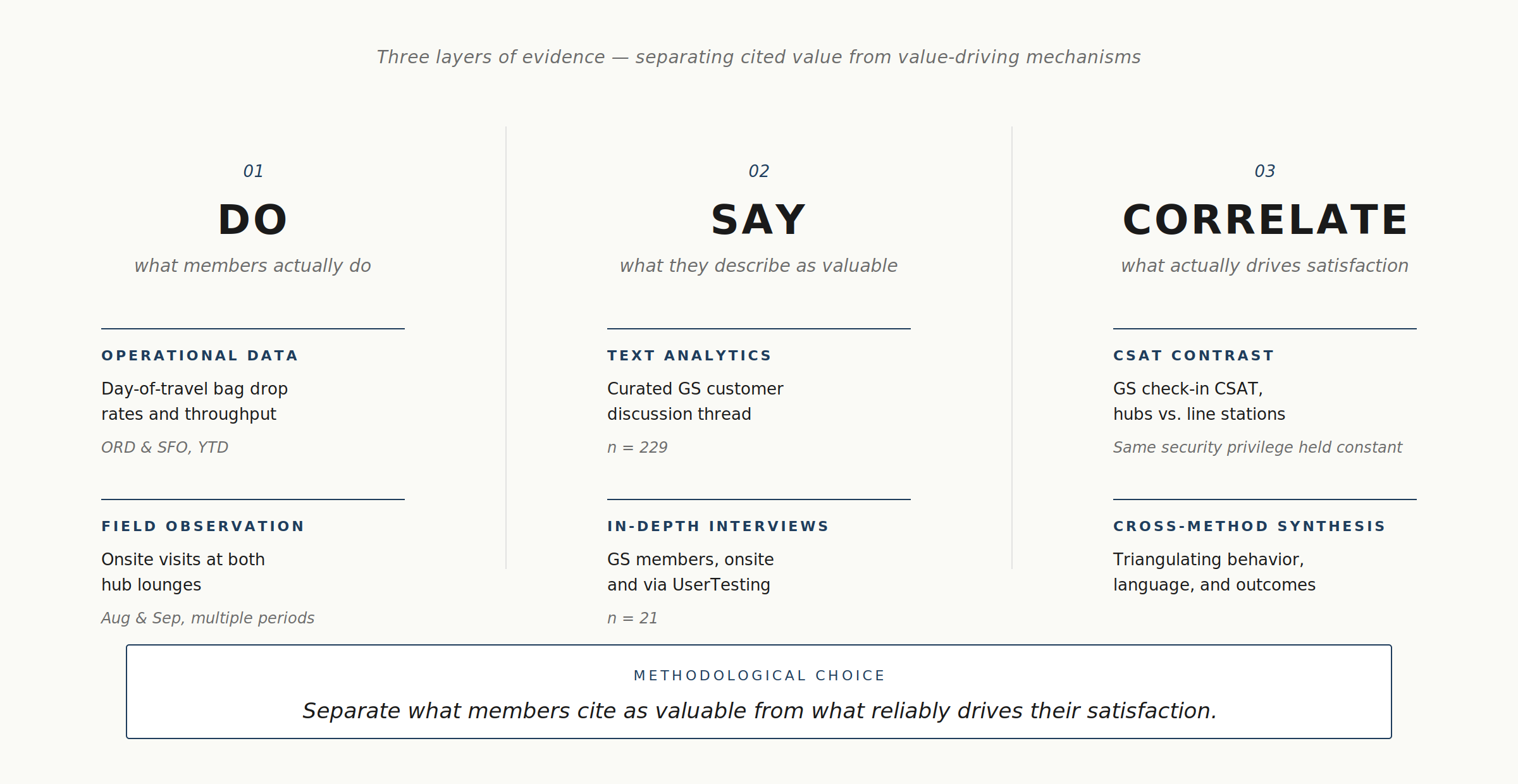
The design choice that mattered most was structuring the research to separate three things operational data alone couldn't: how GS members use the lounge, what they say they value about it, and what actually correlates with their satisfaction. Each method captured a different layer. Operational data showed actual behavior in the space. Text analytics from the discussion thread captured the language and framing members use to describe value. Field observation grounded both in real conditions. Interviews connected the patterns to motivation and expectation. Without all four, the study would have produced one of two misleading conclusions: either "members love the lounge, so it's essential" or "members don't really use the lounge, so it's expendable." Neither would have been right.
Insight
Three patterns emerged, each reshaping how the premium lobby was understood internally.
GS members use the lounges as a path to security, not a place to spend time — "efficiency" and "convenience," not amenities, dominated the language of value.
But security bypass alone didn't explain satisfaction. Hubs with lounges outperformed line stations offering the same security privilege without one.
Members weren't attached to the footprint. They were attached to the outcomes — calm, predictability, and a controlled start to the journey. The lounge is one expression of the GS promise, not the only possible one.
1. GS Members Use the Lounges as a Path to Security, Not a Place to Spend Time
In the discussion board thread, the overwhelming majority of GS respondents indicated regular lounge use across hubs. But that "use" didn't show up as heavy utilization of the lounges' check-in desks. YTD operational data showed that bag drops within the lounges at both ORD and SFO were low: reasonable estimates based on security throughput indicated that roughly only 17% of travelers using the ORD lounge and 26% using the SFO lounge dropped a bag inside. Field observation supported these estimates and surfaced little use of the lounges for sitting, working, or relaxing.
The operative question became: when GS members say they "use" the lounge, what are they actually using it for?
Across interviews, the discussion thread, and observation, the same answer emerged. The lounge was valued primarily as a controlled path to the expedited security shortcut. This was consistent with the traveler profile — most participants identified as primarily business travelers, often traveling carry-on only on shorter trips. All 21 interview participants described using the lounge primarily to access security; bag drop and agent interactions were secondary; lingering in the space was tertiary.
The text analytics mirrored this prioritization: "efficiency" and "convenience" dominated the language of value. Personal attention and physical environment appeared far less frequently. The lounge functioned less like a traditional lounge and more like an insulated, high-certainty routing pathway through the lobby — valued mostly for what it helped members avoid (crowds, queues, uncertainty) rather than for the services delivered inside it.
2. But Security Bypass Alone Didn't Explain Satisfaction
If the security shortcut were the only meaningful driver of satisfaction, line stations offering the same security privilege without a dedicated lounge should produce comparable GS check-in outcomes. They didn't.
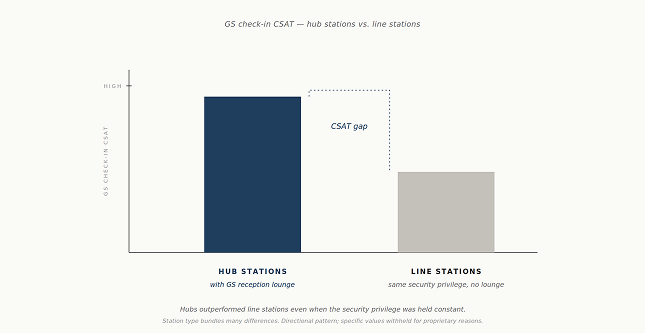
Across hubs — where the security entry point is paired with a dedicated GS reception lounge — average GS check-in CSAT was meaningfully higher than at line stations, where GS customers receive the same expedited access without a dedicated lounge footprint. The comparison doesn't isolate cause and effect, since station type bundles many differences. But the directional pattern was consistent: hubs with lounges outperformed line stations even when the security privilege was held constant.
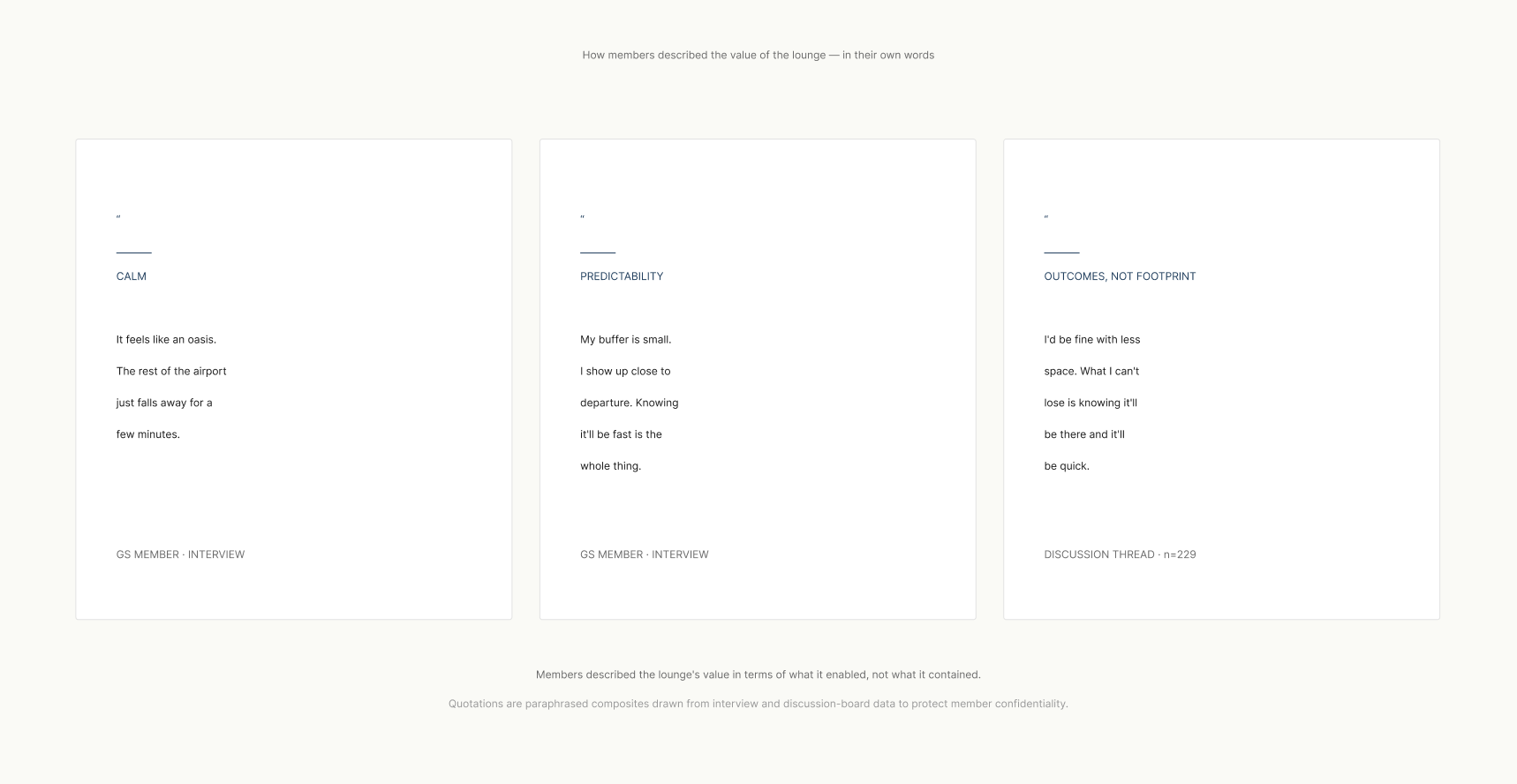
Members didn't treat that protected start as something confined to a particular room. Many described GS recognition as a relationship reinforced across multiple touchpoints — including exclusive GS phone support while en route to the airport. The lounge was one expression of the GS promise, not the only possible one.
The interpretation: the lounge was adding value not by offering a place to sit, but by reducing variability in the check-in experience. The dedicated footprint shaped what the first minutes of the journey felt like — a clear, protected path with fewer moving parts depending on whatever was happening in the main lobby. Across interviews and discussion-board language, members pointed to the same combination: a calmer entry experience that avoided lobby congestion, more reliable access to dedicated agents (often familiar), and a stronger signal of priority and recognition.
That recognition was framed less as status for its own sake and more as part of an ongoing business relationship. Many interviewees described arriving at the airport within an hour of departure, which makes predictability essential — when the buffer is small, variability becomes consequential. For these members, the lounge's incremental value was in creating a more predictable, lower-friction start to the trip.
3. Members Were Flexible About How That Value Was Delivered
The two findings together created an apparent contradiction: the lounge is primarily used as a path to security, yet its existence as a dedicated footprint correlates with meaningfully higher satisfaction. The natural next question was whether members were attached to the lounge as a physical space or to the outcomes it produced.
In the discussion thread, participants were asked how they would feel if United reduced the size of the GS lounge to free up lobby space for general use. The dominant reaction was positive toward the lounge's presence. But that support wasn't unconditional: a meaningful share of comments expressed openness to change, and some explicitly preferred reallocating resources elsewhere. The pattern suggested that members were reacting less to square footage than to what they believed resizing might threaten or preserve.
What triggered resistance was not the idea of resizing but the perceived risk of losing what the lounge currently guaranteed: time efficiency, a calmer entry, and reliable access to help. Several participants referred to the lounge as an "oasis" or "refuge" — but the language was rarely about comfort or amenities for their own sake. It was about the controlled calm of a short stretch of the journey to security.
Impact
The work made it possible to separate what GS members cite as valuable from what those drivers reliably satisfy. The reception lounge is one way to deliver the underlying needs at hubs, but the needs themselves — ease, familiarity, calm, priority — are what track most closely with satisfaction, not the idea of a pre-security lounge as a destination.
That reframe produced four interlocking outcomes:
A new strategic principle for premium space allocation. Pre-security, GS members optimize for movement and problem-solving, so the reception experience can lean into self-service efficiency and controlled routing without degrading the GS promise. Post-security — where GS members actually choose to spend time — is where larger hospitality investment belongs.
A direct input to lobby redesigns underway at ORD and EWR. The findings reframed the strategic question from "keep or remove" to "how to preserve the oasis effect without assuming the lounge in its current form is the only way to produce it."
A cross-functional evaluation framework. The work is now used internally to evaluate proposals related to lobby modernization and premium investment more broadly — separating cited value from underlying value before footprint decisions get made.
A senior-leadership reference point. Presented to leadership across Loyalty, Airport Experience, Operations, and Customer Experience, the work serves as a reference for thinking about premium experience as an outcome to be delivered rather than a footprint to be preserved — a framing that becomes more consequential as hub modernization continues and physical space gets more constrained.
The broader takeaway, beyond GS and beyond airlines: customer-cited value and value-driving mechanisms aren't always the same thing. Mistaking the first for the second produces investments that look responsive but miss what's actually working. Premium experience strategy, in particular, often improves more from understanding what the experience accomplishes than from preserving what the experience currently looks like.