How Southwest's Shift to Assigned Seating Is Landing With Travelers
How customers are reading the end of open seating —
and what their response reveals about seat strategy across the industry.
Role
Research lead, Customer Strategy & Innovation
Designed and led two-part survey study
Partners
Seat Strategy
Loyalty
Customer Experience leadership
Scope
First competitive read on Southwest's assigned-seating launch
Informing United's seat strategy
Summary
Problem
Design
Insight
Impact
92%
of global carriers now offer paid
seat selection.
Summary
Southwest's move from open seating to assigned seating offered a rare opportunity to study how customers respond when a familiar airline model is replaced with one that's more structured, more monetized, and more conventional. I led a two-part survey study — 470 post-booking respondents and 805 post-trip respondents, 1,275 in total — to understand how customers interpreted the new seat categories, made seat-related decisions, and judged the change against prior Southwest experiences. The research showed broad customer receptiveness, and clarified what was driving it. Assigned seating worked because it made the journey feel more predictable — knowing the seat in advance, having more control at booking, moving through boarding with less scramble. The strongest customer benefit was certainty, not premium seating. The work reframed the competitive lesson for United: the value of a seat strategy depends less on the seat categories themselves and more on the certainty they create across the journey.
+27%
projected annual seat revenue
from Southwest's new model.
−24
points: Southwest's drop in JD Power's 2026 economy satisfaction score,
the largest in the segment.
Sources: Airline Ancillary Services Market Report, 2025;
Southwest Airlines investor disclosures, 2024;
JD Power 2026 North America Airline Satisfaction Study.
Problem
The shift from open to assigned seating was the most consequential customer-facing change Southwest had made in decades. For more than fifty years, open seating shaped not only where customers sat but how they experienced booking, check-in, boarding, and what they understood made Southwest different from every other major U.S. carrier. Customers knew that boarding position mattered, that EarlyBird check-in and A-List status could shape outcomes, and that speed at the gate was part of the deal. The system could be stressful, but it was familiar — and central to how the brand stood apart.
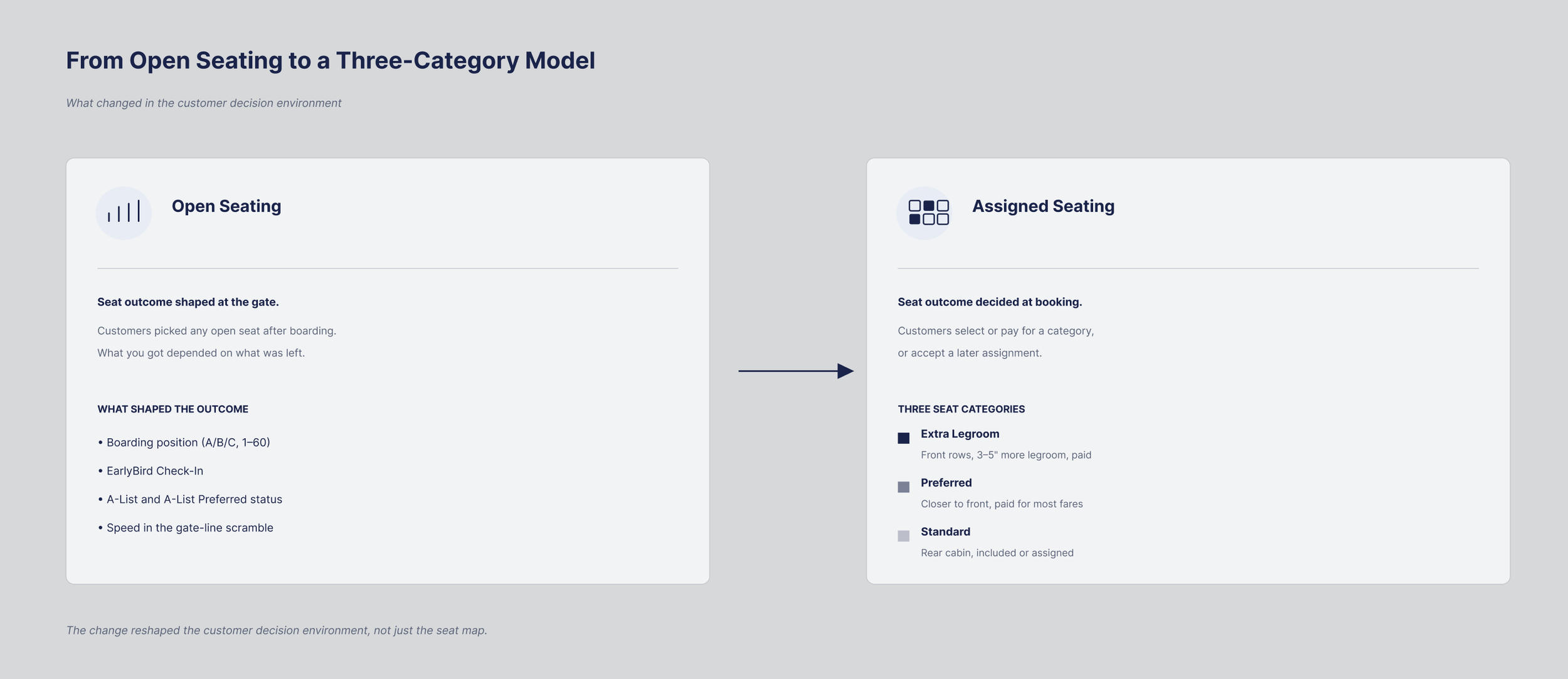
The new model introduced a different set of customer decisions. Travelers now interpret a seat map, evaluate three seat categories, decide whether to select or pay for a seat, and reason about what happens if they accept a later assignment. Long-time Southwest customers compared the new system against an older mental model. First-time customers compared it against other carriers. Families and groups had to assess whether assigned seating would make it easier to sit together or create new pressure to pay. The change reshaped the customer decision environment, not just the seat map.
For United, the useful question was structural: what conditions made the change feel acceptable, valuable, and worth paying for, and what conditions made it feel like a brand drifting toward the industry default? This raised a set of strategic questions:
Where does the customer value of assigned seating actually sit — in the premium seat itself, or in the predictability the system creates?
What makes the paid seat hierarchy feel legible and worth paying for, rather than a charge to avoid an undesirable outcome?
Where do families and groups fall through the cracks, and what does seat adjacency actually require?
What does post-booking flexibility look like in a seat model where the seat is now an asset to manage?
Design
The research used two complementary surveys to capture customer reaction at different points in the journey. A post-booking survey measured immediate reactions after customers encountered the seat-selection flow. A post-trip survey measured how those expectations and decisions held up after boarding, sitting in the assigned seat, and completing the trip. The two surveys together produced 1,275 responses from travelers with recent Southwest experience.
The sample was deliberately weighted toward customers who could compare the new model against the old one. Ninety-three percent of respondents were returning Southwest flyers; 7% were first-time flyers. Travel-party composition mattered: 44% were traveling solo, 48% with other adults, and 9% with at least one child under 13. The sample was also loyalty-heavy — 20% A-List Preferred, 48% A-List, and 33% either non-members or unsure — which meant the read came from customers with real Southwest context rather than first-impression reactions.
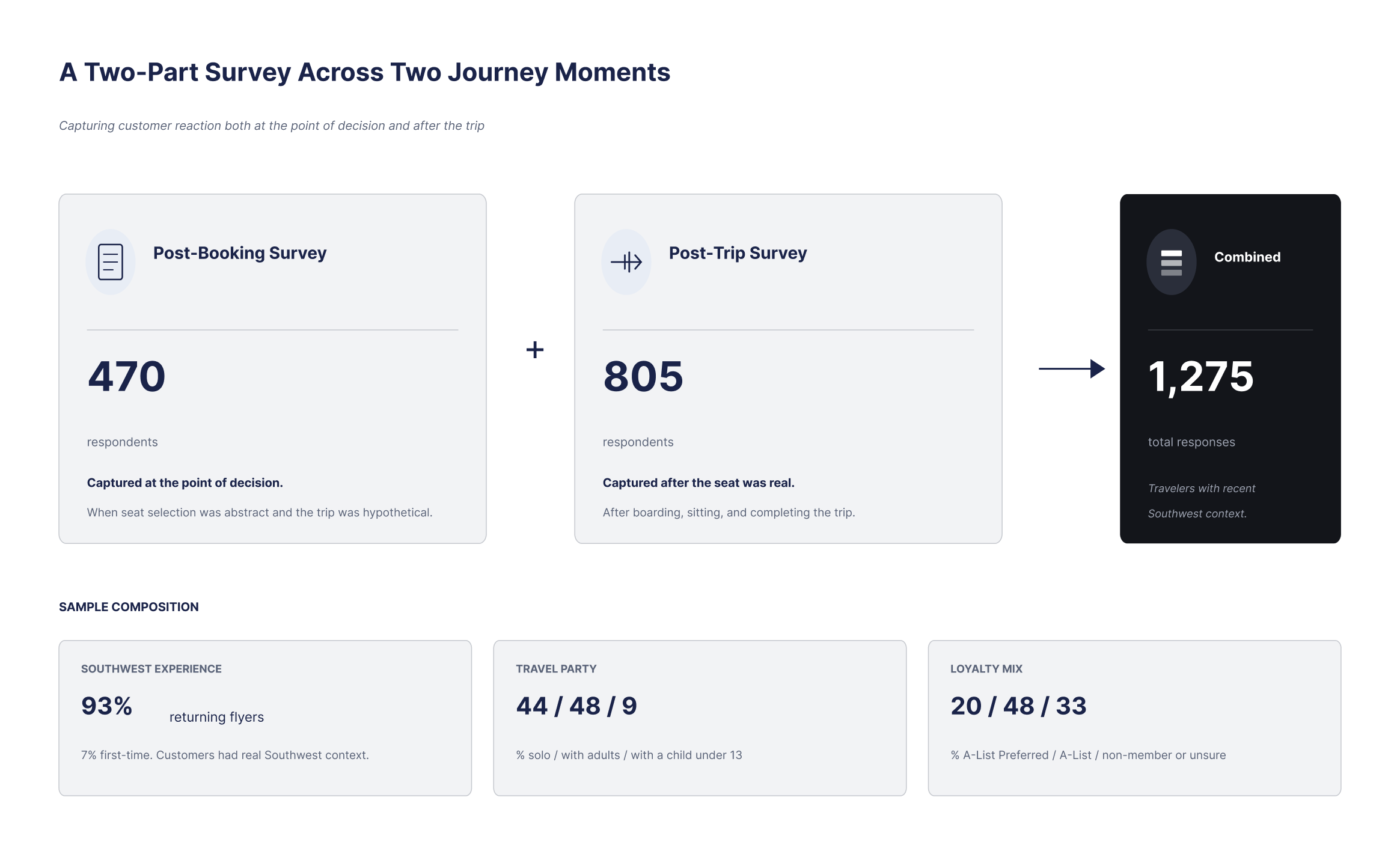
The design choice that mattered most was running the study across two journey moments rather than collapsing it into a single post-trip read. Post-booking captured customers at the point of decision, when seat selection was abstract and the trip was hypothetical. Post-trip captured them after the seat had been a real chair on a real plane. The two reads behaved differently in places — particularly around value perception and post-booking changes — and that gap was itself a finding. A single-moment study would have missed it.
The analysis focused on four recurring dimensions: how customer type shaped interpretation of the change, how expectations and value compared across seat categories, how sentiment moved across the journey, and what most strongly drove acceptance versus resistance. The objective was to identify which parts of the new seat model created genuine customer value and which parts created friction that could erode the brand over time.
The vision animating the work was simple: a seat strategy should make travelers feel more in control of their journey, not more aware of what they didn't buy.
Insight
Across the two surveys, three patterns emerged — each reshaping how a seat strategy should be designed and judged.
Assigned seating earned acceptance because it made the journey feel more predictable — certainty, not premium seating, was the core customer benefit.
Customers understood the seat categories, but the value ladder was fragile — Standard remained acceptable and Preferred felt close to Extra Legroom, leaving the price gap exposed.
The new model worked best when customers could manage changes early and digitally — friction grew at the gate, around price, and where the experience started to feel less distinctively Southwest.
1. Certainty Was the Strongest Source of Customer Value
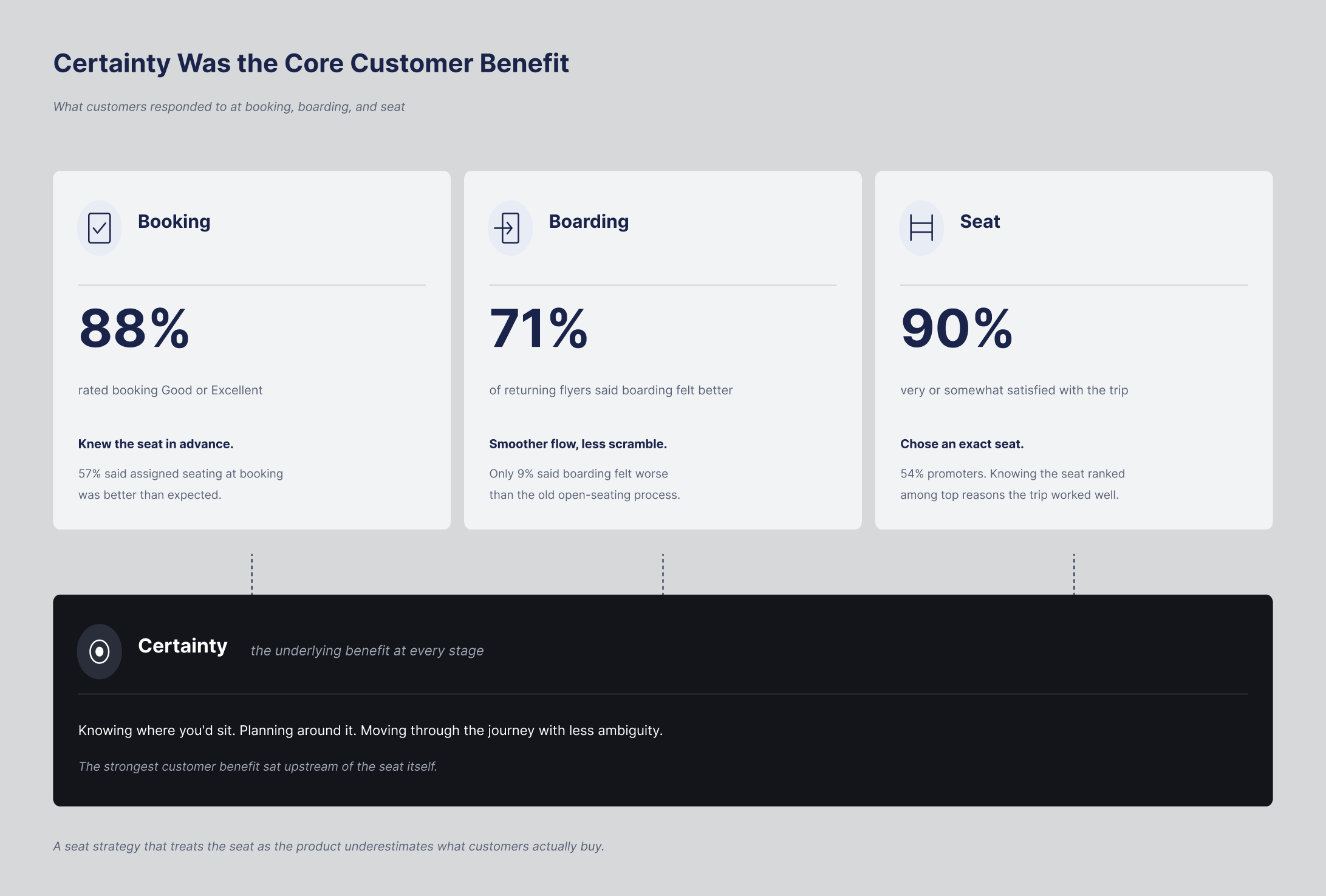
Customer response to the new model was broadly positive. In the post-booking survey, 57% said the assigned-seating part of booking was better than expected, and 88% rated the overall booking experience Good or Excellent. After travel, 90% were very or somewhat satisfied with the trip, and 54% were promoters.
What customers were responding to was more specific than acceptance. At booking, they prioritized a quick and easy process, avoiding extra seat fees, sitting with their travel party, and knowing the seat ahead of time. After the trip, what they said had worked well was knowing the seat in advance, moving through boarding smoothly, and choosing an exact seat. The customer value of assigned seating was certainty — knowing where you'd sit, planning around it, and moving through the journey with less ambiguity.
Boarding and family travel were the clearest proof points. Among returning Southwest flyers, 71% said boarding felt better than the old open-seating process, while only 9% said it felt worse. Among promoters, the most common reason for the score was that boarding felt smooth and organized. Families showed the same pattern. At booking, 68% of travelers with children said assigned seating made the booking process less stressful; after the trip, 71% said it made the trip itself less stressful. Among travelers with at least one child under 13, 81% were seated directly together or across the aisle, 91% were satisfied overall, and 57% were promoters.
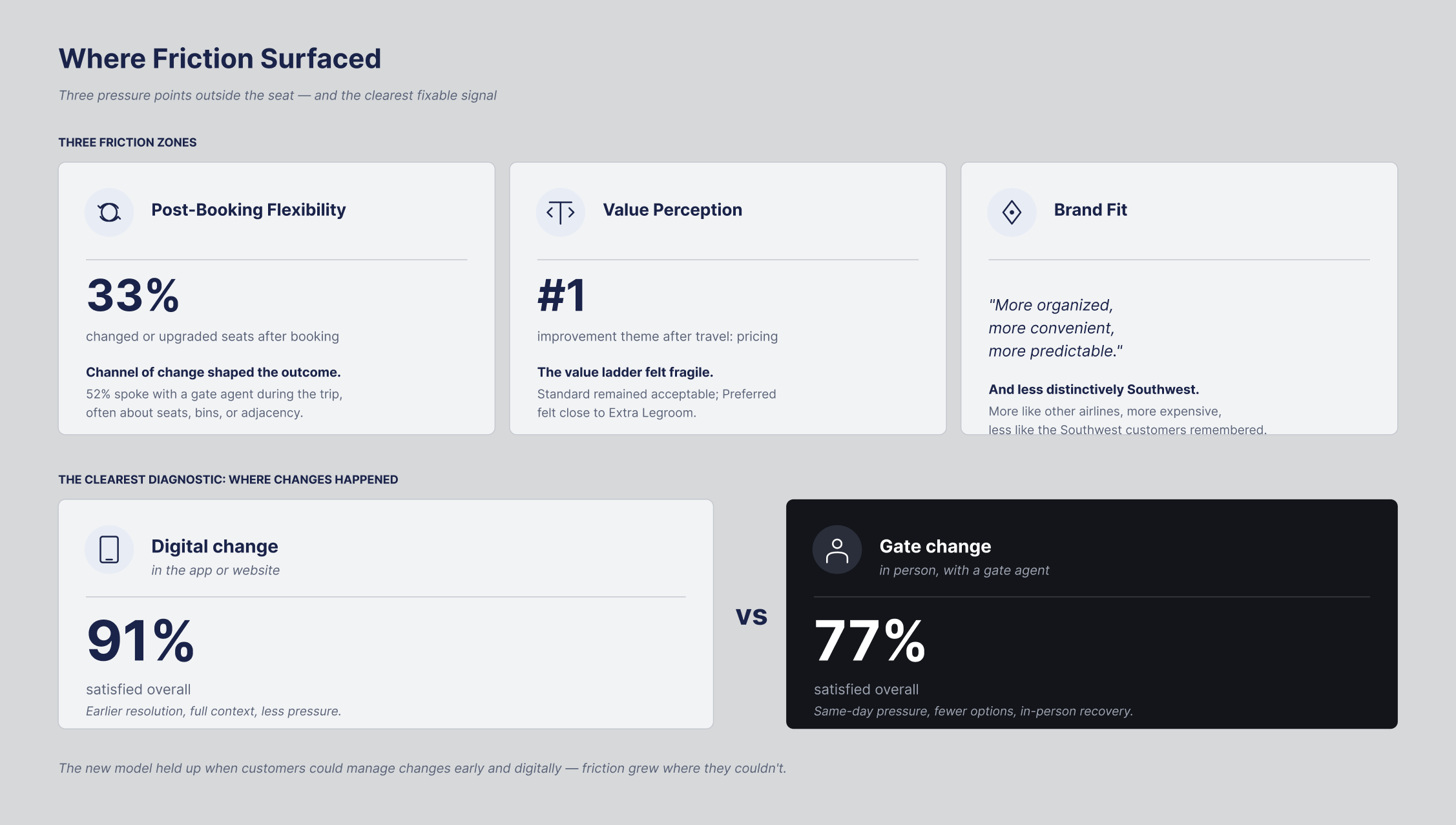
The remaining resistance clustered around price, flexibility, and brand fit. Customers often described the new model as more organized, more convenient, and more predictable. Some also described it as more expensive, more like other airlines, or less like the Southwest they remembered. The change improved predictability and made the airline feel more conventional at the same time. A seat strategy has to hold both — the operational gains of structure and the brand identity that made the airline worth choosing in the first place.
The takeaway for seat strategy is that the strongest customer benefit of assigned seating sits upstream of the seat itself. Customers responded to a journey that felt more legible — clearer decisions at booking, calmer movement through boarding, fewer last-minute unknowns. A seat strategy that treats the seat as the product underestimates what customers actually buy when they accept an assigned-seating model.
2. Customers Understood the Categories — But the Value Ladder Was Fragile
Customers generally understood the new seat model. Seventy-one percent said the differences between Extra Legroom, Preferred, and Standard were very clear, and 95% said they were at least somewhat clear. Nearly half said nothing about the seat options was unclear. The in-flight seat experience was also broadly positive: all three categories performed reasonably well on comfort and overall satisfaction.
The fragility sat in the gap between categories. Standard still delivered an acceptable experience for many customers, and Preferred performed close to Extra Legroom on several measures. That created the central value tension. If Standard is acceptable and Preferred feels close to Extra Legroom, customers need a clearer reason to pay more. The top improvement theme after travel was pricing of seat options, and among lower scorers, one of the strongest negative drivers was that the extra cost for better seats did not feel worth it.
Premium has to be legible at the seat itself, not only at the price point. When the experience gap between paid and unpaid seats is narrow, the price gap reads as a charge to avoid an undesirable outcome rather than as access to a clearly better one. That framing erodes value perception even when satisfaction with the paid seat is high.
3. Friction Grew at the Gate, Around Price, and Around Brand Fit
Assigned seating remained active after booking. Thirty-three percent of post-trip respondents changed or upgraded seating after the initial booking process. Outcomes were strongest when the change happened digitally: customers who changed seats in the app or website were 91% satisfied overall, compared with 77% for those who changed seats at the gate.
Gate agents played a meaningful recovery role. Fifty-two percent of respondents spoke with a gate agent during the trip, often about carry-on or bin space, sitting with a travel group, seat assignment changes, moving to a different seat, or upgrade questions. Among customers who spoke with a gate agent, promoter rates were actually higher than among those who didn't — the recovery worked. What mattered was what pushed customers into needing recovery — most often, seat-related questions that couldn't be resolved cleanly upstream.
Impact
The work led to four interlocking outcomes:
A competitive read on the most significant U.S. seating change in decades. The study gave United the first structured customer-side view of how a peer carrier's shift to assigned seating was actually being received, separating the surface narrative ("backlash") from what customers reported in their own bookings and trips.
A reframing of seat strategy around certainty. The research established that the strongest customer benefit of assigned seating sits in the predictability the system creates across booking, boarding, and seat — not in the premium category itself. This shifted how seat decisions could be evaluated internally, treating seat strategy partly as an orientation system rather than only as a merchandising one.
A diagnostic for value-ladder design. The findings clarified what determines whether a paid seat hierarchy feels legible: the experience gap between categories has to be visible at the seat, not only at the price. This gave seat strategy and merchandising a sharper test for when a paid tier is doing real customer work versus when it is mainly extracting fees.
A set of forward research priorities. Three areas surfaced for follow-up: how seat value forms across loyalty segments, what counts as acceptable family and group adjacency, and how AI-supported seat management could help customers reason through pricing tradeoffs, adjacency, and downstream contingencies without making the experience feel more transactional.
The broader takeaway, beyond Southwest: when an airline restructures one of its most familiar customer moments, the customer-side payoff comes from what the new structure makes easier to predict, not from what it makes available to buy. Assigned seating worked for Southwest customers because it reduced ambiguity at the moments where ambiguity used to cost them most. A seat model that monetizes without delivering that certainty risks the worst of both worlds — a more conventional experience that no longer earns the brand premium the old model used to carry.