How Premium Customers Read
the Departure Lobby
How elite travelers evaluate coverage in a premium check-in space —
and what makes status feel useful in the first minutes of the trip.
Role
Research lead, Customer Strategy & Innovation
Designed and led mixed-methods competitive study
Partners
Airport Operations
Lobby Experience
Loyalty & Premium
Scope
Competitive assessment of Delta's premium check-in experience
Informing United's premium lobby strategy
Summary
Problem
Design
Insight
Impact
$22.1B
Delta's 2025 premium cabin revenue, on track to overtake main cabin revenue in 2026.
Summary
Premium check-in areas must do two things at once: move high-value travelers through routine operational tasks quickly, and make those tasks feel protected from the friction of the regular departure experience. Internal speculation that Delta had been staffing Sky Priority more heavily than other US carriers raised a competitive question for United: was visible staffing the lever to match? I led a mixed-methods competitive study of Delta Sky Priority customers, pairing a day-of-travel diary study with a survey of recent users completing real lobby tasks. The study showed that customers read premium lobbies through a single synthetic signal — whether the space is covered. Coverage is the integrated read of whether lines are moving, whether help is visible and reachable, whether the task path is legible, and whether exceptions can be resolved without the customer having to interpret the system. Once the lobby reaches that threshold, additional staffing produces diminishing returns. Coverage gets built at two specific moments — arrival and complication — and status works through quiet operational confirmation more than through verbal recognition. The work reframed the competitive question from whether to match Delta's staffing levels to how a premium lobby should signal coverage.
+27%
Growth in premium seats on US domestic flights since 2020,
nearly triple the rate of main cabin.
#1 of 7
ranks first among the seven dimensions driving US airport satisfaction, above facilities, staff, and amenities.
Sources: Delta 2025 financial results; Wall Street Journal industry analysis; J.D. Power 2025 North America Airport Satisfaction Study.
Problem
Premium check-in lobbies are among the most visible and most expensive elements of an airline's premium service offer. They must move thousands of high-value customers through routine operational tasks every day while making each customer feel that the regular departure experience belongs to someone else. The competitive stakes are growing. Premium revenue is now nearly equal to main cabin revenue at Delta, and the industry has added 27% more premium seats over the past five years. The marginal premium dollar is being spent on experiences far closer to the customer than the cabin itself, and the departure area is at the front of that line.
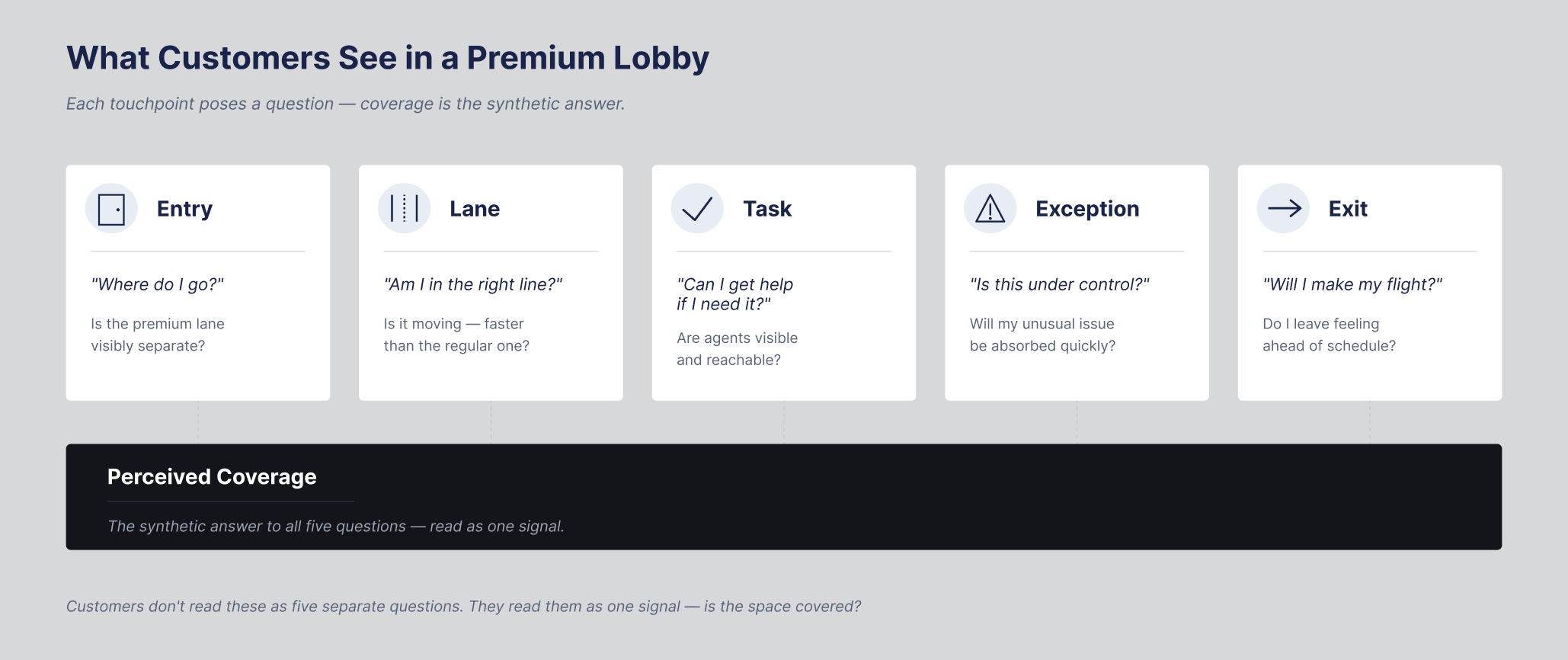
The question that prompted this study was concrete. Several United leaders had observed during travel that Delta appeared to be staffing Sky Priority lanes more heavily than United staffed its First Class check-in equivalent. The competitive concern was whether Delta was producing a more reassuring premium check-in experience by investing in raw bodies on the floor, and whether United needed to match.
That concern broke down into four research questions:
What do premium customers actually evaluate when they enter a Sky Priority lobby — and how much of that evaluation is shaped by staffing visibility?
At what point does additional staffing stop producing additional perceived value?
How does the same lobby handle routine throughput and exception handling without one degrading the other?
What does it take for elite status to feel useful in a space whose primary job is operational?
Customers walk into a premium lobby carrying a clock, a set of tasks, and a learned expectation of what "premium" should feel like. They form a fast read of the space within the first minute or two of being in it. Characterizing that read — what travelers actually attend to, and how that attention translates into evaluation — was the research target.
Design
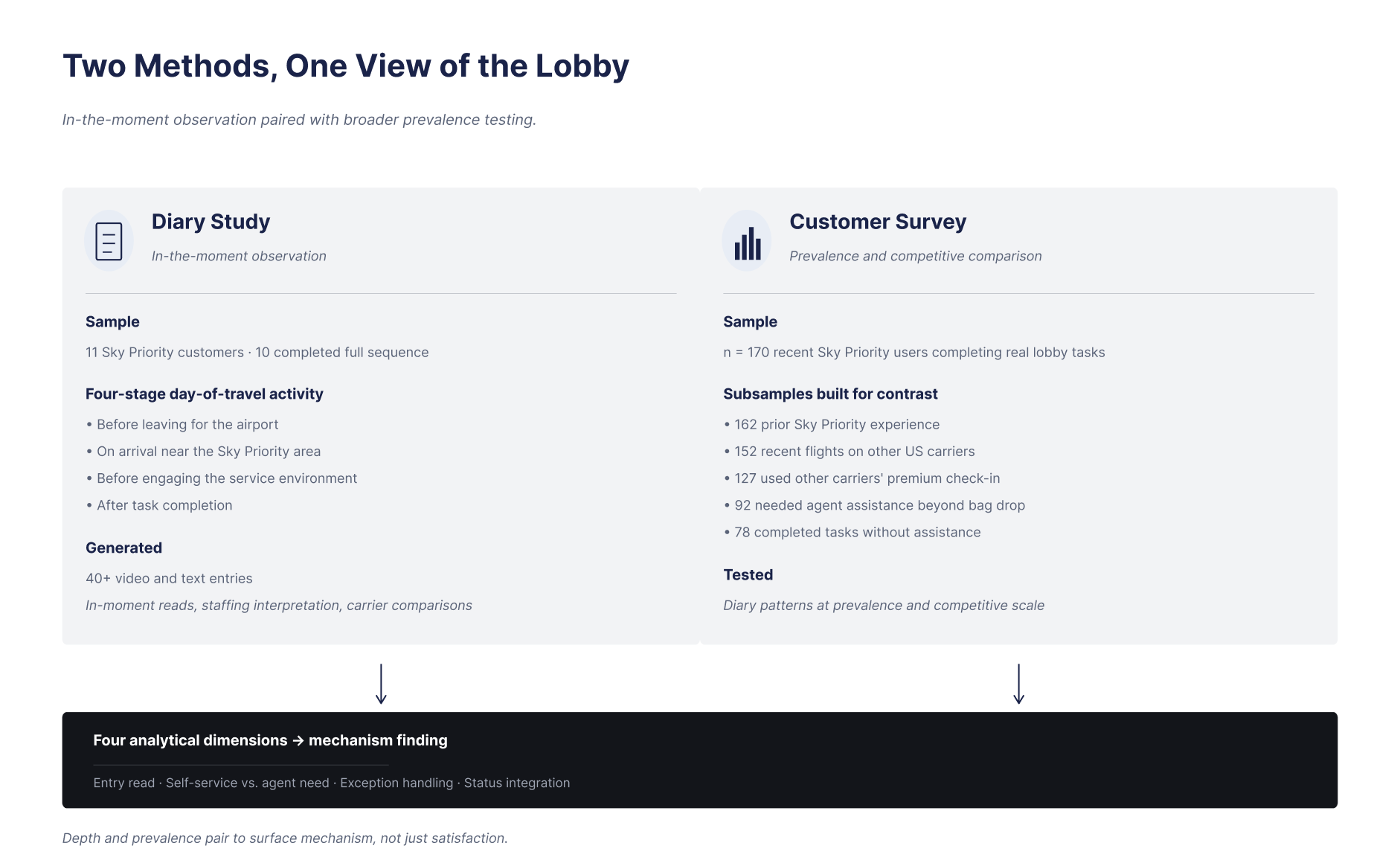
The study used two complementary methods. The diary study captured what eleven Delta Sky Priority customers were noticing and interpreting as they moved through real lobby tasks. The survey then tested those real-time observations against a broader sample of 170 recent Sky Priority users. The diary supplied depth and behavioral detail. The survey supplied prevalence and competitive comparison.
The diary study. Eleven Sky Priority customers were enrolled to complete real check-in tasks across a structured four-stage activity sequence: before leaving for the airport, on arrival near the Sky Priority area, immediately before engaging the service environment, and after task completion. Ten participants completed the full sequence. The diary produced more than forty video and text-based entries spanning pre-arrival expectations, environmental observation, staffing reflections, task walkthroughs, comparison to other carriers, loyalty-value reflection, and improvement suggestions. The structure was built to surface what customers were noticing in the moment, before memory compressed the experience into a single satisfaction score.
The customer survey. A 170-respondent survey of recent Sky Priority users completing real lobby tasks was fielded. Subsamples were built into the design to enable specific contrasts the diary had suggested were worth testing: 162 with prior Sky Priority experience, 152 with recent flights on other US carriers, 127 with exposure to other carriers' premium check-in areas, 92 who required agent assistance beyond bag drop, and 78 who completed their tasks without assistance. The survey measured whether the patterns from the diary held at scale, gave the patterns competitive frame, and provided the prevalence numbers needed for internal communication.
Premium lobby research is typically conducted through satisfaction scores collected after the fact. Satisfaction scores compress evaluation into a single number once the moment has passed, after the customer has reorganized the experience in memory. The diary was specifically built to interrupt that compression — capturing the entry presence, the line movement, the sorting cues, the agent positioning, the lane separation, and the kiosk support as the customer was reading them in real time. The survey then took those real-time observations and tested whether they were shared at scale. The two methods together separated three things customers normally blend in memory: the physical organization of the space, the behavioral role of staff, and the psychological feeling of being covered.
The analysis worked through four recurring dimensions: how customers read the space on arrival, where they accepted self-service and where they needed staff, what they did when something fell outside the routine, and how status entered the evaluation. The objective was mechanism finding — identifying the conditions under which the premium lobby felt premium, so the competitive question could be answered through strategy rather than through a staffing target.
Insight
Three patterns emerged, each reshaping how the premium lobby was understood internally.
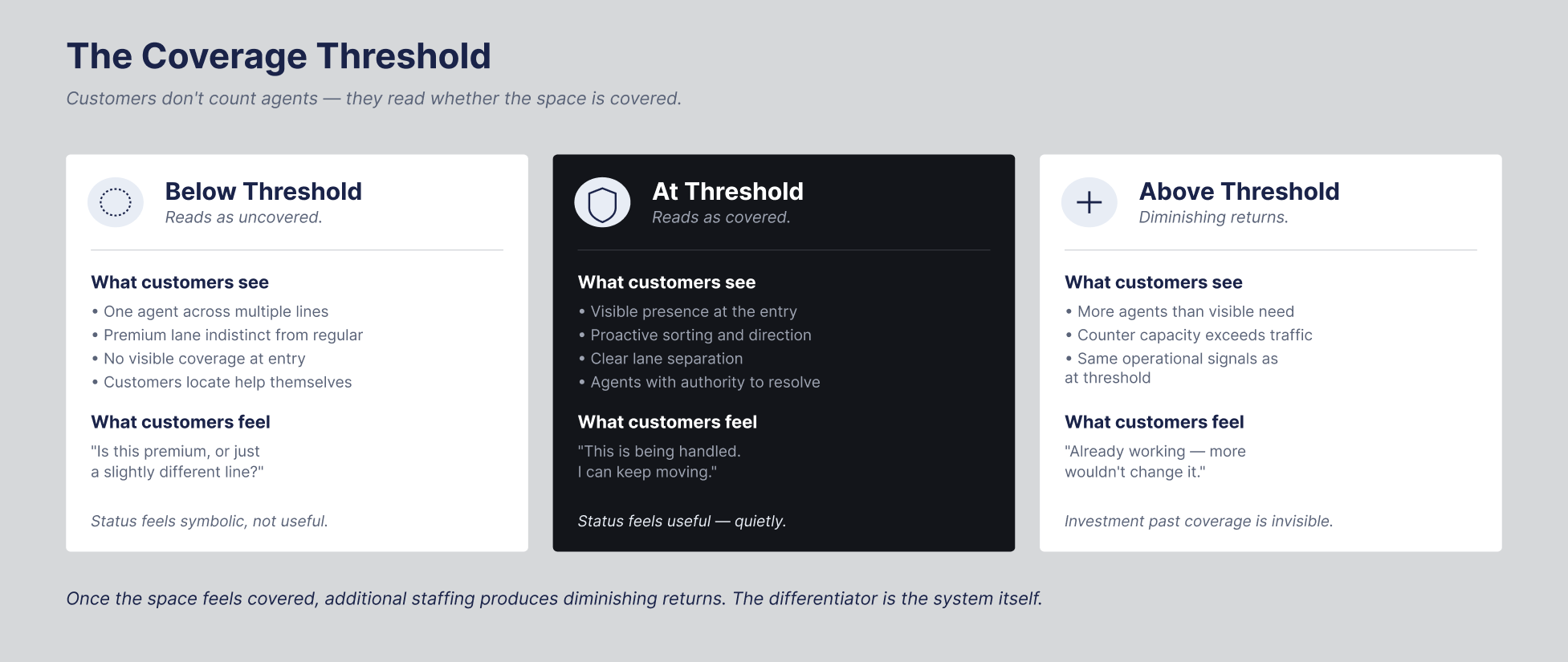
Customers evaluated premium lobbies through a coverage threshold. Once the lobby read as covered, additional staffing produced diminishing returns.
Coverage was built at two operational moments — arrival and complication. Routine throughput reached the coverage threshold on its own.
Status worked through operational confirmation more than through verbal recognition. The lobby's job was to make status feel useful.
1. The Coverage Threshold
The clearest pattern across both studies was that customers cared about whether the space let them keep moving with confidence. In the survey, "getting through quickly without delays" was the most cited marker of the experience working well, at 72%. "Help being easy to find" followed at 69%. "The space feeling calm and controlled" rounded out the top three at 59%. In the diary ranking exercise, efficiency was the top-ranked value. Recognition ranked last.
Premium value began with operational confidence — the sense that the space would resolve routine tasks without forcing the customer to deliberate or be exposed to the regular-lobby crowd. Once that threshold was met, satisfaction was already high. Overall satisfaction with the most recent Sky Priority experience averaged 6.06 on a 7-point scale, with 79% rating it 6 or 7. The lobby scored strongly on feeling calm and organized, on knowing where to go, and on ease of completion.
The shape of the improvement opportunity is also revealing. Customers who said the lobby could be better suggested several different mechanisms — shorter waits, easier-to-find employees, more agent authority to resolve issues, better self-service tools, clearer organization, fewer handoffs. The recurring theme across these suggestions was changes in how the space conveys control. Headcount appeared only secondarily and never as the main recommendation.
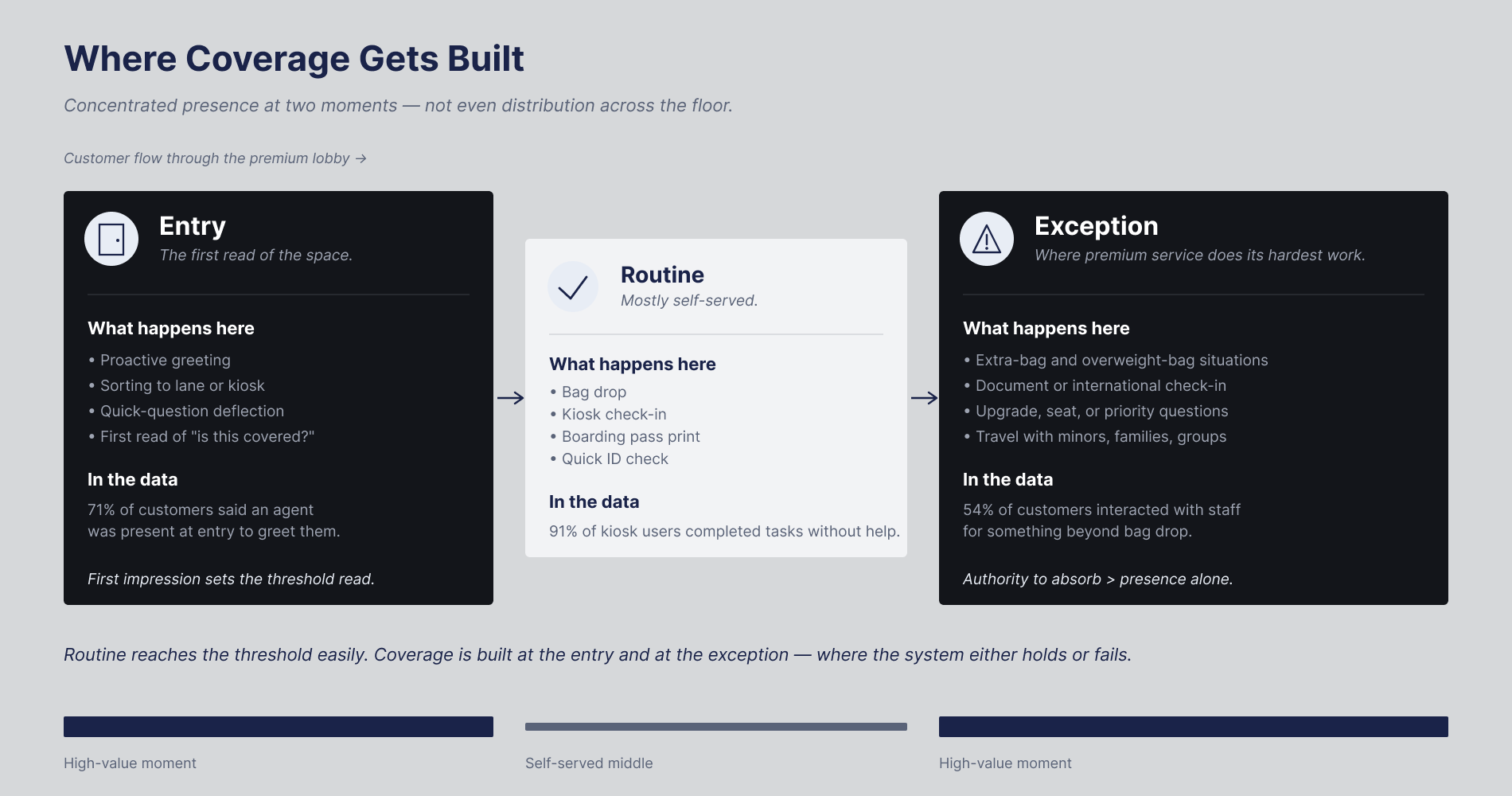
The exception was where premium service did its hardest work. Among the 54% who interacted with staff beyond bag drop, the most common needs were extra-bag situations, document verification and international check-in support, boarding pass issues, overweight bags, upgrade and priority questions, seat assignment changes, ticketing and payment problems, and assistance for minors, families, and groups. These were the moments where self-service could not carry the experience. They were the moments where coverage was built — by an agent nearby, with authority to resolve, who could absorb the situation before the customer had to interpret it.
Premium value was produced by concentrated presence at two moments rather than by even distribution across the floor. The first was arrival, where the customer formed an initial read of the space. The second was complication, where the customer was most likely to feel a system either holding or failing.
3. Status as Operational Confirmation
Recognition of status was the weakest standalone attribute in the research. In the survey, "feeling recognized as a priority customer" ranked lowest in importance across the satisfaction drivers tested. It was selected by 17% as something that stood out when Sky Priority worked at its best, by 15% as a factor influencing the most recent satisfaction rating, by 15% as something that worked best on the trip, and by 14% as an improvement priority. Recognition as a standalone moment carried less weight than any other measured attribute.
The diary study added a layer. Participants reacted positively when agents thanked them for being Gold or Platinum Medallion, acknowledged Sky Priority, or treated the interaction as belonging to a distinct premium path. These small confirmations registered, even when they did not produce direct comments about being "recognized." Recognition was operating as a layer on top of the operational experience, providing a quiet signal that the system knew who the customer was.
That distinction explains why status-value reinforcement still scored well overall. The statement "My recent Sky Priority experience reinforced the value of my Medallion and/or other Delta loyalty status" averaged 5.88 on a 7-point scale, with 71% selecting 6 or 7. The lobby was making status feel useful — through the protected separation, the fast movement, the available help, the agent acknowledgment in moments where it occurred — even when verbal recognition was not the headline experience.
Competitive comparison sharpened the point. Among customers who had used premium check-in on other airlines, 90% rated Delta's Sky Priority somewhat or much better. Diary participants who had used other carriers described Delta as friendlier, more distinct, or more consistent than the alternatives. What set Delta apart was the operational experience itself: clear separation, fast movement, available help, and a service tone that made the premium path feel intentional. Luxury was rarely cited.
Status value, then, is created through a sequence of operational confirmations that link the experience to who the customer is to the airline. Verbal recognition contributes to that experience but does not carry it on its own.
What customers were evaluating was whether the space reached a coverage threshold. Below the threshold, the lobby read as exposed: one agent running multiple lines, the premium lane indistinguishable from the regular, no one watching the entry. At threshold, the lobby read as covered: visible entry presence, proactive sorting, clear lane separation, agents with authority to resolve. Above the threshold, additional staffing did not change the evaluation. The differentiator was the system itself, not the headcount inside it.
2. Where Coverage Gets Built
Staffing was highly salient in the diary study, but the salience came from interpretation rather than from counting. Multiple agents, short lines, active direction, someone positioned near kiosks — these read as calm and confidence. The opposite — one agent stretched across multiple lines, the premium lane indistinguishable from the regular, no one watching the entry — read as deferred attention. The presence or absence of an agent at a specific point in the lobby carried operational meaning.
The survey confirmed the mechanism at two specific points. At the entry, 71% of respondents said an agent was present to greet them. Beyond bag drop, 54% interacted with staff for some additional reason. Among those interactions, the split between customers seeking out an agent and an agent approaching them was nearly even, providing a useful proxy for how often proactive service was occurring. Proactive service was not universal, but when it happened, it was memorable.
Routine tasks reached the threshold easily. 75% of survey respondents dropped bags. 65% used a kiosk. 91% of kiosk users completed the task without help. 81% rated the lobby as extremely or very easy to use. These tasks required visible separation from the regular lobby, working kiosks, and bag-drop staff. They did not require concentrated agent presence around them.
Impact
The work produced four outcomes:
A first competitive read on Delta's premium check-in experience. The study combined diary-based behavioral observation with a customer-base survey to establish how Delta's Sky Priority experience is performing in the eyes of Delta's highest-value customers, and how it compares to other US carriers' premium check-in environments. It was the first United-led research of this kind.
A reframing of the competitive question. Leadership had been asking whether United needed to match Delta's apparent staffing levels. The study reframed the question as whether United's premium check-in spaces are reaching the coverage threshold — a measurable signal customers actually use, rather than a headcount target. The conversation moved from staffing investment toward system design.
The coverage threshold as an operating concept. The threshold became a working internal definition of premium lobby quality. It is now used to evaluate proposed premium lobby investments by separating those that change perceived coverage — entry presence, exception authority, lane legibility, kiosk support — from those that add capacity without changing how the space reads.
A senior-level reference. The study has been used by leadership across Airport Operations, Customer Experience, and Loyalty & Premium as the foundation for framing premium lobby strategy as a system-design question. The diary footage and survey data sit behind several follow-on initiatives in the premium check-in environment.
In service environments where customers cannot directly observe the operational system, they read it through compressed cues — who is positioned where, what feels covered, where help is available. Premium service strategy benefits from designing for those cues directly. The most effective investments are the ones that change how covered the space reads to the customer, and those investments do not always correlate with raw spend.