Designing Diachronic Orientation
in Travel Apps
Day-of-travel coordination is moving to mobile,
and its most consequential moments happen before travelers reach the terminal.
Role
Research lead, Customer Strategy & Innovation
Designed and led mixed-methods generative study
Partners
App team
Digital Technology
Operations
Scope
Foundational research underpinning Travel Mode
Behavioral framework now used across day-of-travel work
Summary
Problem
Design
Insight
Impact
76%
of global travelers seek
travel apps that reduce
the friction and stress of travel..
Summary
The 24 hours before a flight present a distinct challenge for airline apps. During that window, travelers shift from planning to execution, coordinating a sequence of time-sensitive actions as conditions change. Engagement narrows and intensifies as departure approaches: check-in, seat confirmation, weather, traffic, security preparation, and boarding timing become tightly linked. Once travelers arrive at the airport, engagement shifts toward closure. I led the foundational research for Travel Mode, a multi-year initiative to define a dedicated app experience for this window. The study combined a cross-airline day-of-travel diary, journey mapping across the full ecosystem of apps travelers actually use, and moderated follow-up interviews. Day-of-travel breakdown stemmed less from missing information than from the difficulty of coordinating fragmented timing signals across many apps under unpredictable conditions. Cognitive load peaked before the airport, not inside it. Once in the terminal, most travelers wanted the app to have already done its hardest work, so they could rely on signage and physical momentum. These findings shaped a product direction that prioritizes coordination upstream and lets the app step back where the physical environment can take over. That direction is now reflected in Travel Mode, live in the United app.
51%
growth in U.S. airline app
downloads since 2019.
80%
of Americans say air travel is a leading cause of personal stress — more daunting than filing taxes.
Sources: Hilton 2024 Trends Survey; Sensor Tower, State of Mobile 2025; Expedia 2024 Air Travel Hacks Report.
Problem
Airline app strategy has historically focused on what travelers do at the airport: check-in, seat confirmation, boarding, gate changes. The 24 hours before a flight have evolved into a coordination problem of their own. Travelers stitch together timing signals across an unstable ecosystem of apps — airline, maps, ride-share, weather, parking, security wait, and increasingly an AI assistant — while conditions shift around them.
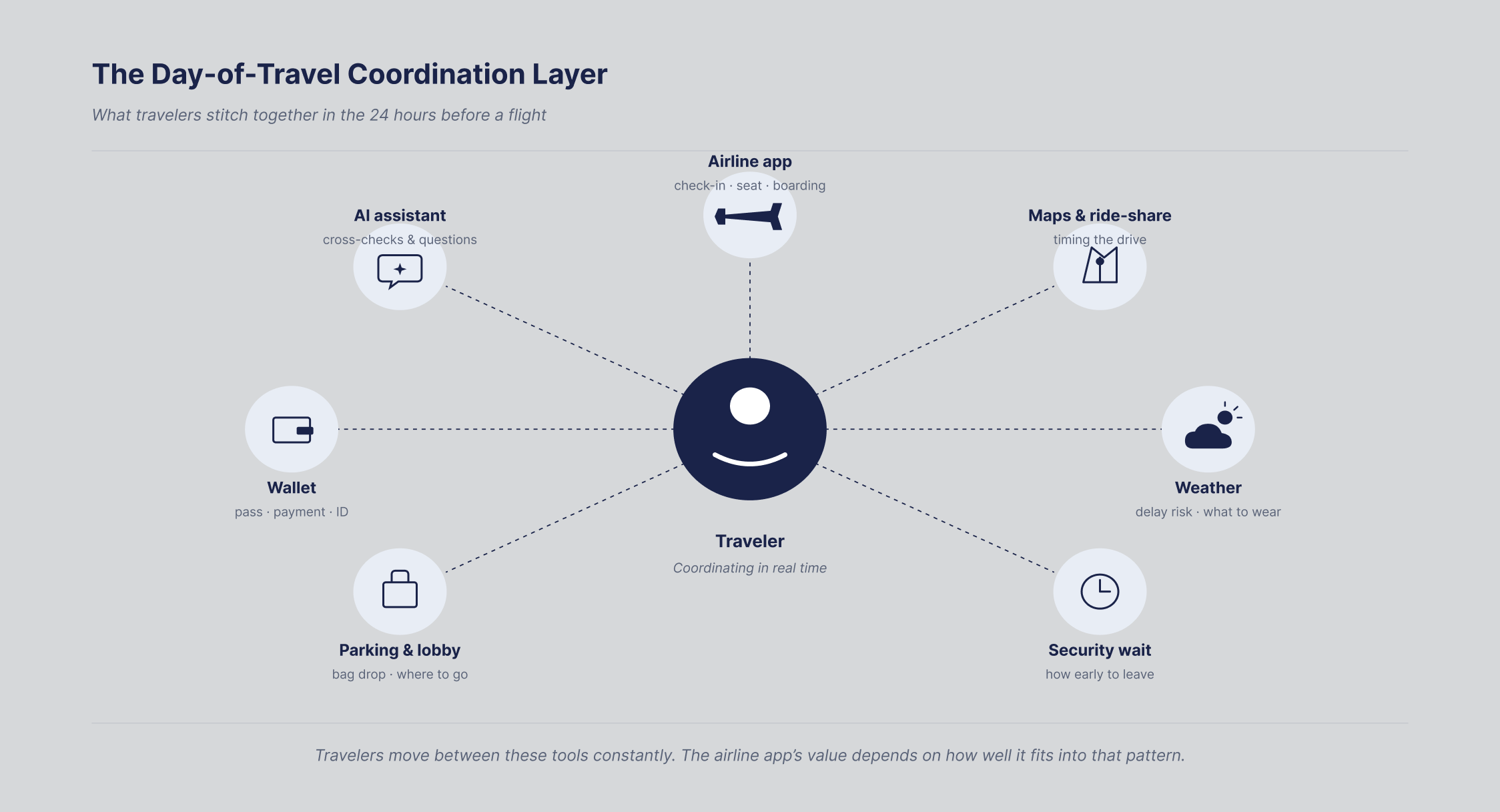
The traveler's relationship with the airline app is no longer a series of discrete tasks. It runs across the full day of travel, and the airline app is being evaluated against the coherence of the entire workflow travelers are running in parallel.
Designing a dedicated day-of-travel app experience required understanding how this window actually works. The research focused on several connected questions:
Where, across the 24-hour window, is the airline app actually load-bearing, and where is it just one more signal to reconcile?
What should earn priority placement in a dedicated day-of-travel mode, and what should remain available without competing for attention?
What does the app need to deliver before travelers reach the terminal so that, once inside, travelers can rely on signage and physical momentum?
Where are customer needs opening up that no major airline app currently supports?
Answering these questions required research that tracked travelers across the full day of travel, across the full set of tools they used, and across multiple airlines — not just United.
Design
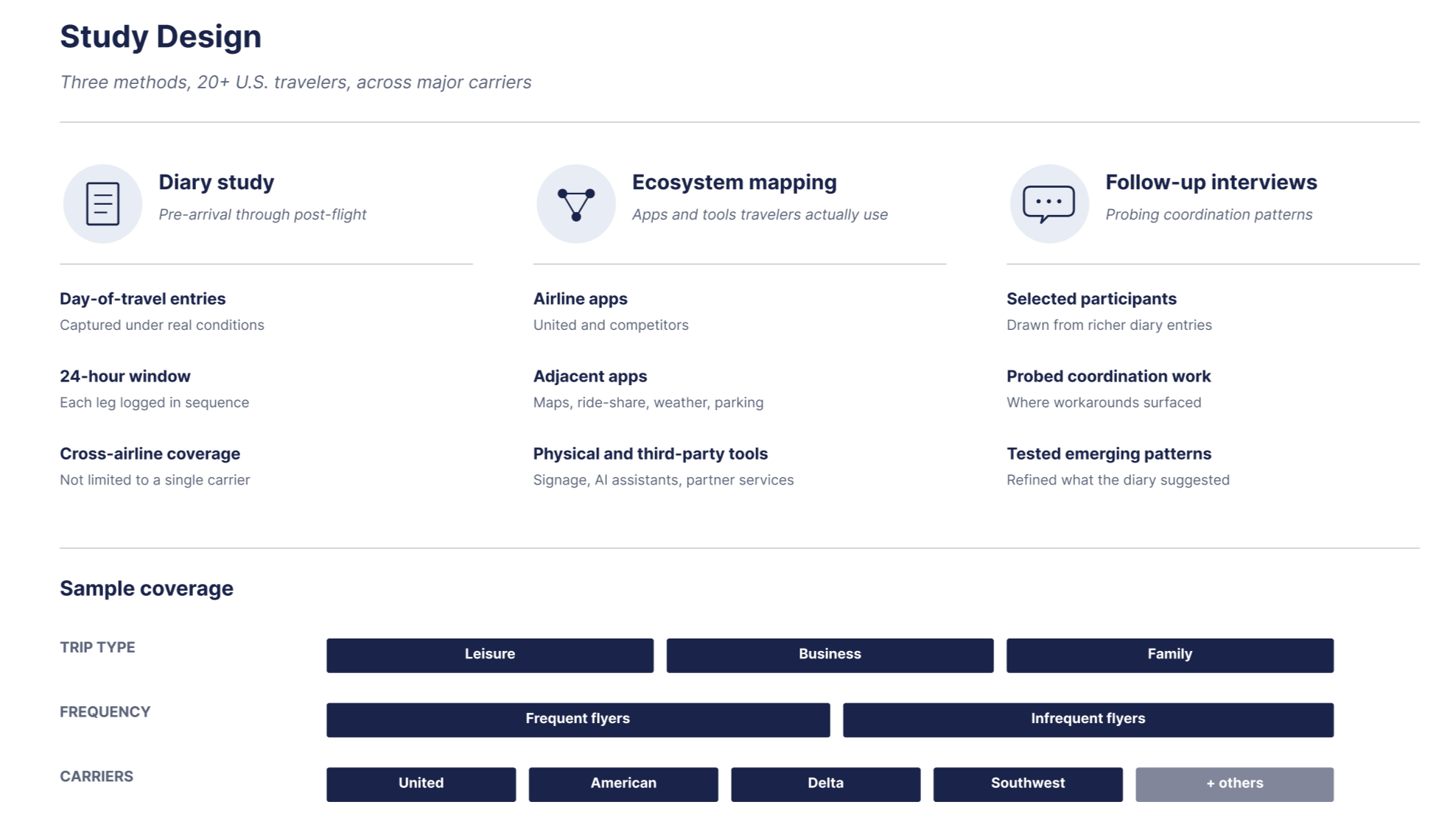
The study took a cross-airline, behaviorally grounded approach designed to capture the lived experience of day-of-travel app usage rather than survey-style attitudes toward features. Three elements were combined: a day-of-travel diary study spanning pre-arrival through post-flight; engagement mapping across the broader ecosystem travelers actually use, including airline apps, maps, ride-share, wallets, parking, weather, signage, and third-party services; and moderated follow-up interviews to probe the coordination work that diary entries surfaced.
The final sample included 20+ U.S.-based travelers across major carriers, covering leisure, business, and family travel and a mix of frequent and infrequent flyers. The study generated diary entries spanning the full window, journey-mapped artifacts of the app and tool ecosystem each participant relied on, and follow-up conversations that grounded the patterns in specific moments: getting to the airport, dropping bags, judging security wait, boarding, deplaning, baggage retrieval, and ground transportation.
The most consequential methodological decision was to treat the day of travel as a time-evolving experience rather than a series of discrete tasks. Most app strategy research treats the customer's relationship with the app as transactional: features, flows, conversions. That framing misses what happens on the day of travel, where the relationship evolves moment to moment as conditions change, pressure rises and falls, and physical context shifts. A journey-mapped frame surfaced patterns that a feature-by-feature evaluation could not have produced. It also established journey mapping as a sustained research practice within the team, applied across multiple subsequent day-of-travel initiatives.
The analysis focused on four recurring dimensions: where airline app reliance was highest and where it broke down, which other apps were recruited to compensate, how cognitive load shifted across stages of the day, and where attention opened toward discretionary choices the app could plausibly support. The goal was structural. The aim was to identify how day-of-travel work distributes itself across the 24-hour window, so the airline app can become load-bearing where it matters and step back where it should not.
Insight
Three patterns emerged across the diary entries and follow-up interviews. Each one shifted how the airline app sits across the day of travel.
Coordination work peaks before the airport, and so does the airline app's leverage.
Security and delays are the throughlines that define the day.
After security and at arrival, attention opens to discretionary choice that no airline app currently serves well.
1. The Coordination Burden Peaks Before the Airport
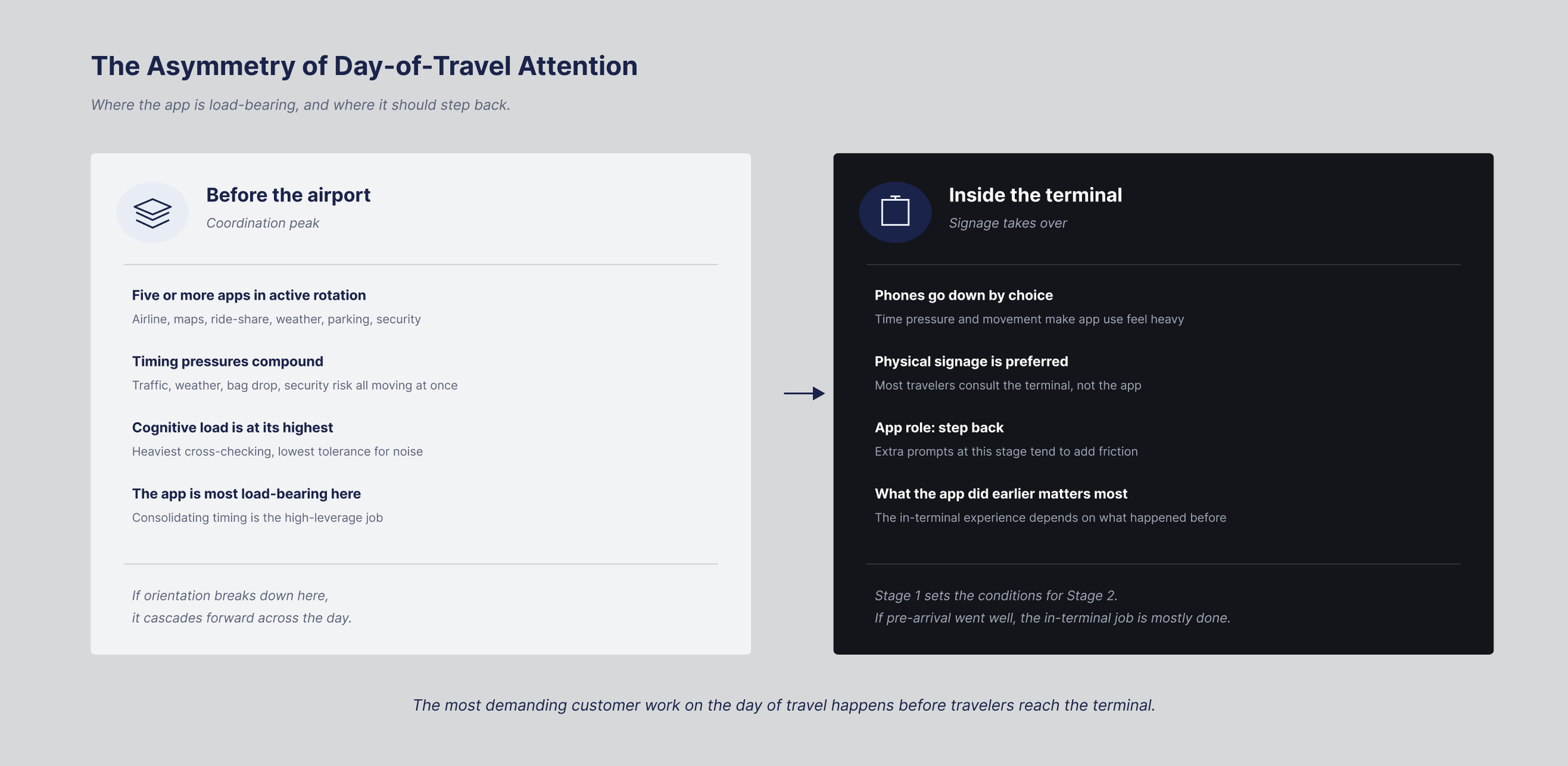
The most cognitively demanding moments of the day of travel happened before travelers ever entered the terminal. During pre-arrival, travelers were simultaneously factoring traffic conditions, ride-share timing, weather risk, lobby tasks like bag drop, and security wait times, often while moving. Participants routinely moved between as many as five apps to balance timing. For some, an AI chatbot added a sixth. When the airline app's signals were insufficient, delayed, or inconsistent, travelers compensated by cross-checking elsewhere. The app's value during this stage depended on whether it helped consolidate timing and sequence into a single coherent plan, or simply added one more signal to reconcile.
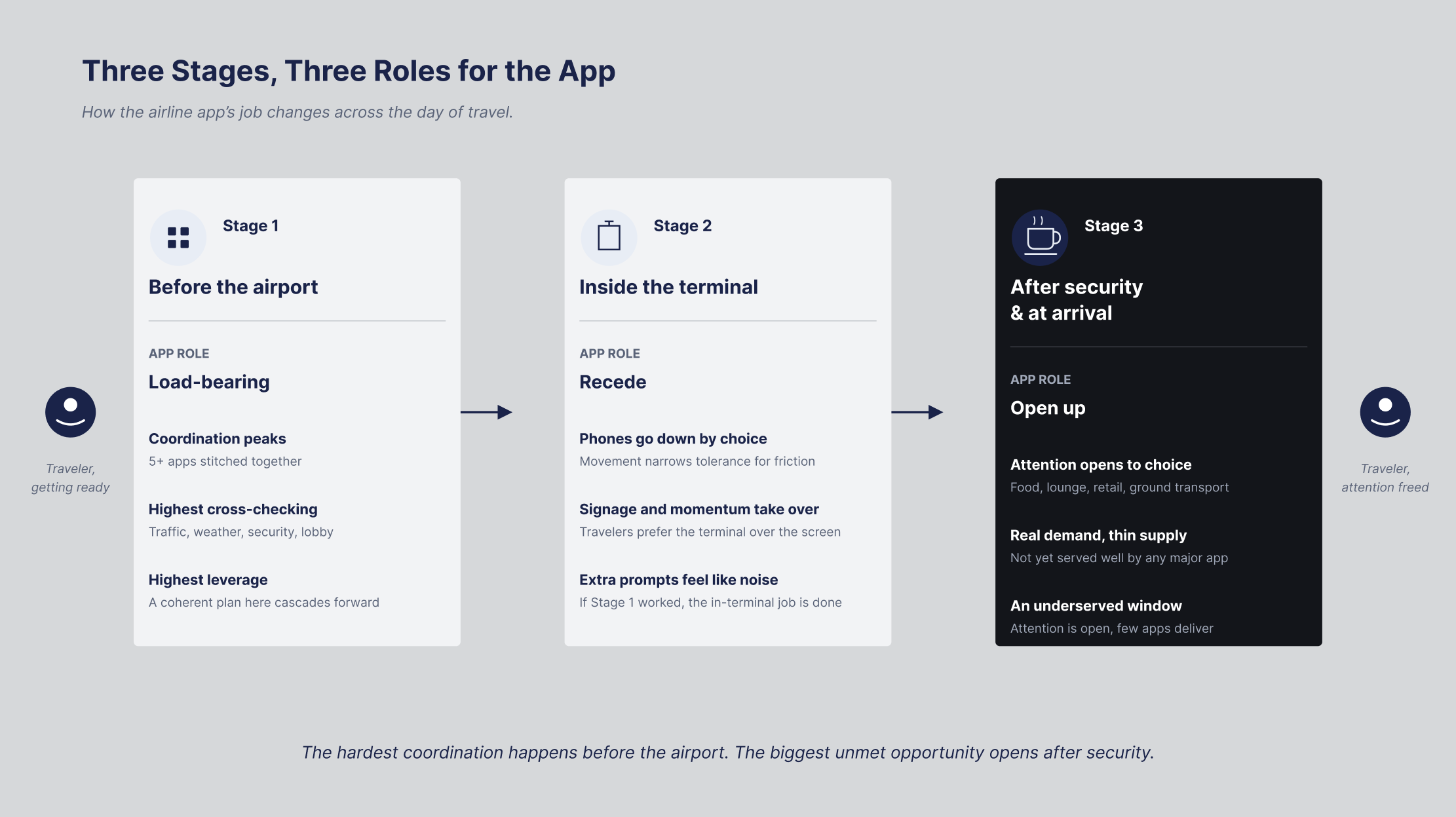
These post-security and arrival windows revealed underserved opportunities. Food discovery, airport retail, lounge prompts, post-arrival guidance, and partner integrations were all areas of customer demand that no major carrier in the study fully supported. The opportunity sat in the moments when attention had opened up, when coordination work had ended and the next set of choices was just beginning to form.
This matters because most product effort points the opposite way. Day-of-travel app strategy tends to concentrate features around high-pressure moments like check-in, boarding, and gate changes. Those are exactly the moments where travelers do not want one more thing to manage. The leverage sits on the other side of those moments, when the customer's attention is free.
A related pattern surfaced alongside this. Travelers explicitly did not want to consult their phones once inside the terminal. Time pressure, physical movement, and environmental demand made in-airport app usage feel burdensome. Most participants preferred physical signage for directional needs once inside. Pre-security, travelers wanted the airline app to all but eliminate functional decisions about timing: which security touchpoint to use, which lane to queue at, where to drop a bag, when to leave the lobby. Once those decisions were resolved, customers wanted to switch to physical momentum and free attention for everything else.
This asymmetry sits at the core of day-of-travel design. Pre-arrival is where the work is hardest, where cross-app coordination is heaviest, and where the airline app has the most leverage. It is also where customers are most vulnerable to the consequences of getting it wrong. Once inside the terminal, the same app that was load-bearing minutes earlier should step back, with its hardest work already done.
2. Security and Delays Are the Throughlines of the Day
The two largest concerns across the day of travel were security wait times and potential delays. Those same two factors largely determined satisfaction with the day-of-travel experience and with the airline overall.
Security and delays did not behave like ordinary feature requirements. They surfaced repeatedly across the 24-hour window, generating a low-grade anxiety that ran through the day. App success at these stages was determined by how well the app had prepared travelers before the moment: orienting them for the physical experience, coordinating with signage, and reducing the verification work they would otherwise have to do.
When the app succeeded at this preparation, travelers could think ahead to post-security choices: upgrading a seat, choosing where to eat, browsing airport retail. When it did not, travelers stayed in monitoring mode, reluctant to commit attention to anything discretionary because they were still anxious about whether the basics were under control. This finding directly motivated subsequent research on Security Wait Times specifically, work that built on the behavioral foundation established here to design a targeted product intervention.
3. After Security, Attention Opens Toward Discretionary Choice
Once travelers cleared security, the character of their attention changed. The intense coordination of traffic, timing, bags, and boarding gave way to something looser. Beyond necessities like restrooms or charging, travelers began thinking about food, lounge access, or simply how to pass time. A similar pattern appeared at arrival. The immediate moment was task-heavy — baggage retrieval, ground transport, connections — but travelers were already thinking ahead to choices beyond the airport.
Impact
The work produced four interlocking outcomes.
A clear product direction for Travel Mode, now live in the United app. The behavioral framework translated directly into product direction: coordination burden peaking before the airport, the app as orientation-first rather than navigation-first once inside, security and delays as the throughlines that define the day, and post-security as the opportunity window. Travel Mode is the experience that direction made possible.
A behavioral foundation for downstream day-of-travel research. The framework underpinned multiple subsequent studies, including the case studies on Security Wait Times, the ORD Lobby, and Compensation for Travel Delays. Each built on the day-of-travel framing this work established.
Journey mapping as a sustained research practice. This study introduced large-scale journey mapping as an ongoing methodology within the team. It has since shaped how the team approaches customer experience research across the day-of-travel window, replacing feature-by-feature evaluation with a view of the day of travel as a coordinated, time-evolving experience.
A foundational reference at senior levels. The work has been presented to senior leadership across the App team, Digital Technology, Customer Experience, Operations, and Loyalty. The framework is now used internally to evaluate day-of-travel app proposals, providing a way to assess whether new features support or fragment customer orientation across the window.
The strategic implication extends beyond Travel Mode. Many of the most consequential customer moments happen upstream of where companies typically design for them. On the day of travel, much of the cognitive work happens before the customer reaches the airport. Investments in those upstream moments have compounding effects across the rest of the day.