How Compensation Reshapes
the Judgment of a Delay
Why offering compensation can lower perceived fairness, and what makes a recovery gesture actually help.
Role
Research lead, Customer Strategy & Innovation
Designed and led the survey study
Partners
Digital Products
Airport Operations
Customer Experience leadership
Scope
First systematic test of compensation effects on delay perception
Informing time-banded compensation strategy
Summary
Problem
Design
Insight
Impact
23%
of US flights ran
late or were
canceled in 2024–25.
Summary
Flight delays are one of the most consequential moments in the travel experience, and one of the most difficult to address. Compensation is one of the primary tools at an airline's disposal, but it is also one of the most difficult to deploy effectively. Effective deployment must balance financial, operational, and regulatory constraints while at the same time meeting customer expectations. I led a research initiative to better understand customer expectations of delay compensation and to translate that understanding into actionable rules for compensation that are both effective for travelers and feasible for the business at scale. The study showed that compensation is not a simple remedy. Once offered, it expands the scope of customer evaluation from the delay itself to the airline's response — its fairness, timeliness, accessibility, usefulness, and the extent to which these factors translate into an acknowledgment of the traveler's situation. When compensation is late, effortful, or not usable during the disruption, it lowers perceived fairness, even relative to receiving nothing. Fairness peaks instead with early, immediately useful gestures and shows diminishing returns as delays lengthen. The findings informed time-banded compensation strategies that prioritize in-the-moment usefulness and low-friction delivery, aligning customer perception with operational and financial constraints.
$33B
annual cost of US
flight delays
to the airline industry.
46%
of travelers say a recent delay weakened
their loyalty.
Sources: DOT BTS analysis (2025); FAA/Nextor; CMAC Group survey (2024).
Problem
Flight delays are among the most consequential moments in air travel and among the hardest to manage. Across day-of-travel research, delays consistently emerge alongside security as one of the strongest drivers of dissatisfaction. Industry data and internal benchmarks show that delays reliably depress Net Promoter Scores, with declines steepening as disruptions lengthen.
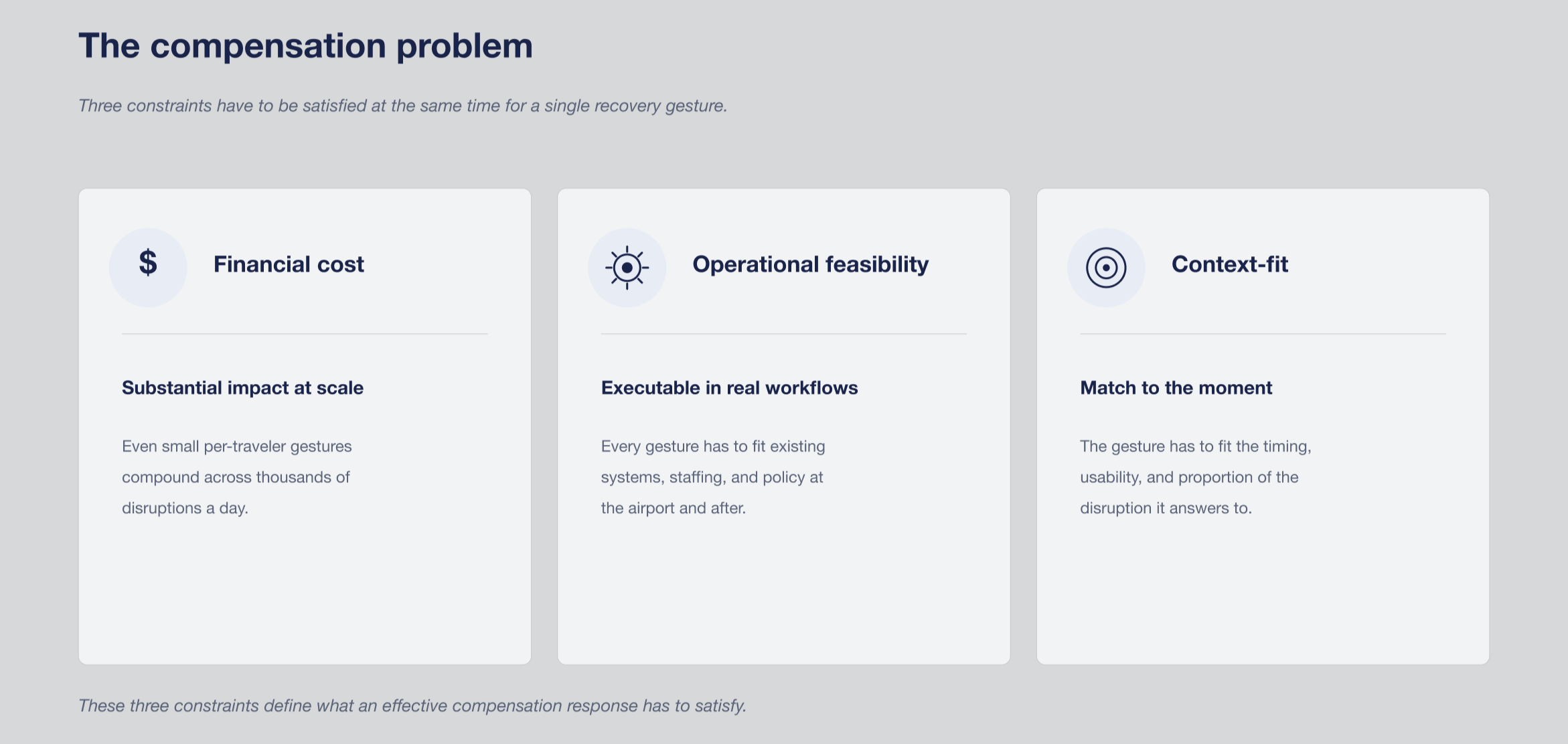
Improving the experience of delays has become a strategic priority at United, and one of the hardest things to address. It requires coordinated work across operations, communications, digital experience, and finance. Compensation sits at the center of that effort. It is one of the most direct levers an airline has to shape how a delay is ultimately judged, and effective deployment requires balancing three constraints at the same time: financial cost at scale, operational and policy feasibility, and a context-fit with the disruption itself, including timing, immediate usability, and proportionality.
The research was designed around four questions:
Does compensation change how a delay is evaluated, and if so, in which direction?
Which dimensions of compensation drive fairness: timing, format, delivery, or value?
Where do diminishing returns set in, and how should compensation scale with delay length?
What does effective compensation look like across short, moderate, long, and overnight disruptions?
All four sit on top of a more basic question: what makes a recovery gesture feel like the airline understood what the traveler needed, when they needed it.
Design
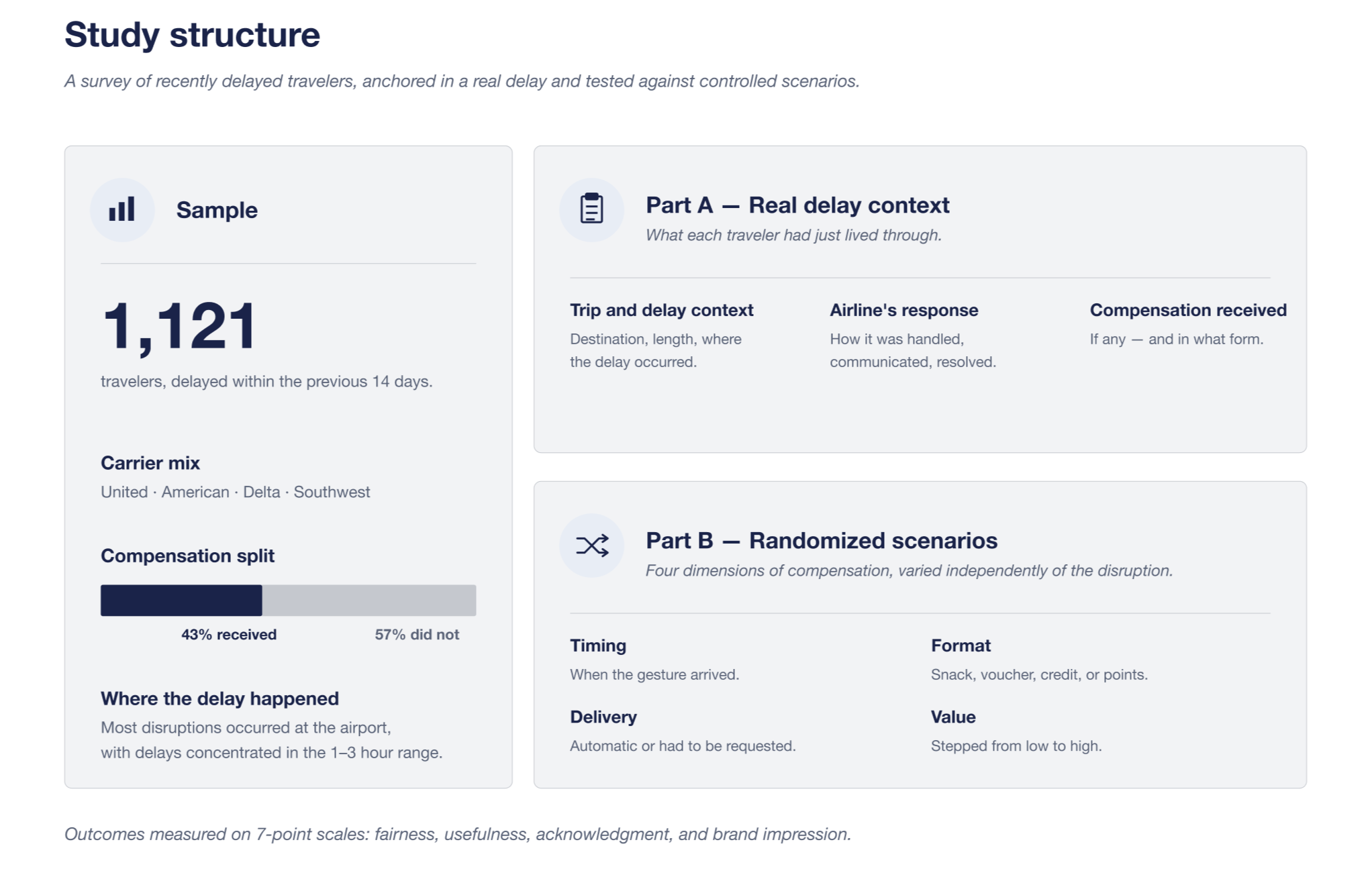
The study used a survey of travelers who had experienced a flight delay within the previous fourteen days. The survey was structured in two parts. Part A captured each traveler's actual delay context and their evaluation of the airline's response, including whether compensation was received. Part B used randomized modules to test reactions to controlled compensation scenarios, varying timing, format, delivery method, and value.
The final sample included 1,121 travelers across a broad mix of U.S. carriers — United, American, Delta, and Southwest — so that expectations reflected common industry experience rather than any single airline's policies. Most delays fell in the one-to-three-hour range, and most occurred at the airport. 639 travelers (57%) reported receiving no compensation, while 482 (43%) reported receiving some form, most often credits, miles, or meal vouchers. That split allowed direct comparison between compensated and uncompensated experiences.
The design choice that mattered most was anchoring half the work in actual delays and half in controlled scenarios. Asking travelers in the abstract what they would consider fair tends to surface ideals rather than behavior. Anchoring the question to a delay each traveler had recently lived through, and then varying compensation independently of the disruption, produced a more useful record: how travelers actually weighed the elements of compensation against the moment of the delay.
The controlled modules varied four dimensions independently: timing of delivery, format (snack, voucher, points, credit), delivery method (automatic or requested), and value level. Outcomes were measured on seven-point scales capturing fairness, usefulness, acknowledgment, and brand impression, alongside structured context and open-ended responses. The objective was to identify which combinations supported customer judgments of fairness, and where additional value stopped doing useful work.
Insight
Three patterns emerged from the study, each reshaping how compensation should be designed for delays.
Once compensation is offered, the airline's response, not just the delay, becomes part of what travelers judge.
Fairness peaks with early, immediately useful gestures; additional value past that point produces diminishing returns.
Effective compensation is adaptive across delay windows. What works at thirty minutes is different from what works at six hours.
1. Compensation Expands What Travelers Evaluate
An immediately notable result was that, on average, travelers who received compensation rated the fairness of the airline's response lower (M = 2.83) than travelers who received no compensation at all (M = 4.48). How could this be?
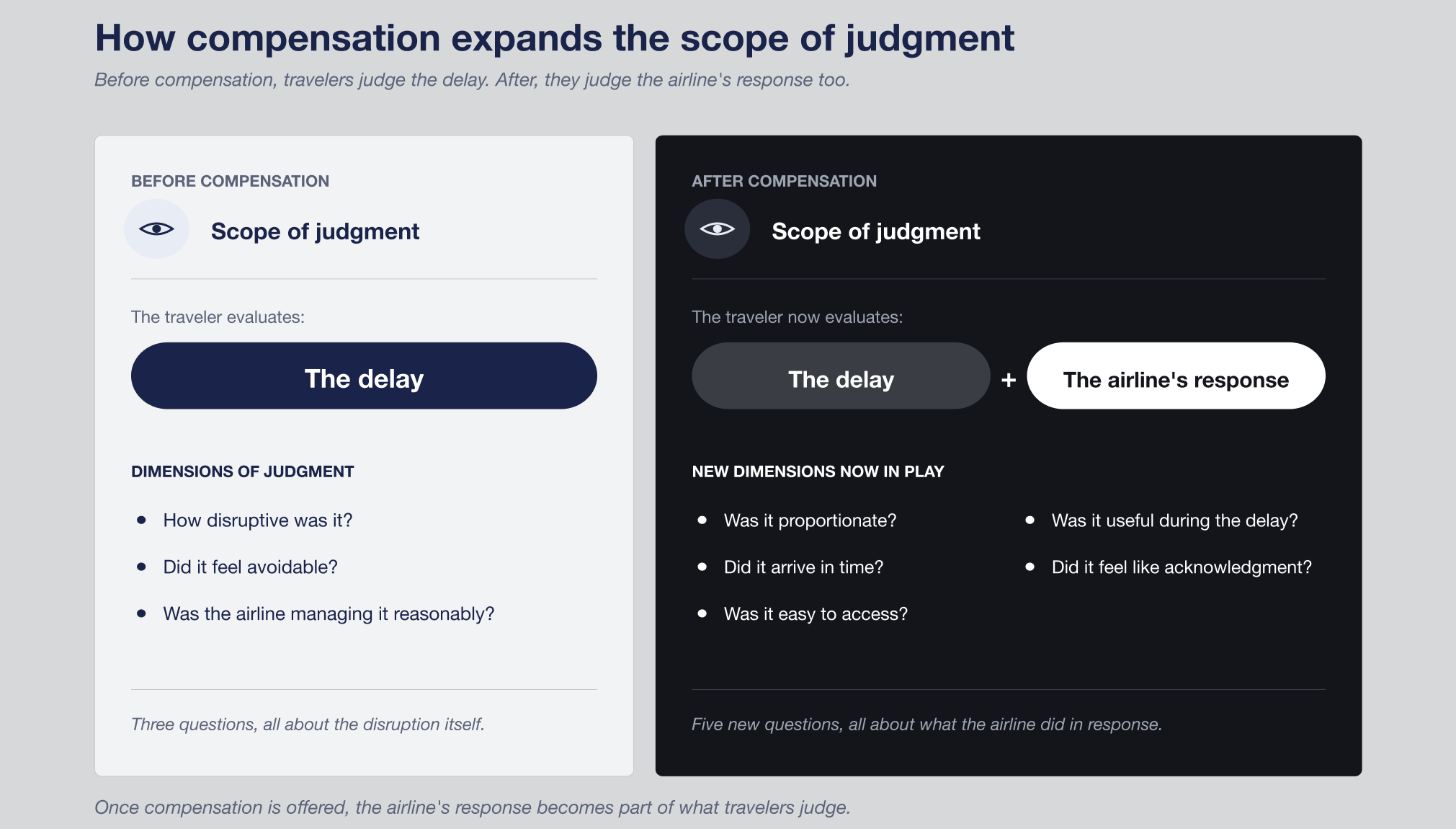
One explanation is that compensation changed the scope of what people were evaluating. Before compensation, travelers assessed the delay itself: how disruptive it was, whether it felt unavoidable, and whether the airline appeared to be managing the situation reasonably. After compensation was dispensed, the scope of travelers' evaluation widened to include the airline's response. Travelers' judgment expanded from the details of the delay itself to questions about the airline's handling of it: Was the compensation proportionate to the disruption? Did it arrive at the right time? Was it easy to access? Was it actually useful during the delay? Did it make the traveler feel that the airline acknowledged the discomfort they had to endure?
Further data corroborated this thesis. Among travelers who received compensation, 57% received it after the disruption had already ended, 52% said it did not help during the delay itself, and 61% said they had to ask for it or actively search for it. Nearly half received digital-only or post-travel value, such as credits or points.
When compensation arrived after the disruption had largely resolved, required active effort to obtain, or could not be used during the delay, it failed to align with expectations around timing, accessibility, and usefulness. This did not simply limit the benefit of compensation; it made the airline's response itself the main object of judgment.
Perceived unfairness developed not simply, or even primarily, from the amount offered. It developed from the response delivery as a whole. Compensation that arrived late, required effort, or could not be used during the delay became abstract rather than tangible, misaligning with the traveler's situation and contributing to lower fairness ratings, even relative to travelers who received nothing.
2. Fairness Peaks Early and Shows Diminishing Returns
Using travelers' evaluations of their most recent delays as a reference point, we then examined how they judged compensation in the controlled scenarios. Plotting fairness, usefulness, and brand impression across these scenarios revealed a consistent pattern: ratings rose sharply with early, tangible gestures — such as snacks or drinks provided around the first hour of delay — then declined quickly and sharply, flattening as delay length increased.
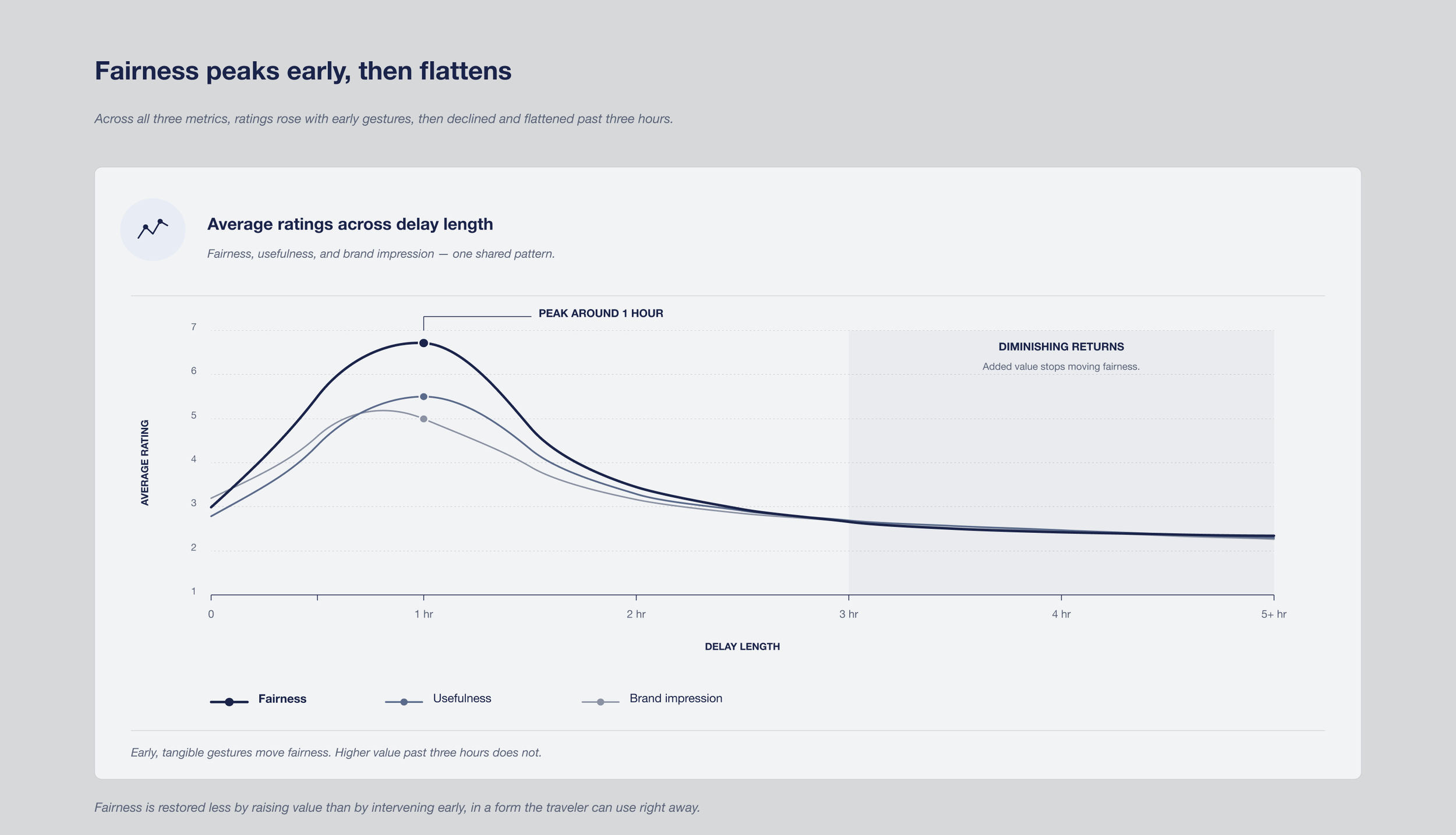
Beyond the three-hour-plus range, increasing monetary value produced diminishing returns. More compensation did not meaningfully improve fairness or brand impression, particularly when delivered in abstract forms such as miles or credits, or when it could not be used during the delay itself.
These patterns indicate that fairness is restored less by increasing value than by timely, immediately helpful intervention. Compensation is most effective when it addresses conditions during the disruption, rather than retroactively attempting to offset loss. Once timing and usability break down, additional value at any reasonable scale yields diminishing returns.
3. Effective Compensation Is Adaptive Across Delay Windows
The results also showed that effective compensation is adaptive across delay windows. Each delay band exhibited a distinct pattern of what mattered most.
For short delays, immediate acknowledgment mattered most. Small, tangible gestures, delivered early, had the strongest impact and outweighed monetary value.
For moderate delays, uncertainty became the dominant factor. Compensation was most effective when it was delivered automatically and required no effort to access. How the gesture was delivered mattered more than how much it was worth.
For longer delays, travelers shifted from noticing individual gestures to judging whether the response as a whole matched the scale of the disruption.
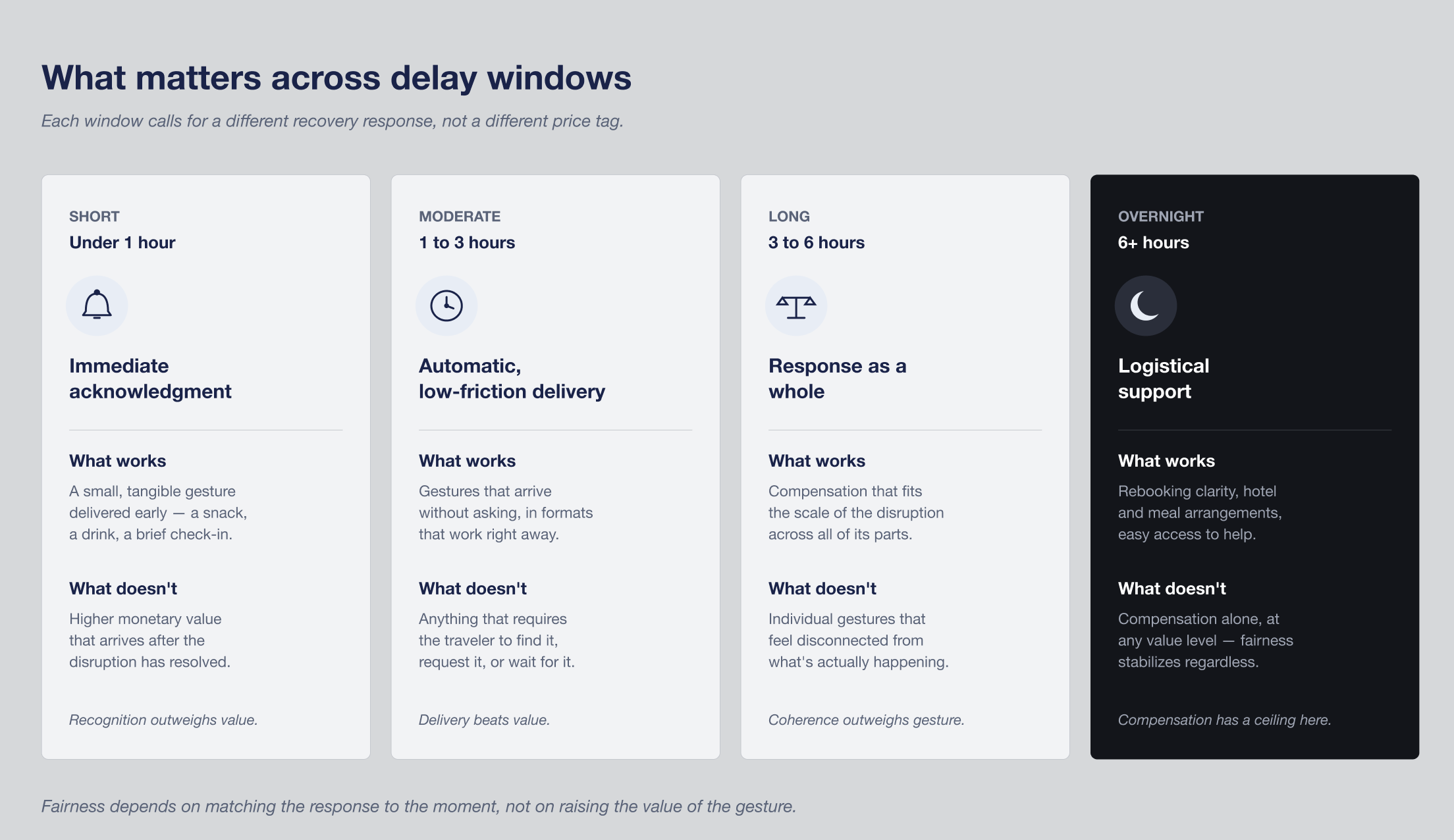
For extended or overnight disruptions, compensation alone had limited influence. Fairness perceptions stabilized over value increases. In this window, perceived effort and logistical support, including rebooking clarity, hotel and meal arrangements, and ease of getting help, drove participants' judgments more than incrementally higher amounts.
This pattern points toward time-banded compensation logic: different delay windows require different recovery responses.
Impact
The work led to several interlocking outcomes:
A behavioral foundation for compensation strategy. This was the first systematic study at United isolating the elements of compensation — timing, format, delivery, value — that move fairness judgments at scale. Compensation became a structured design problem rather than a discretionary spend question.
A shift toward time-banded compensation logic. The research informed differentiated recovery responses across delay windows: early acknowledgment in short delays, automatic and low-friction delivery in moderate delays, response-as-a-whole considerations in long delays, and logistical support beyond compensation in overnight disruptions.
Renewed focus on delivery mechanics. The finding that 61% of compensated travelers had to ask for their compensation, and 57% received it after the disruption had ended, focused attention on the operational delivery system — automatic issuance, app delivery, gate and agent workflows — as a determinant of fairness perception independent of the value of the gesture itself.
A shared frame for finance and operations. The diminishing-returns curve gave finance and operations a common reference point: the same spend can produce different results depending on when and how it lands. The work reframed compensation as a design lever rather than a discretionary make-good cost.
The broader strategic lesson is that service-recovery gestures should not be evaluated only by their nominal value. They should be evaluated by how well they fit the customer's situation at the moment of disruption. A small gesture delivered early and automatically may outperform a higher-value gesture that arrives too late or requires effort to obtain. During a delay, travelers are not only asking, "What did I receive?" They are asking, "Did the airline understand what I needed when I needed it?"