Designing for Uncertainty
A multi-phase research program on how travelers respond to security wait time uncertainty ,
and how pre-arrival information in the mobile app changed their behavior.
Role
Research lead, Customer Strategy & Innovation
Designed and led multi-phase research program
Partners
Digital Products
Airport Operations
Customer Experience leadership
Scope
Multi-year research program
Live pilot of in-app wait-time feature
Summary
Problem
Design
Insight
Impact
3.1M
the largest screening day in TSA history, June 22, 2025.
Summary
Security is one of the most consequential stages of the day of travel and one of the most difficult for an airline to influence. The airline does not operate the checkpoint, yet travelers' experience of it shapes how they feel about the airline and how they plan around their flight. When travelers cannot predict what the security experience will be, they compensate by arriving early, padding their schedules, and turning to whatever information they can find in the hours before departure. I led a multi-phase research program to understand how this uncertainty shapes traveler behavior before they reach the airport, and whether wait-time information delivered through the airline's mobile app could change it. The research showed that the lever is not how long the wait is but how predictable the wait is. Travelers do not need certainty about security to plan around it; they need credible expectations, set early enough to act on. In a 21-day live pilot of a security wait-time feature in the airline's mobile app, 71% of pilot-flight respondents noticed the feature, and observed arrival times shifted later on average compared to comparable non-pilot flights at the same terminals and departure windows. The findings informed how the airline approaches pre-arrival information and shaped the broader design of the mobile app's day-of-travel experience.
59%
of global travelers say they prefer
to arrive at the airport earlier
than they need to.
23%
of passengers actually wait
more than 20 minutes
to clear security.
Sources: Transportation Security Administration, June 2025; Opodo Travel Habits Survey, 2026; J.D. Power 2025 North America Airport Satisfaction Study.
Problem
Airline customer-experience research has traditionally focused on the parts of the day of travel that the airline directly controls: check-in, bag drop, the gate, boarding. Security sits in the middle of that day, but the airline does not operate it. Travelers experience the day as a continuous arc, and security is one of the most emotionally weighted stages within it. When something goes wrong at security, the airline absorbs the dissatisfaction even when the source is not its own.
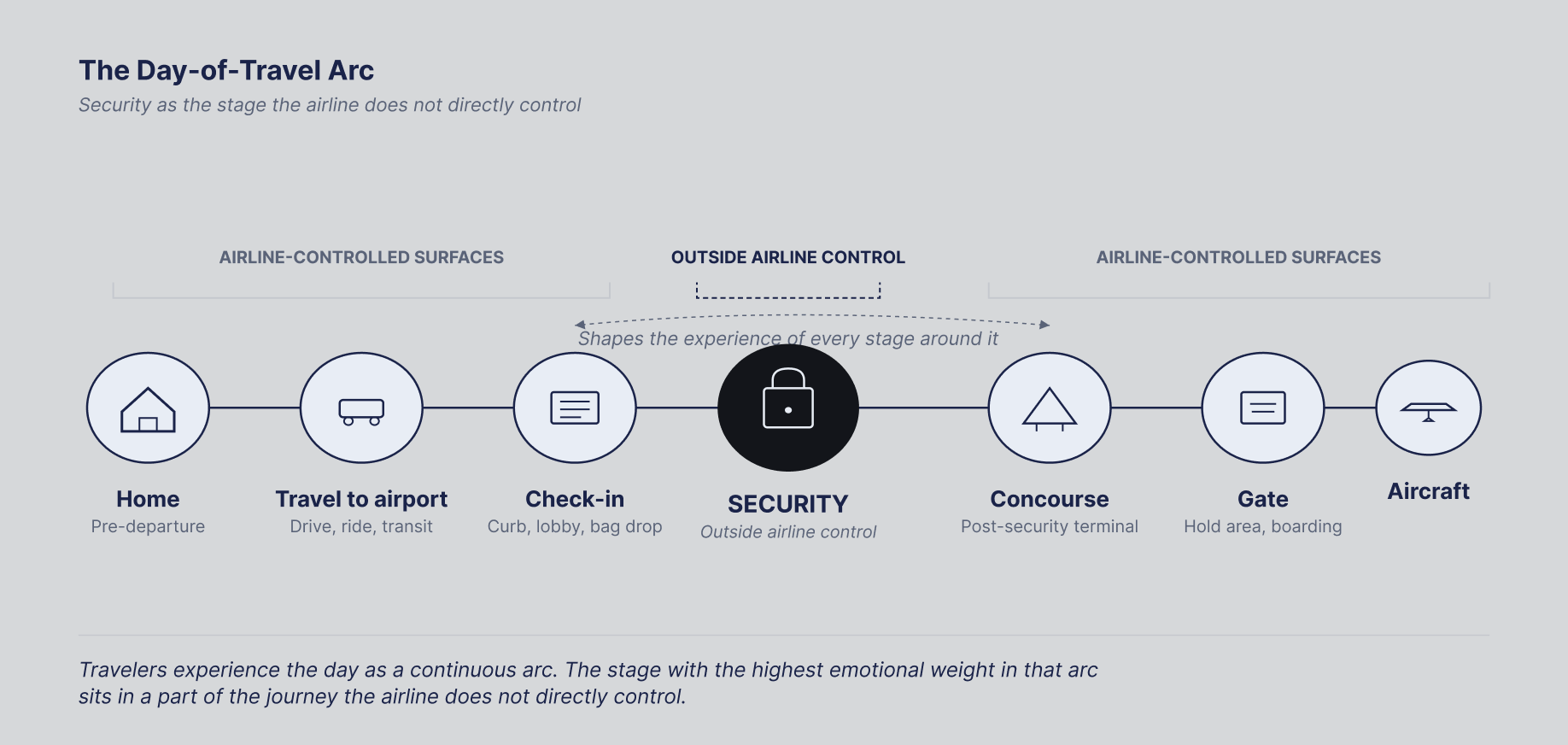
Rising passenger volumes have made the asymmetry more acute. As hubs grow, the airport experience compresses around the security checkpoint: longer dwell times in pre-security spaces, more crowding, more precautionary early arrivals, and more variability in how the experience actually unfolds on any given day. Travelers respond to that volatility the way people respond to any uncertain wait — they over-buffer. They leave home earlier than they need to, they pad their schedules, and they treat the airline app as the place they expect to find out what's going to happen. When the information isn't there, they reach for whatever else they can find — Google Maps, airport sites, the TSA app, third-party wait-time trackers.
This raised a set of strategic questions:
Where in the planning window does uncertainty about security actually shape behavior?
What kinds of wait-time information can travelers trust enough to act on rather than treat as generic signage?
How does the role of that information shift across the planning timeframe — from reassurance to active planning?
Can a mobile-app feature credibly reduce uncertainty enough to change observed arrival behavior at scale?
The broader issue wasn't whether wait-time information is useful. It was whether the day of travel is being reorganized around a different kind of leverage — not faster screening, but more legible uncertainty, set early enough to shape the behavior that produces congestion in the first place.
Design
The research was conducted in three sequenced phases. The first was a generative phase that included traveler interviews, airport intercept conversations, journey walkthroughs, an attitudinal survey, and a synthesis of academic and industry literature on the psychology of waiting and procedural justice. The second was a concept and content testing phase. Earlier rounds tested whether a prototype security wait-time feature could reduce uncertainty across different points in the pre-departure window. Later rounds refined the language, ranges, timestamps, and presentation that travelers needed in order to act on the information. The third was a live pilot of the feature in the airline's mobile app for 21 days, paired with post-security SMS surveys, intercept interviews, and geofenced arrival timing.
The research drew on traveler interviews and airport intercepts across multiple hub airports, an attitudinal survey of travelers in the planning window, concept evaluations of the prototype across pre-departure timeframes, content-testing iterations on labels, ranges, and timestamps, and pilot-window measurement that combined SMS survey responses, intercept interviews, and geofenced arrival data for pilot-flight travelers benchmarked against comparable non-pilot flights at the same terminals and departure windows.
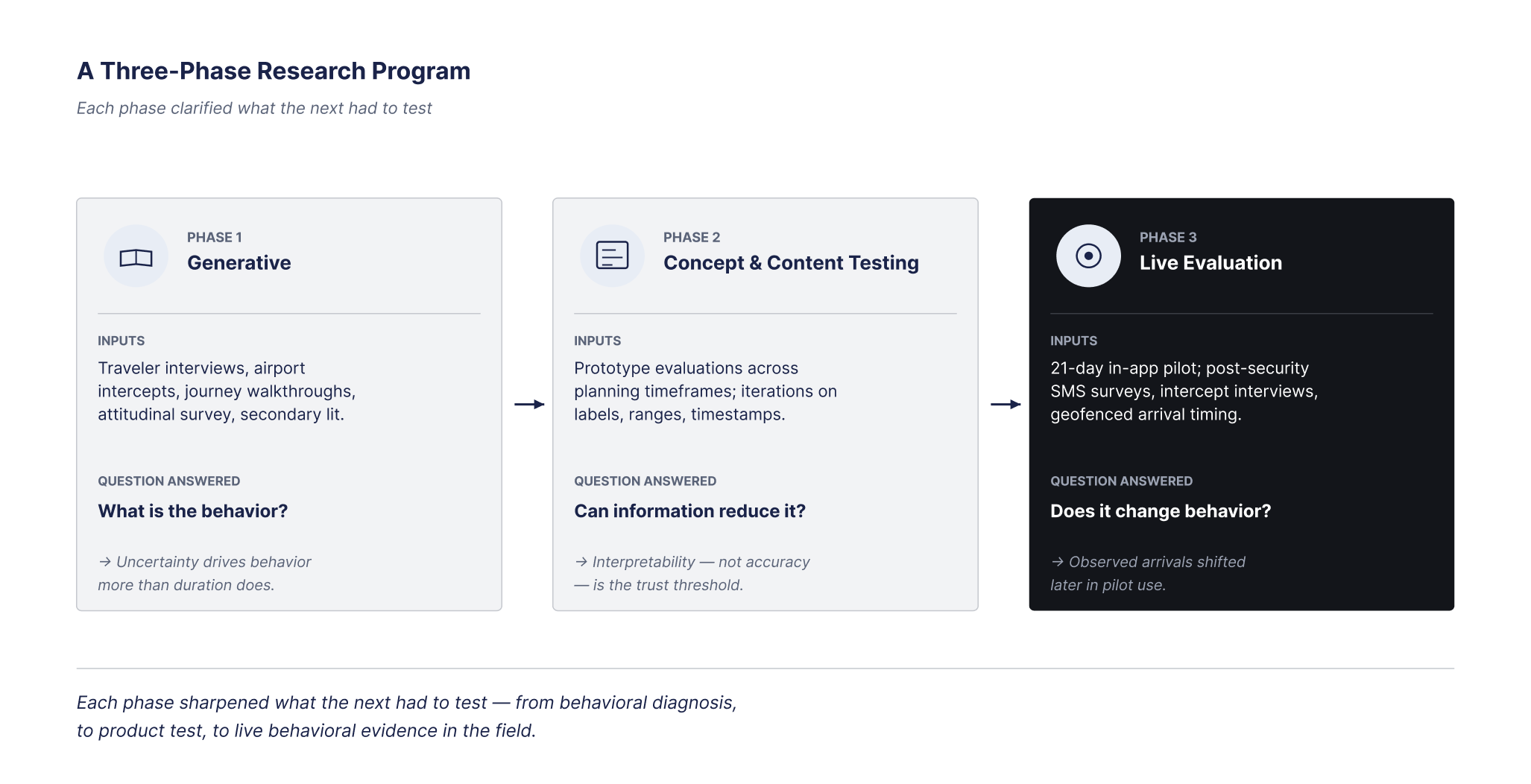
The phased structure was the design decision that mattered most. Each phase clarified what the next had to test. The generative phase established the underlying behavioral pattern. The concept and content testing phase identified what the feature needed to do and how it needed to communicate. The live pilot tested whether the feature, as designed, changed observed behavior in the field.
The analysis focused on four recurring dimensions: when in the planning window travelers engaged with security information, how they interpreted ranges and timestamps, what cues moved them from reassurance to action, and where reported behavior aligned with or diverged from observed arrival patterns. The objective was to identify how uncertainty operates upstream of the security checkpoint and whether a single information surface in the mobile app could change the arrival behavior that produces congestion.
Insight
The research surfaced three patterns about how travelers respond to security uncertainty:
Uncertainty drove behavior more than duration did. Travelers over-buffered against the worst-case version of a wait they could not predict.
Wait-time information played different roles at different points in the planning window: reassurance early, decision support late, and proactive planning across both.
Interpretability, not accuracy, was the trust threshold. When the information was legible enough to act on, observed arrivals shifted later.
1. Uncertainty Drove Behavior More Than Duration
Travelers who did not feel confident about what to expect at security arrived earlier and rated the experience more negatively than travelers who felt confident, even when their actual wait times were similar. The behavior was disproportionate to the duration. Travelers were responding more to the unpredictability of the wait than to its length.
This produced a self-reinforcing pattern. When travelers lacked credible expectations, they compensated by leaving home earlier. Earlier arrival increased dwell time at the airport and sensitivity to small delays. When the wait stretched without explanation, frustration escalated and was often interpreted as unfairness or neglect. That experience reinforced precautionary behavior the next time, and the pattern repeated.
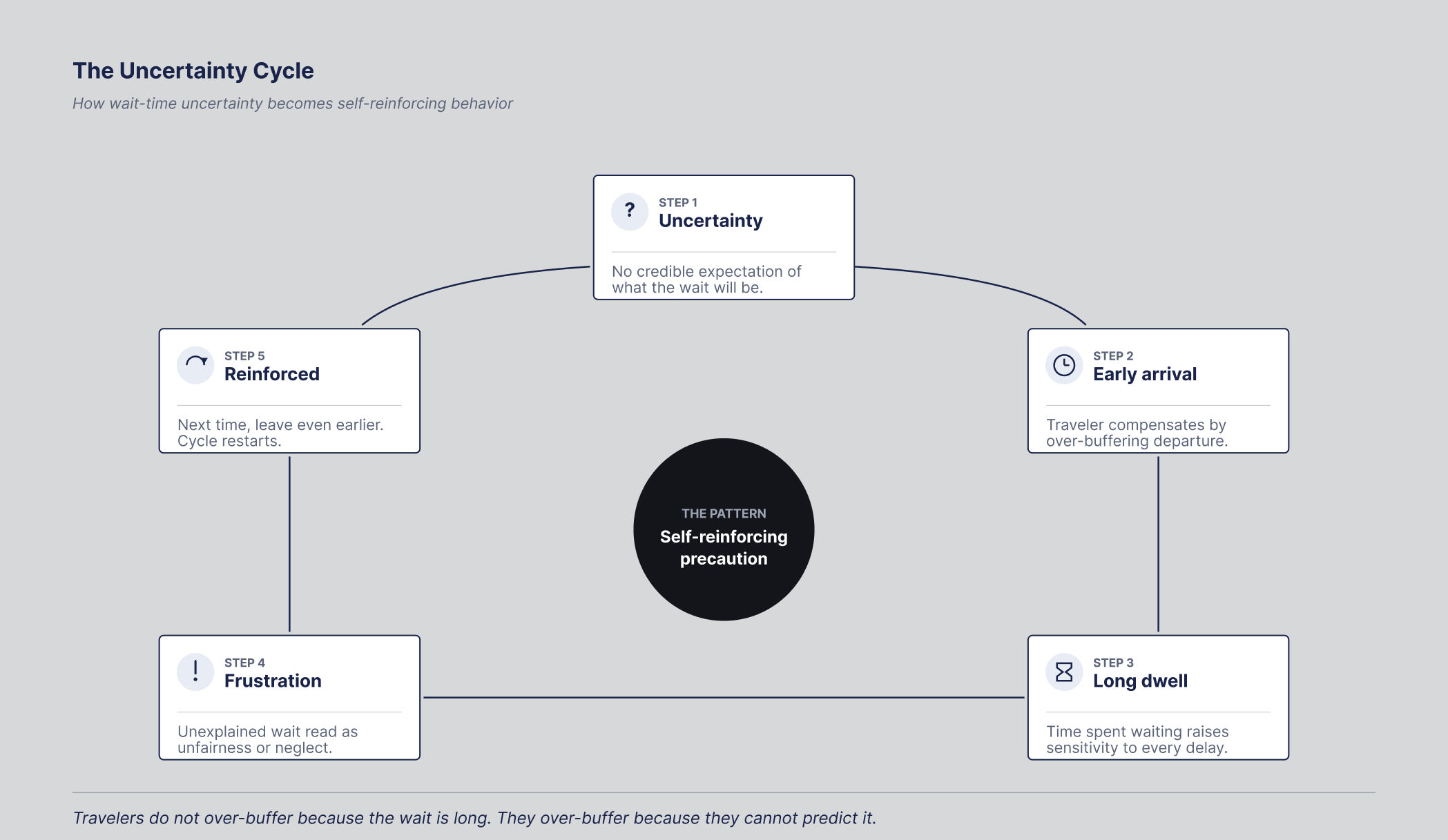
Secondary research on the psychology of waiting helped explain it. Predictability and explanation matter more for perceived control than absolute duration. When travelers can see how a situation is unfolding and understand why it looks the way it does, they can judge risk, time their actions, and decide what to do next. When they cannot, even short waits feel threatening, because there is no stable basis for planning.
The practical implication was that travelers did not need certainty about security. They needed credible expectations, set early enough to plan around and revisable as conditions changed.
2. The Role of the Information Shifted Across the Planning Window
Concept testing surfaced a pattern the original framing had not anticipated. Travelers used the wait-time feature in different ways at different points in the pre-departure window.
Earlier in the window, such as the day before a flight, the morning of, or the drive in, travelers described the feature primarily as a source of reassurance. They were not necessarily changing their intended arrival time. They were checking whether the situation matched their assumptions. The feature reduced anxiety without producing a behavior change.
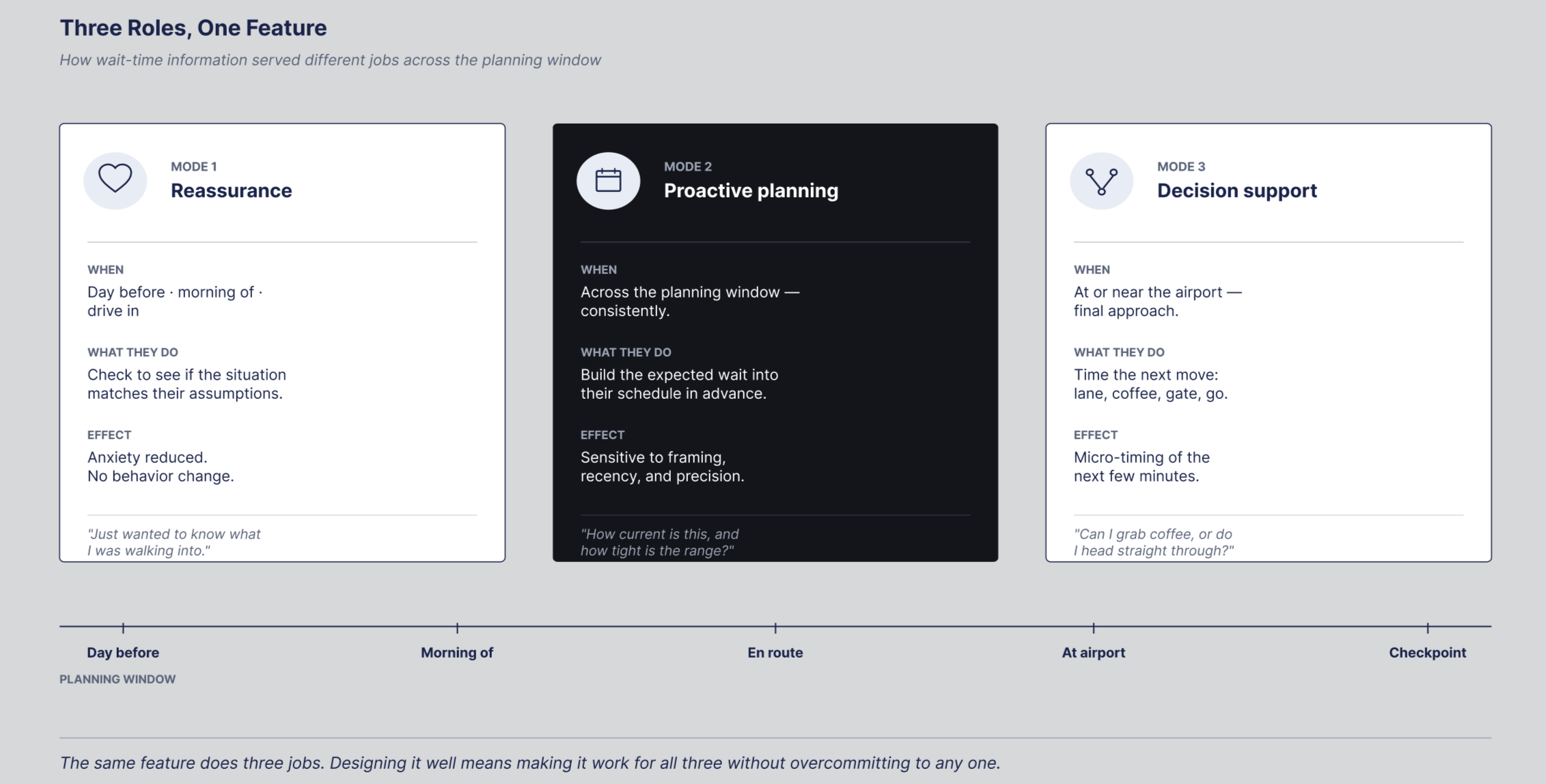
Closer to departure, once travelers were already at or near the airport, the same feature was used as decision support. Travelers were timing the next few minutes: which lane to choose, whether to stop for coffee, whether to head to the gate. The information helped them make small, immediate decisions.
A third pattern ran across both moments. Some travelers used the feature for proactive planning, building the expected wait into their schedule in advance. These travelers were less interested in reassurance and more sensitive to how the estimate was framed, including the tightness of the range, the recency of the timestamp, and the precision of the language. The same information that comforted one traveler could feel imprecise to another.
The feature was doing three jobs at once, and designing it well required making it work for all three without overcommitting to any one of them.
3. Interpretability, Not Accuracy, Was the Trust Threshold
Content testing produced a consistent pattern across iterations. Travelers were not asking whether the wait-time estimate was right; they were asking whether they could tell what it meant.
Point estimates were often read as promises. A single number, such as "wait time: 14 minutes," was interpreted as a commitment, and any deviation from it was treated as the airline's failure. Ranges communicated variability more credibly, but only when the range was tight enough to act on and the framing made clear what the range represented. Timestamps mattered. An estimate without a clear recency cue felt static, while one that read as current felt actionable. Nomenclature that implied precision the system could not support eroded trust on contact.
What travelers needed was greater interpretability, not greater accuracy. They needed to understand what the estimate meant, what it did not mean, and how confidently they could act on it. The legibility of the information mattered more than its precision.
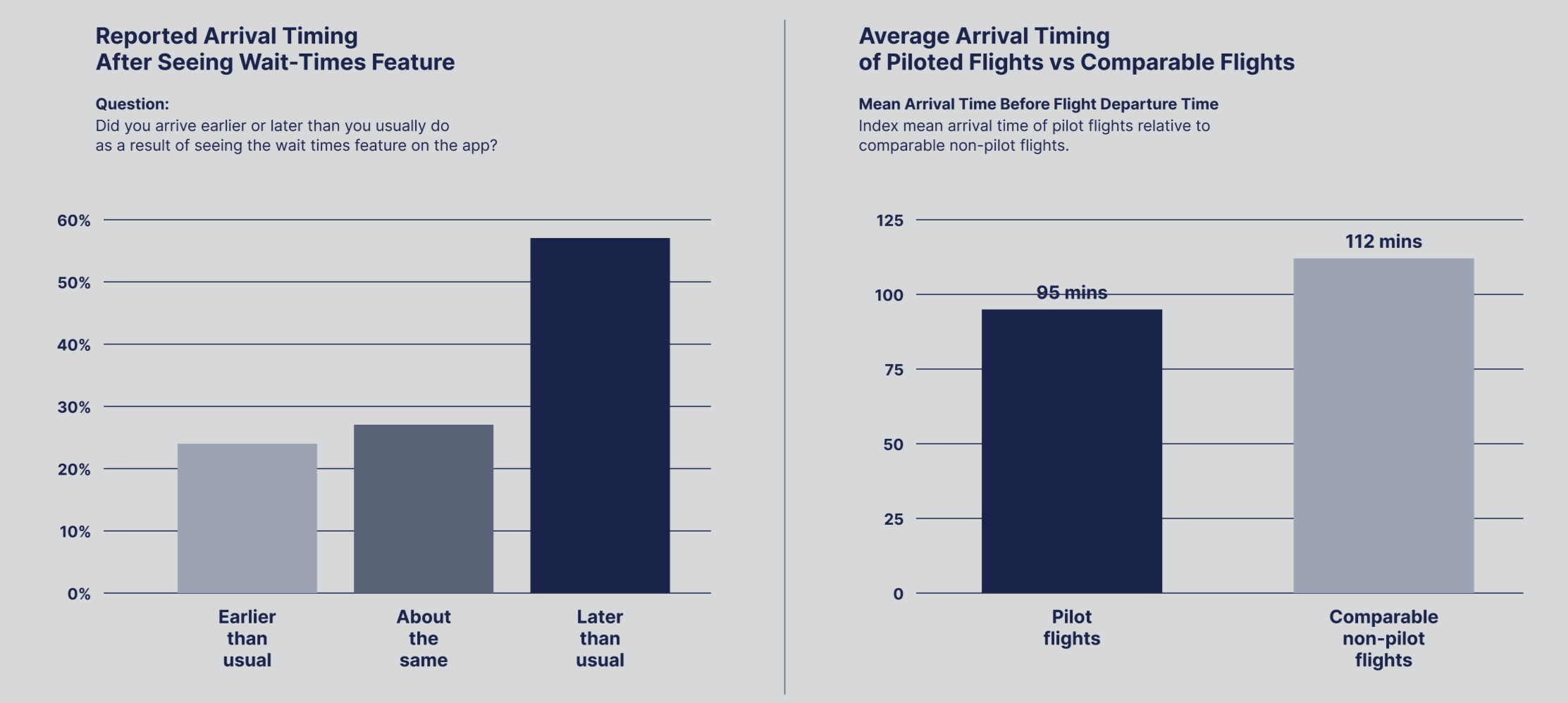
In live pilot use, that legibility translated into behavior. Among pilot-flight respondents, 71% noticed the feature, and a majority of those who noticed it reported using it to help decide when to leave for the airport or how to approach security. The geofencing analysis was consistent with the survey results. During the 21-day pilot window, observed arrival times shifted later on average for travelers on pilot flights compared to travelers on comparable non-pilot flights at the same terminals and departure windows. The pilot's duration and sample size limit definitive conclusions, but the direction of the shift was consistent with both the survey responses and the underlying behavioral model.
Impact
The work produced four outcomes:
A behavioral framework for upstream day-of-travel planning. The findings produced the first behavioral account at the airline of how uncertainty around security shapes traveler behavior before arrival, including arrival time, app engagement, and information-seeking in the hours before a flight.
A live pilot that moved observed behavior. The 21-day pilot produced both reported and observed behavioral shifts. 71% of pilot-flight respondents noticed the feature, and observed arrivals shifted later on average compared to non-pilot flights at the same terminals and departure windows. This was the first behavioral evidence at the airline that pre-arrival information could change how travelers arrived.
A content and trust framework for wait-time information. The interpretability findings, including clear ranges, current timestamps, conservative nomenclature, and framing that makes the level of certainty legible, became reference material for any time-bound information surface across the airline's digital products.
A foundation for adjacent day-of-travel work. The research integrated with a broader study of mobile engagement in the 24-hour pre-departure window and helped shape a new app travel mode. It clarified how security uncertainty fits into the larger pattern of how travelers coordinate between the airline app and outside sources in the final hours before a flight.
The broader strategic lesson is that improving an experience an airline does not directly control does not always require taking over that experience. Often, the higher-leverage move is to reduce the uncertainty around it before it begins. Predictable information delivered early enough to be actionable can reduce the precautionary behavior that produces congestion at the checkpoint, even when capacity at the checkpoint itself does not change.