Designing for Distributed Trust:
Metasearch and Flight-Booking
How comparison work has moved upstream of the airline —
and what direct booking has to receive when customers arrive with the decision already underway.
Role
Research lead, Customer Strategy & Innovation
Designed and led mixed-methods diary study
Partners
Shopping
MileagePlus & Loyalty
Customer Experience leadership
Scope
Foundation for direct booking strategy
Informing comparison-to-purchase handoff design
Summary
Problem
Design
Insight
Impact
76%
of travelers compare prices
across at least three platforms
before booking.
Summary
Flight shopping has always been distributed across channels — search engines, airline sites, OTAs, loyalty programs, credit-card portals, and now AI tools that summarize options before customers ever reach an airline's owned experience. The team had observed a meaningful pattern: customers entering from metasearch were converting at higher rates through downstream booking steps than customers who began directly on the airline's channels. The pattern was clear; its cause wasn't. I led a diary study with 47 recent flight bookers, anchored in real bookings with screen recording and live narration, to understand how customers actually compare flights, decide when to stop searching, and judge whether an itinerary is good enough to buy. The research showed that comparison channels and airline channels support different kinds of trust: metasearch helps customers establish market confidence by surveying the field, while airline sites help them establish purchase confidence by confirming what's actually being bought. The work reframed the conversion gap from a channel-preference problem to a decision-readiness problem — and surfaced where direct booking strategy needs to go as planning increasingly happens outside the airline's owned experience.
37% / 51%
of travelers book directly
with airlines; the majority — 51% —
book through OTAs.
80%
of online travel bookers visit a comparison site before booking — including most who
ultimately book direct.
Sources: Phocuswright; Yodlee Travel Index; Cornell Hospitality Research, 2023–2025.
Problem
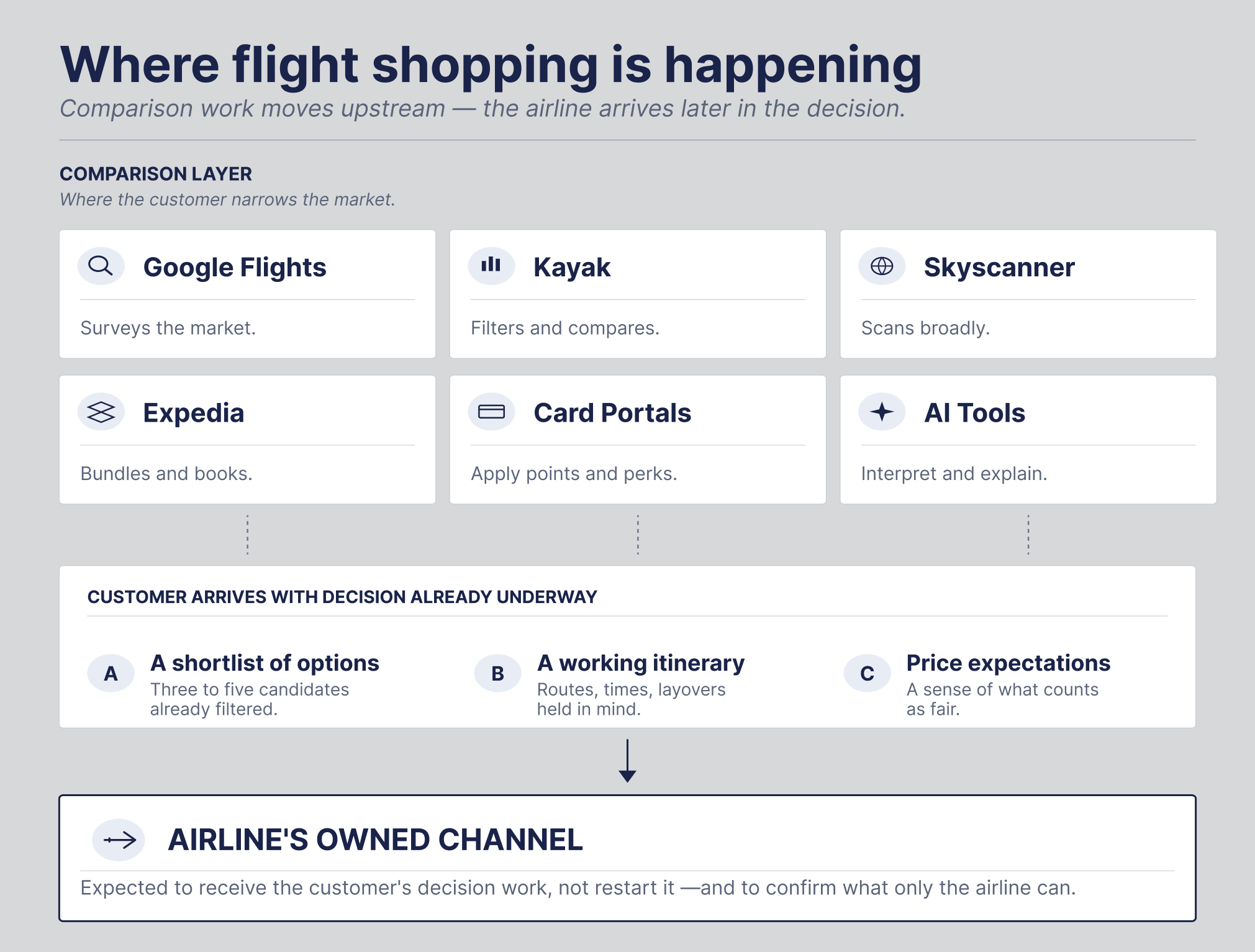
Digital commerce has typically assumed that purchase journeys begin inside the channel that owns the transaction. Customers may research elsewhere, but the working assumption has been that the owned site is where the decision takes shape. That assumption is becoming less stable. Flight shopping now begins across a distributed set of comparison environments — Google Flights, Kayak, Skyscanner, Expedia, credit-card travel portals, and increasingly AI tools that summarize or interpret choices before customers ever reach an airline site or app.
For airlines, this creates a familiar pattern with new stakes. Internal data showed customers entering from metasearch converting at higher rates through downstream booking steps than customers who began directly on United's channels. Meta-originating customers often bypassed Flight Search Results entirely and arrived deeper in the booking flow. The pattern was visible. Its meaning wasn't. If confidence was being built outside the owned experience, the airline still had to understand what kind of trust was being formed there — and what kind still needed to be earned at purchase.
This raised a set of strategic questions:
Where in the flight-shopping journey are customers actually forming their decisions?
What kinds of trust are being created in comparison channels — and what kinds still have to be earned on the airline's site?
What conditions make a customer ready to stop comparing and commit?
How should the airline design the handoff from comparison environments into purchase?
The broader issue wasn't whether comparison tools are influential. It was whether flight shopping is being reorganized around a distributed trust system — one where different channels build different parts of confidence, and the owned channel has to design for what arrives, not what it imagines customers came in cold to evaluate.
Design
The study used a real-booking diary design. Each participant booked a flight they actually needed, on their normal device — mobile or desktop, depending on how they normally shop. During the session, they recorded their screen and narrated their reasoning aloud as they searched, compared, narrowed, selected, and booked. The structure followed three moments in the decision: a starting state (what they had already researched, what still needed to be confirmed), live booking (which tools they used, what created hesitation, what made an itinerary feel good enough), and immediate reflection (what allowed them to commit, what remained unresolved, where ancillary decisions fit).
The final sample included 47 recent flight bookers using their normal tools — Google Flights, Kayak, Skyscanner, Expedia, airline sites and apps, credit-card travel portals, and occasional AI tools. The study generated 47 screen-recorded booking sessions, 47 narrated walkthroughs, structured measures of tool usage, ranked decision factors, sources of difficulty, and confidence drivers, and open-ended responses explaining how those signals appeared in real decisions with real stakes.
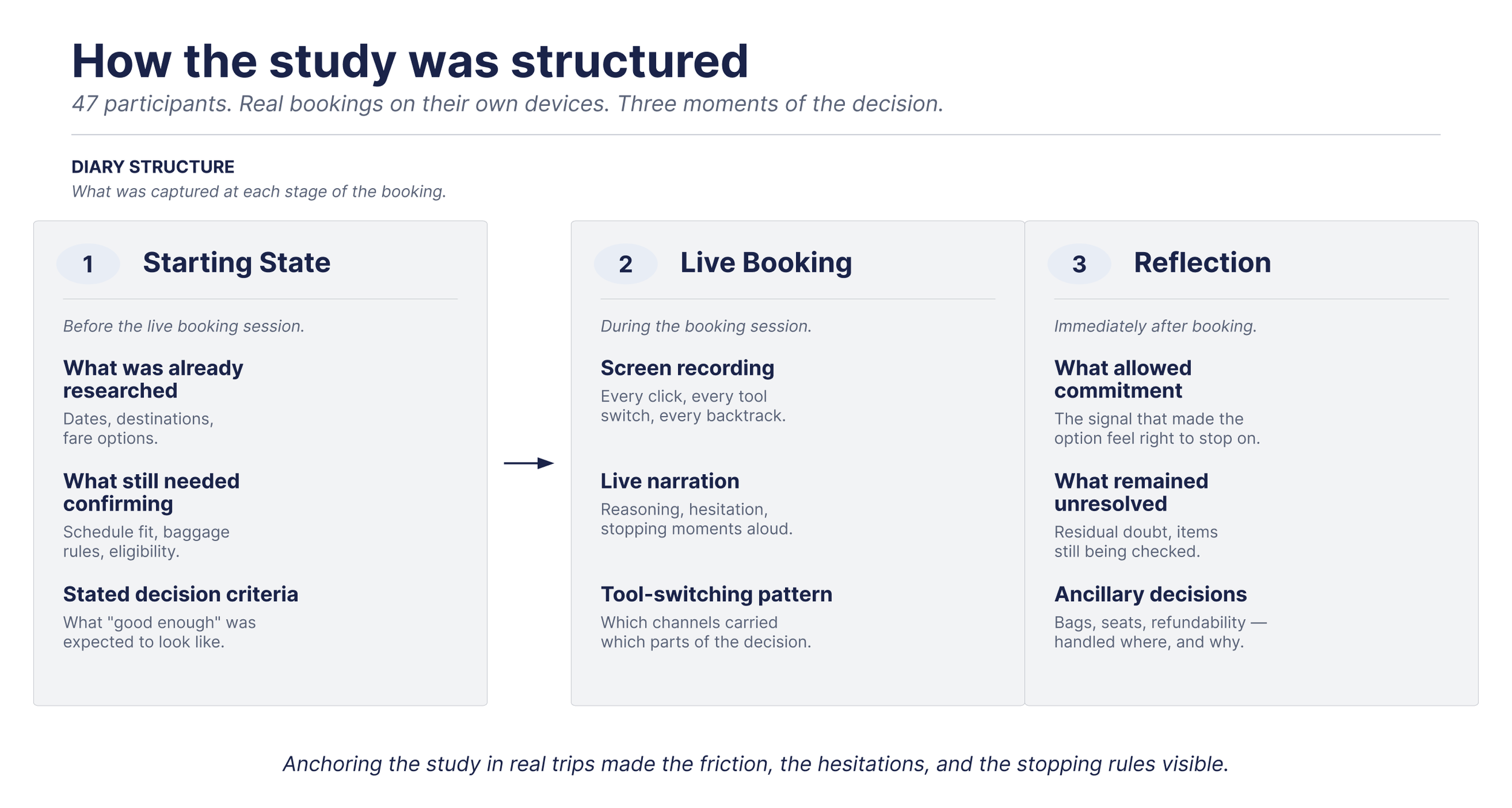
The design choice that mattered most was letting participants book real trips rather than constructing a controlled task. Flight shopping is shaped by tradeoffs — schedule, price, airport, family logistics, loyalty status, work calendar — that don't surface cleanly in a hypothetical task. Asking abstract questions about how someone would book a flight tends to surface stated preferences rather than evidence of behavior. Anchoring the study in real trips meant the friction, the hesitations, and the stopping rules came from decisions that actually mattered. That's what made it possible to see why customers were doing what they were doing — not just what tools they used.
The analysis focused on four recurring dimensions: where comparison work was being performed, which signals helped customers stop comparing and commit, what made the airline site feel like the right place to complete the purchase, and where the handoff between comparison and purchase created friction. The objective was structural pattern finding — identifying how trust is being distributed across the shopping journey, and where the airline's owned channel needs to receive comparison work cleanly rather than ask customers to redo it.
The vision animating the work was simple: a strong direct channel doesn't reproduce metasearch. It receives the customer's market work and completes it with what only the airline can confirm.
Insight
Three patterns emerged, each reshaping where the airline sits in a distributed shopping journey.
Flight shopping was a stopping problem before it was a comparison problem — customers struggled to decide when an option was good enough to commit.
Metasearch and airline channels built different kinds of trust — market confidence and purchase confidence — and neither could replace the other.
Trust was distributed across the journey, but accountability stayed with the airline — and that asymmetry is where the strategic opportunity sits.
1. Flight Shopping Was a Stopping Problem Before It Was a Comparison Problem
Across the study, price and timing dominated the decision — but rarely as a hunt for the absolute lowest fare. Customers evaluated whether a cheaper flight created another cost: a worse airport, an early departure, a long layover, a missed work window, a rental car, a riskier family itinerary. Flight choice was a tradeoff problem before it was a checkout problem.
The most common difficulty wasn't lack of options. It was balancing competing priorities — and a meaningful share of participants specifically reported difficulty figuring out which option was good enough to stop comparing. Customers weren't stuck because they had too few options. They were stuck because too many options remained plausible.
The clearest evidence came when stopping rules broke down. One participant couldn't complete the booking because prices had risen sharply from a fare she'd seen earlier, making every current option feel like a mistake. Another moved across multiple tools — comparison sites, an airline site, promo-code searches, baggage rules — because the trip had to satisfy price, work schedule, direct-flight preference, and bag constraints simultaneously. In these cases, more information didn't create confidence. The missing piece was a stable basis for commitment.
What customers needed wasn't more options. It was a clearer signal that this option, in this moment, is the right one to stop on.
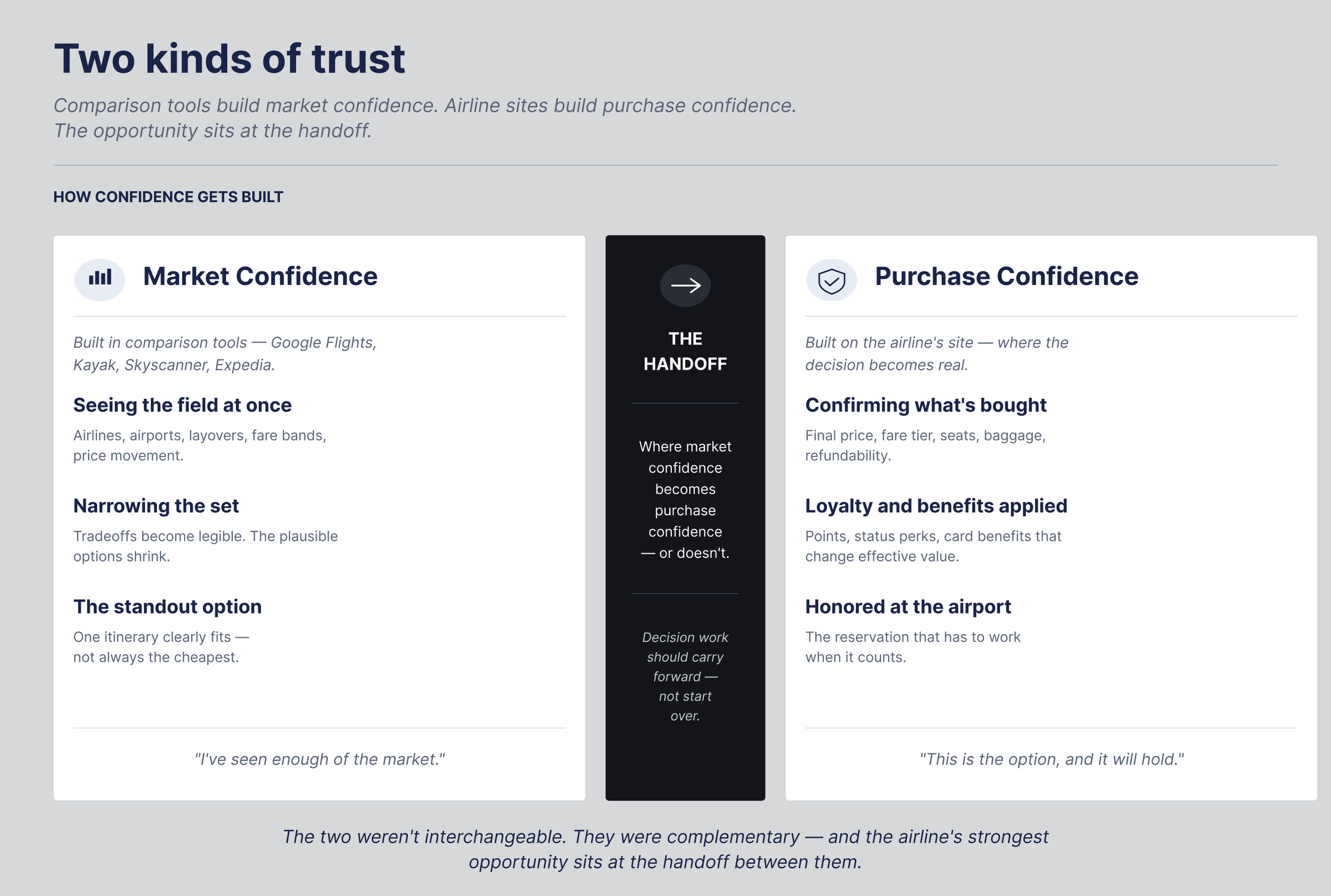
Airline sites and apps carried a different kind of authority. Customers went to the airline to confirm final price, fare tier, seat availability, baggage rules, refundability, loyalty numbers, status benefits, payment, and confirmation. Roughly the same proportion of participants who cited a standout comparison option as a confidence driver also cited confirming final total price and included benefits on the airline site. A separate large share cited understanding rules and add-ons there. Participants repeatedly described the airline site as the place where the decision became real — sometimes after comparing prices on Google Flights or Kayak, sometimes because they distrusted third-party booking, sometimes because of past issues when a reservation or add-on didn't translate cleanly.
This was purchase confidence: the certainty that what's about to be bought is what the customer actually wants — and that it will be honored at the airport.
The two weren't interchangeable. They were complementary. The strategic question wasn't which channel customers preferred. It was how cleanly market confidence could hand off into purchase confidence without forcing the customer to redo their own decision work.
3. Trust Was Distributed, but Accountability Stayed With the Airline
No single source owned trust across the whole decision. When asked which source most reassured them that booking was the right decision, airline sites/apps and comparison tools were essentially tied. Past experience with the airline came next. AI was named by a small minority but consistently — usually for clarifying refundability, checking whether a better deal might exist, or understanding a rule faster than searching policy pages.
Customers trusted comparison tools for visibility across the market. They trusted airline sites for transaction accuracy. They trusted their own past experience for operational reliability. AI was beginning to occupy the interpretive space between them. Each source had a different role.
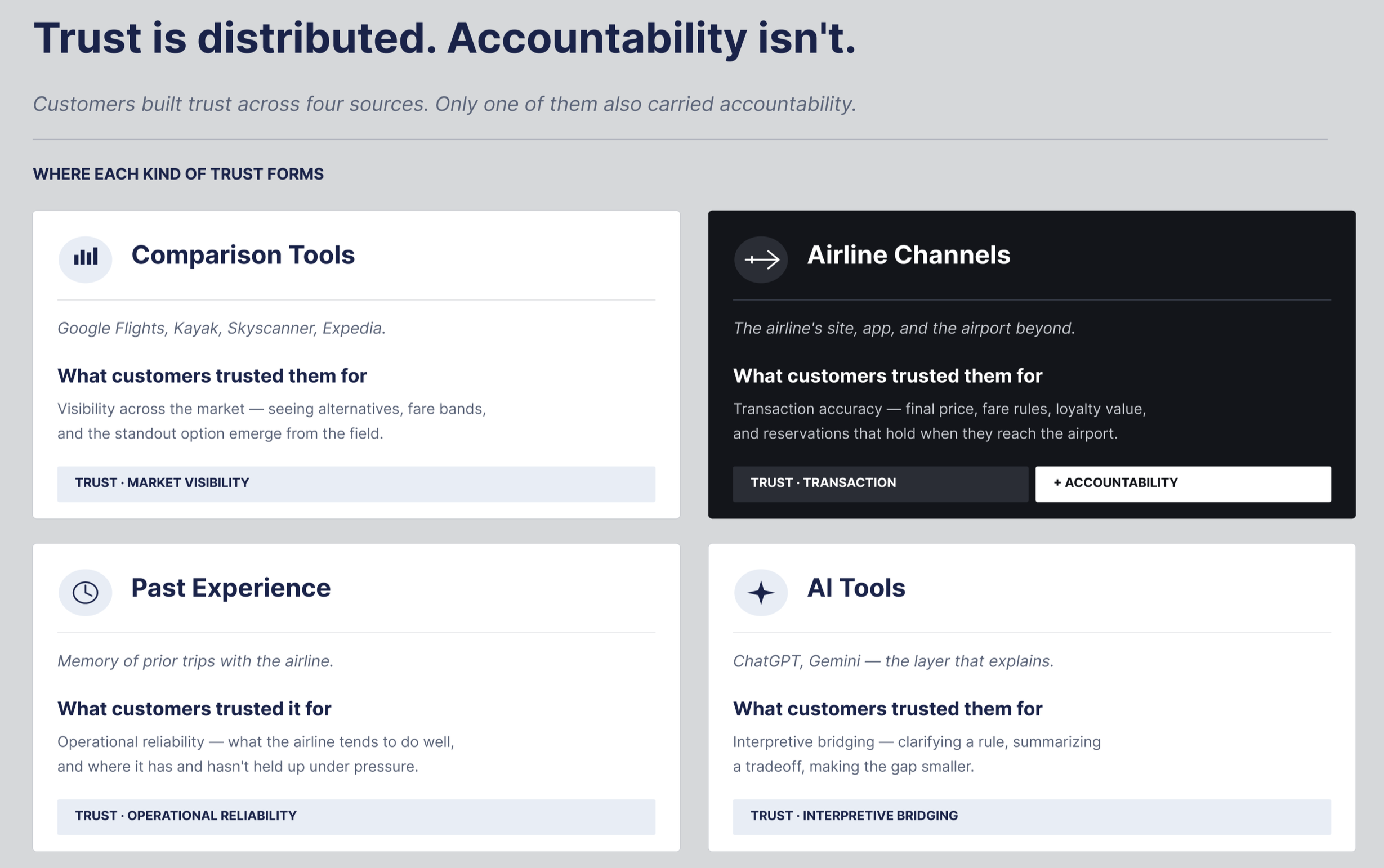
But the asymmetry that mattered most appeared around add-ons and third-party booking. Most participants didn't purchase ancillary options. When add-ons did matter, they were functional rather than discretionary: bags, seat assignment for family travel, refundability, fare tiers that prevented later uncertainty. Comfort-oriented extras rarely shaped the original flight decision. And participants overwhelmingly expected to handle these purchases through the airline. The reason wasn't convenience alone. It was confidence that the purchase would attach correctly to the booking record and could be resolved with the airline if something went wrong. Search platforms were useful for comparison; customers were reluctant to rely on them for anything that had to be honored at the airport.
This is the asymmetry the strategy has to design around. Trust forms in many places. Accountability still returns to the airline. The opportunity wasn't to compete with comparison tools where they're strongest. It was to be the channel that receives distributed trust cleanly — and converts it into something only the airline can guarantee.
2. Metasearch and Airline Channels Built Different Kinds of Trust
Comparison tools played the largest role in narrowing. Most participants used Google Flights, Kayak, Skyscanner, Expedia, or another comparison tool more than any other source during the session. These tools helped customers see the market at once: airlines, airports, dates, departure times, layovers, price bands, and fare movement. The strongest confidence signal in the study was tied to this work — the largest single share of participants said that seeing one option clearly stand out in a comparison tool helped them feel confident moving forward. That standout option wasn't always the cheapest. It could be the flight that best balanced price and schedule, avoided a connection, used a preferred airport, preserved a workday, or made a family itinerary easier.
This was market confidence: the feeling that the customer had seen enough of the relevant market to know which option deserved attention.
Impact
The work led to four interlocking outcomes:
A new strategic frame for direct booking. The conversion gap between meta-originating and direct customers was reframed from a channel-preference problem to a decision-readiness problem. Meta-originating customers were arriving with comparison work already done; direct customers were still doing that work inside the airline's flow. Treating both groups as if they arrived in the same decision state had been obscuring the real opportunity.
Operational guidance on what to mirror, what to assert. The "market confidence vs. purchase confidence" framing surfaced a clearer principle for direct booking design: mirror what metasearch does well in the moments where comparison closure is hardest (price context, fare-inclusion clarity, schedule-tradeoff legibility, cues for when customers have seen enough); assert what only the airline can confirm where it matters most (final total price, fare rules, loyalty value, transaction reliability). The work is now shaping how the Shopping team evaluates direct-channel improvements against the comparison work that precedes them.
A foundation for the comparison-to-purchase handoff. Handoffs from metasearch are being reconsidered as continuity problems rather than entry-point problems. The principle now in use: meta-originating customers shouldn't have to restate their reasoning when they arrive at the airline; the channel should pick up where comparison left off. AI-mediated shopping is being treated as a new layer between comparison and purchase rather than a replacement for either.
A reference point at senior levels. Presented to VP and senior leadership across Shopping and MileagePlus, the research is now embedded in how the team thinks about one of the company's most consequential digital-strategy questions: how to keep customers who increasingly form confidence through independent channels arriving at — and converting through — the airline's owned experience.
The broader takeaway, beyond airlines: customer trust no longer lives in one place. Market trust forms where customers compare. Purchase trust forms where they buy. Relationship trust forms through prior experience with the brand. As planning and comparison continue migrating upstream — and as AI begins to occupy the interpretive space between them — the strategic question for any direct-purchase business isn't whether to compete with comparison channels. It's how to receive the trust they build, complete it with what only the owned channel can confirm, and own the moment when distributed confidence finally converts.