Designing Visible Coverage in the Premium Departure Lobby
* Specific details have been omitted or modified for proprietary reasons.
Role:
Research lead; designed and led a mixed-methods competitive evaluation combining diary research with a large-scale survey; translated findings into strategic recommendations on premium lobby investment.
Partners:
Loyalty / MileagePlus, Airport Experience, Operations, CX leadership
Scope:
Conducted at the direct request of a managing director
mixed-methods study of Delta Sky Priority users (diary study with 11 participants; survey of 170 recent Sky Priority customers) presented to top leadership.
Informing United's self-service-first strategy for the Premier lobby and the expansion of two-stage kiosks in premium space.
Summary
Premium departure lobbies have to deliver two things at once: faster movement through operational tasks and a felt sense that high-value customers are being protected from uncertainty. Internal speculation that Delta had been increasing staffing in its Sky Priority lobbies prompted a strategic question: was Delta's premium lobby advantage real, what was actually driving it, and what should United's response be? I led a mixed-methods study, conducted at the direct request of a managing director, combining a diary study of Delta Sky Priority users completing real airport tasks with a 170-person survey of recent Sky Priority customers. The research showed that travelers weren't evaluating staffing as headcount. They were evaluating whether the space felt covered — lines moving, agents visible, paths legible, exceptions resolvable without customer interpretation. Delta performed strongly on that threshold. But the findings also showed diminishing returns: once customers felt covered, additional staffing mattered less than proactive triage, role clarity, and visible authority. The reframe was that premium lobby advantage isn't built by adding people. It's built by making coverage legible — and that finding now informs United's premium lobby strategy.
Problem Space
Premium check-in areas occupy a complicated position in the day-of-travel experience. They're operational spaces, not hospitality spaces in the traditional sense. Customers enter them to complete specific tasks — checking bags, verifying documents, solving seat or ticketing issues, traveling with minors, or handling same-day changes — under time pressure and before security.
At the same time, these spaces carry a symbolic burden. For elite customers, a premium lobby is one of the first physical confirmations that loyalty status has practical value. If the experience feels fast, calm, and supported, it reinforces confidence in the airline before security. If it feels crowded, understaffed, or indistinguishable from the regular lobby, it undercuts the value of the status promise at the exact moment customers expect differentiation.
The business question was prompted by internal speculation that Delta may have been increasing staffing in its Sky Priority areas. But the more important research question wasn't whether Delta had more agents present. It was whether customers noticed staffing, how they interpreted it, and whether it changed their sense of reassurance, effort, exception confidence, and loyalty-relevant value.
That distinction mattered because a competitive response could easily overcorrect. If the value of visible staffing came from raw headcount, United would need to consider direct investment in premium lobby labor. If the value came from how agents were positioned, signaled, and empowered, the stronger response could involve role redesign, clearer triage, better self-service support, or more consistent premium-lane organization without a blanket staffing increase. The study had to surface which one was true.
Approach
The research used a mixed-methods design to connect what customers noticed in the moment with how a broader sample evaluated the experience after completing real tasks.
The qualitative component was a diary study with Delta Sky Priority users traveling through the airport and completing in-lobby tasks. Eleven participants confirmed orientation; ten completed the core activities. Participants documented the experience across four stages: before leaving for the airport, upon arrival near the Sky Priority area, immediately before engaging with the service environment, and after completing their tasks. The study generated more than 40 video and text-based entries across pre-arrival expectations, environmental pans, staffing reflections, task walkthroughs, comparison to other carriers, loyalty-value reflection, and improvement suggestions.
The quantitative component was a survey of 170 recent Delta Sky Priority users. The survey measured trip purpose, travel party, task type, Delta frequency, Sky Priority usage, exposure to other airlines' premium check-in areas, attribute importance, satisfaction, ease, staff effectiveness, staffing adequacy, status-value reinforcement, and competitive comparison.
The design choice that mattered most was running diary and survey together. Diary research alone would have shown how customers experienced specific moments but couldn't have established whether the patterns were typical. Survey alone would have measured satisfaction and competitive comparison but couldn't have shown what customers were actually responding to in real conditions. Pairing the two made it possible to separate three things customers tend to blend together in memory: the physical organization of the space, the behavioral role of staff, and the psychological feeling of being covered.
What We Found
Customers Were Evaluating Coverage, Not Staffing Levels
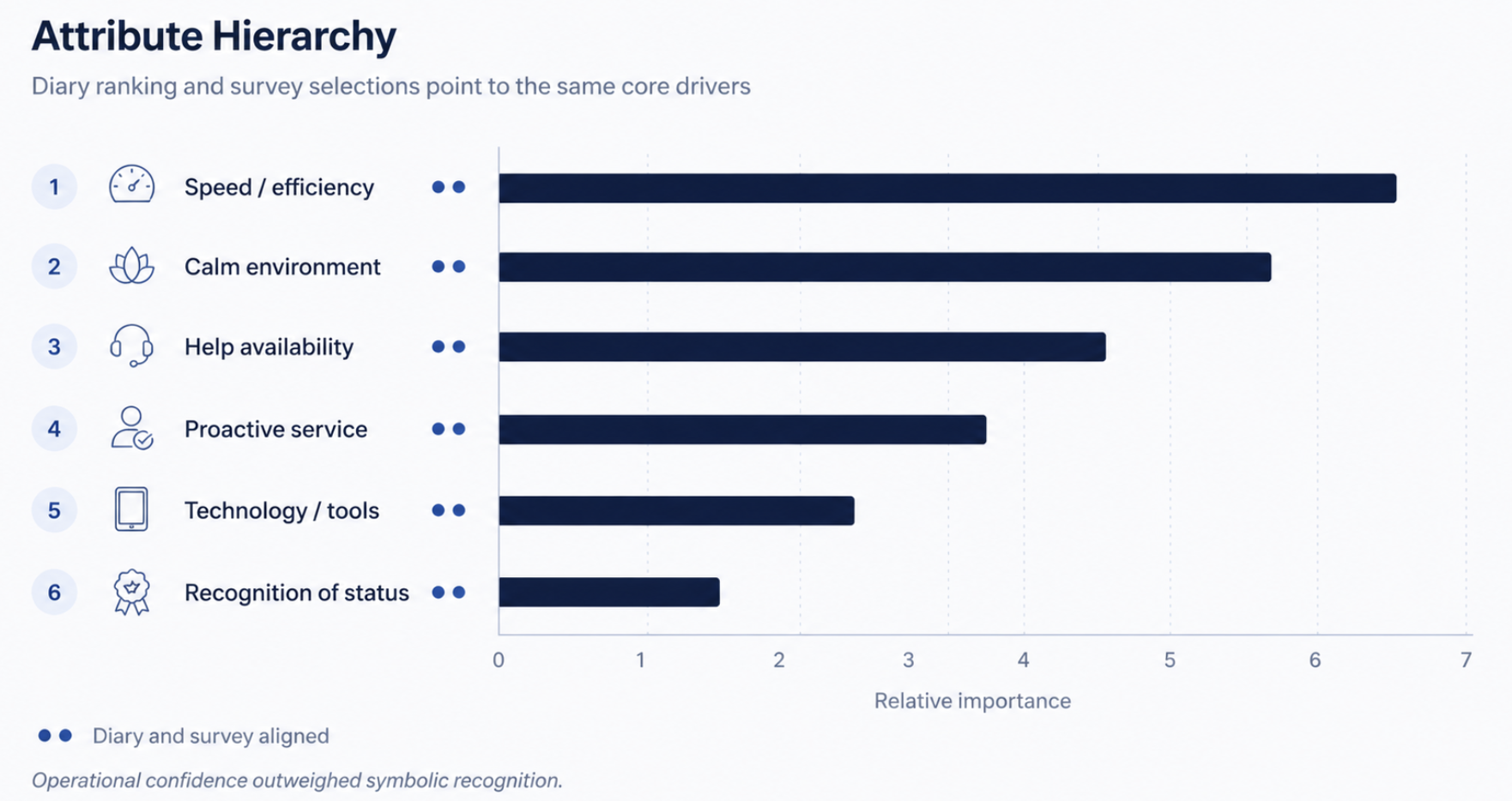
The strongest pattern across both methods was that customers cared most about whether the premium lobby allowed them to keep moving with confidence. The most frequently cited markers of the experience working well were getting through quickly without delays, finding help easily, and the space feeling calm and controlled.
In the diary ranking exercise, efficiency was the top-ranked value, followed by a calm environment and the availability of help. Recognition ranked last. That didn't mean recognition was irrelevant — but it showed that premium value begins with operational confidence. Customers first need to feel that the space will get them through the lobby without unnecessary delay, confusion, or exposure to the regular-lobby crowd.
Performance scores reinforced the pattern. Overall satisfaction with Sky Priority averaged near the top of the scale, and the large majority rated the experience at the highest end. The improvement priorities, however, were spread across multiple mechanisms — shorter waits, easier-to-find employees, more authority to resolve issues, better self-service tools, clearer organization, fewer handoffs, calmer space. No single failure point dominated.
This is the threshold pattern. Once the space feels covered, customers don't appear to demand more staffing for its own sake. What they notice is whether the visible system — agents, signs, lanes, kiosks, counters — lets them proceed without deliberation.
Staffing Mattered When It Made Help Visible Before Customers Searched for It
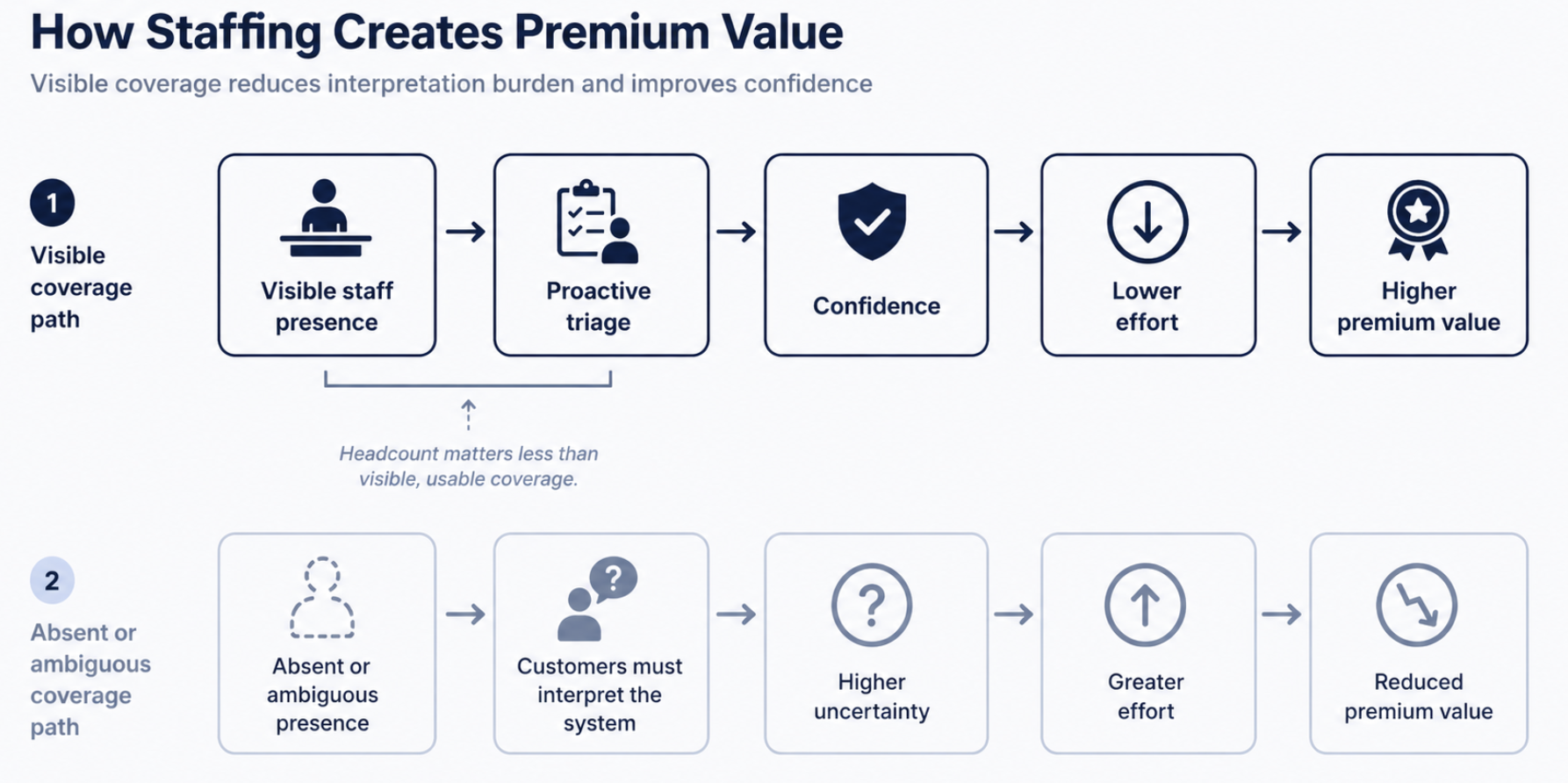
Staffing was highly salient in the diary study, but not because participants were counting agents. They were interpreting agent presence as a signal that the space was under control. When they saw multiple agents, short lines, active direction, or someone positioned near kiosks, they described the environment as calm, reassuring, and likely to move quickly.
The most effective staffing role wasn't passive counter availability. It was visible, active coverage: greeting, sorting, directing, answering quick questions, helping customers identify the correct lane or kiosk, and creating confidence that exceptions could be handled if they came up. The survey supported this — most respondents said an agent was present at entry to greet them, and a meaningful share interacted with staff for tasks beyond bag drop. Of those interactions, some were customer-initiated and some were agent-initiated. That split mattered: proactive service wasn't universal, but when it occurred it was memorable.
The contrast cases sharpened the finding. Several diary participants compared the current trip favorably to past Sky Priority experiences in which the lane existed but didn't feel separately staffed. In those cases, one agent appeared to be running multiple lines, or the regular line moved as quickly, or the premium lane didn't feel meaningfully different. The issue in those weaker experiences wasn't simply "too few agents." It was the absence of visible coverage at the moment customers needed to decide where to go.
In other words, staffing mattered most when it reduced interpretation before a problem occurred. That's a different role from "support" or "backup." It's the work of making the system legible in real time.
Routine Tasks Reached the Threshold Quickly; Exceptions Revealed Where Premium Investment Matters
Most customers entered Sky Priority for routine tasks — bag drops and self-service kiosks. Most completed kiosk tasks independently. Ease was strong: the large majority found completing what they needed easy. For these customers, premium value was largely about preserving momentum. The best experiences were uneventful in the positive sense: short wait, clear lane, quick ID check, bag tagged, status acknowledged, movement toward security.
But a meaningful share of survey respondents interacted with staff for something other than bag drop — extra-bag issues, document verification, international check-in, boarding-pass issues, overweight bags, upgrade or seat questions, ticketing or payment issues, and family or group needs. These are the moments self-service alone can't carry the premium promise. Customers will complete routine steps independently, but they want to know that competent help is nearby if a task becomes ambiguous, if a kiosk fails, if documents need verification, or if a same-day issue surfaces.
This explains why technology performed well but didn't dominate loyalty-value judgments. Kiosks were rated intuitive and easy to use. But in the diary study, no participant selected technology as a top factor in whether the experience reinforced status value. Technology helped customers move. Staffing helped customers trust that movement would continue if something went wrong.
The design implication is that premium lobby advantage isn't a tradeoff between self-service and staffing. It's the deliberate pairing of the two — fast, self-directed routine paths with visibly covered exception paths.
What Changed
The research supported a clear strategic conclusion: Delta's premium lobby advantage wasn't built by visible abundance of staffing. It was built by perceived coverage — the sense that the space was staffed enough, organized enough, and empowered enough to keep customers moving and resolve problems if needed.
That reframe argued against a reactive, blanket headcount response, and it shaped the strategic answer the work was conducted to inform. It confirmed and expanded United's self-service-first strategy for the Premier lobby — with agents understood not as backup support but as visible coverage whose role is to make help legible before customers have to search for it, and to handle exceptions with enough authority that issues don't cascade.
The work informed the expansion of two-stage self-service kiosks in the Premier lobby area — applying the broader ORD lobby commitment specifically to premium space. The two-stage design is structured to deliver fast, self-directed routine paths while concentrating visible agent coverage where exceptions actually surface. That's the operational expression of the core finding: premium lobby advantage comes from making coverage legible, not from adding people.
The work was conducted at the direct request of a managing director and presented to top leadership. The framework — separating cited staffing levels from the underlying mechanism of perceived coverage — is now used internally to evaluate proposals related to premium ground experience. It clarified what the right competitive response wasn't (matching headcount), what it actually was (improving role clarity, proactive triage, premium-lane legibility, and exception-handling authority), and how that maps to United's broader self-service-first lobby strategy.
The deeper takeaway, beyond Sky Priority and beyond airlines, is that customer-cited drivers and value-driving mechanisms aren't always the same thing. Reading staffing levels as the cause when legibility of staffing is the actual mechanism produces investments that look responsive but miss what's working. Premium experience, in particular, often improves more from making the system the customer is participating in recognizable in real time than from adding to it.