Pooling, Fairness, and System Design
in the Day-of-Travel Experience
Summary
Being forced to repack one’s bag at the airport and having to handle and exchange multiple IDs are among the highest-friction points in the travel journey. I led research to understand customer behavior and sentiment around these central friction points, as well as the potential of concepts like pooling—i.e., requiring only one ID per group—and, perhaps more radically, setting baggage weight limits based on the total weight of all checked bags rather than on each bag individually. The research illuminated the scope and sources of each friction point, as well as the strengths and weaknesses of concepts like pooling and price tiering (i.e., charging for extra bag weight in increments). While ID pooling was ultimately adopted because it reduced coordination friction at scale without altering safety or compliance structures, bag pooling was not pursued because its limited exposure did not justify the operational and revenue trade-offs it introduced. The study was a classic example of research informing how to weigh structural change against the scale and constraints of the problem.
Key words: departure lobby, overweight baggage, group ID verification, fairness, pooling, tiered pricing, operational trade-offs, structural change vs. restoration.
* Note: specifics details of this project have been omitted for proprietary reasons.
Problem Space
Some of the peak moments of stress during the day-of-travel experience occur in the departure lobby, when travelers are required to handle personal belongings or identification under time pressure and people waiting behind them.
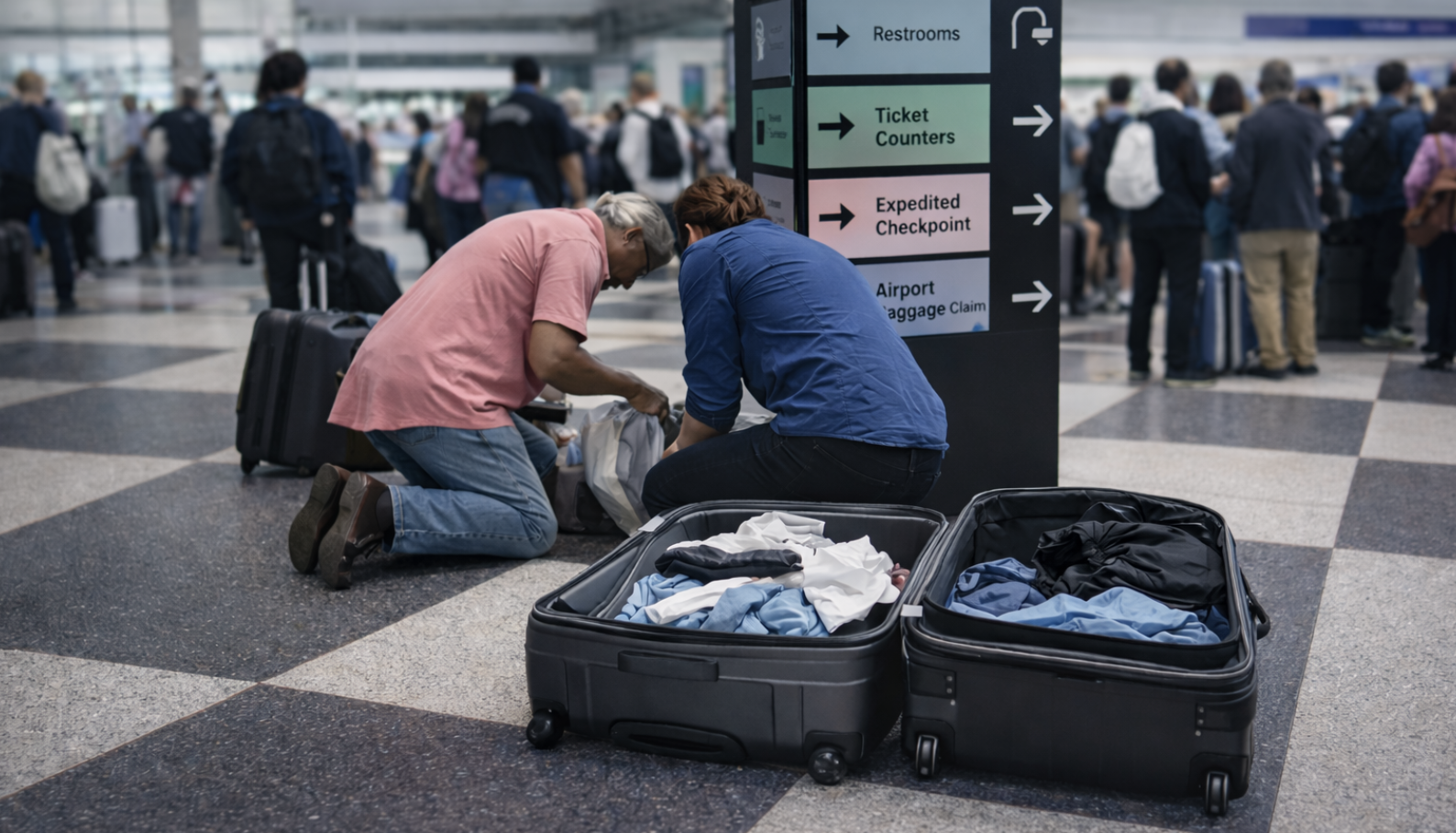
Repacking is the most visible example. Bags are reopened in public, items often redistributed on the floor, and customers negotiate uncomfortable tradeoffs—sometimes discarding personal belongings in order to move forward. A similar tension arises during group ID checks, when families or traveling parties collect, hand over, and redistribute identification, introducing anxiety around loss, delay, or error.
These issues not only disrupt the customer journey, but service agent effectiveness and overall lobby throughput.
Multiple travelers on a shared reservation are especially susceptible to these two issues:
ID verification friction, where each traveler must be processed independently despite traveling as a group, and
Bag weight and repacking friction, where bags overweight and weight must be redistributed or eliminated.
While solo travelers are not immune to repacking due to overweight bags, this problem is more frequent and operationally consequential in group contexts.
The lobby team wanted to explore the concept of pooling as a potential solution to these problems:
ID pooling, which would require agents to only have to check the ID of the reservation holder; and
Bag pooling, which would allow total bag weight to be evaluated collectively rather than per bag.
From a customer experience perspective, pooling promised fewer pre-security disruptions. But it also raised important questions about consistency, unintended incentives, and overall feasibility.
This study set out to determine whether pooling is a viable solution to bag repacking and group ID collection, both operationally and experientially, and what its adoption (whole or part) would mean for the business.
Research Design
The study combined operational-and-NPS dat analysis with ethnography and interviews across customers and frontline staff.
Quantitative:
Day-of-travel data across all 7 hubs and 14 line stations including group travel reservations, multiple checked bags, and overweight bags.
NPS survey data, including a bag-pooling module (May 09–28, 2024; 5% throttle; 384 responses), to help determine the frequency and effect of repacking on experience.
Qualitative:
Field observations at O’Hare, Newark, and Tampa International Airports to document group check in and bag repacking in real time.
Customer interviews (23 total) with group travelers and travelers who repacked.
Service agent interviews (6).
The research first examined how frequently repacking and group ID checks occur, which customers are most affected, how these situations unfold within the lobby, and what operational and environmental factors contribute to their persistence. It then examined the viability of pooling as a solution. In the case of bags, the study evaluated two adjacent concepts—bag pooling and tiered pricing—through the lens of customer reasoning about fairness, cost, and effort.
Research Insights
1. Reorganization and Repacking are concentrated in scope but high in impact.
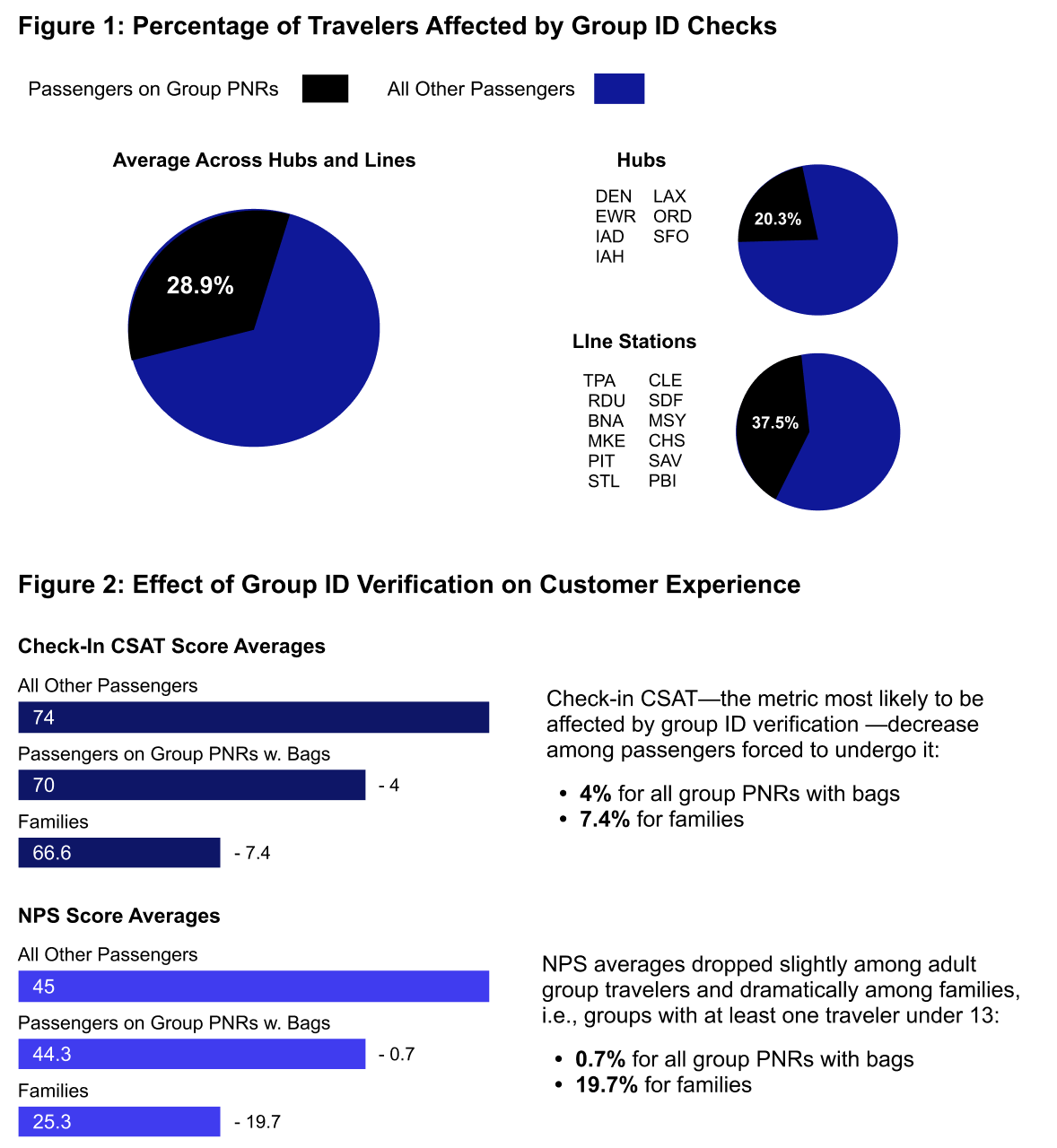
Day-of-travel data indicated that nearly a third of passengers (28.4%) were on a group PNR and therefore likely subject to group ID verification at bag drop (Figure 1). While isolating the precise impact of ID verification alone is difficult, the broader pattern is clear: traveling in groups is associated with lower satisfaction, especially among families with children under 13 (Figure 2). Relative to single-ticket travelers, check-in CSAT declined 4 points for group PNRs and 7.4 points for passengers traveling with children. NPS was largely stable overall but dropped sharply among families (–19.7).
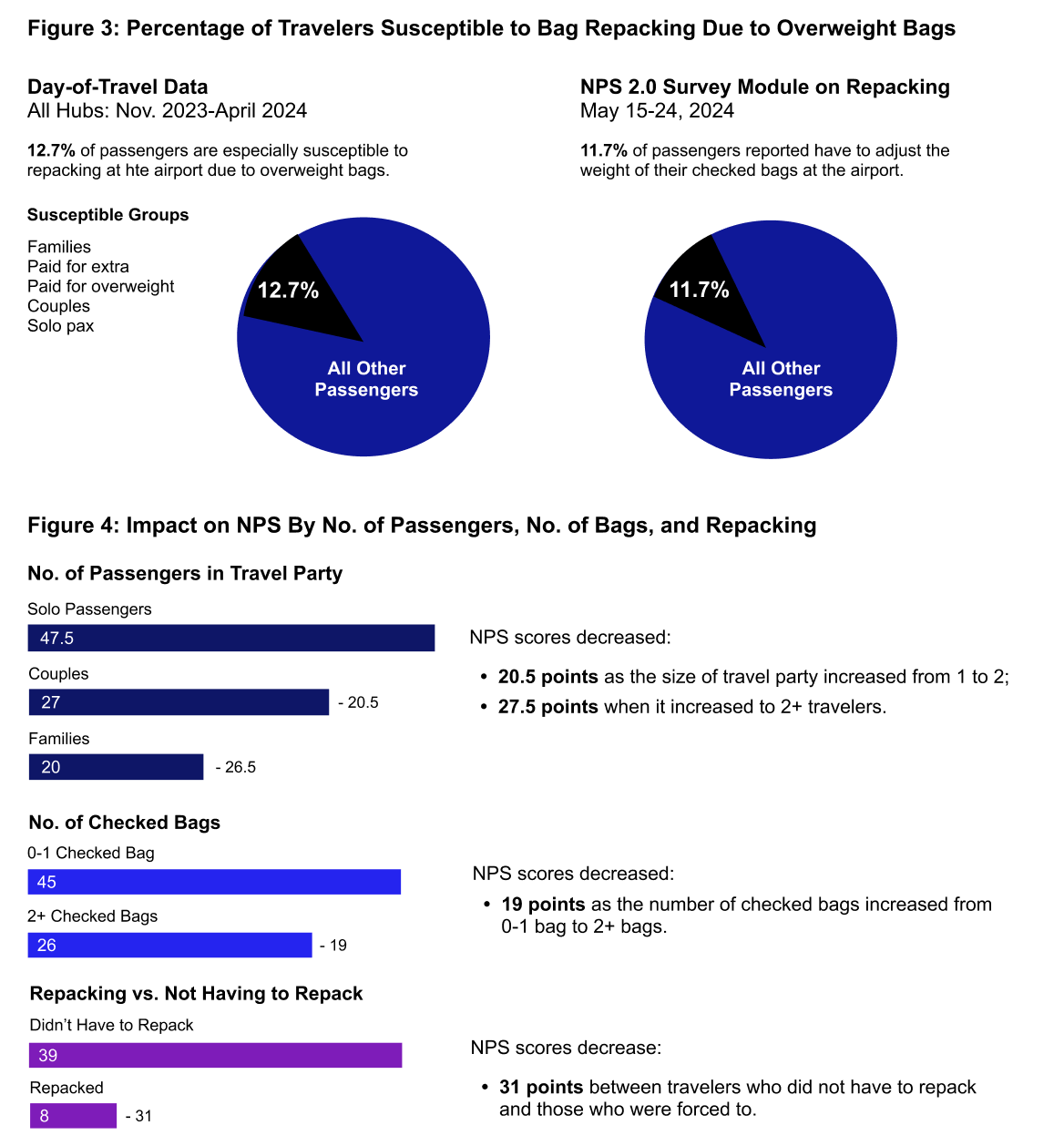
Operational data does not directly capture bag repacking, so we estimated exposure using customer segmentation (e.g., passengers traveling with 2+ checked bags as more susceptible) alongside a targeted NPS module (Figure 3). Day-of-travel indicators suggest that approximately 12–13% of passengers are susceptible to overweight-driven repacking. This aligns closely with survey findings, in which 11.7% of respondents reported having to adjust the weight of their checked bags at the airport.
Although less prevalent than group ID verification, bag repacking—and higher bag counts more generally—is associated with a larger decline in customer experience (Figure 4). Passengers traveling with 0–1 checked bags scored 19 NPS points higher on average than those traveling with 2+ bags. The gap is even more pronounced for repacking specifically: travelers who did not have to repack scored 31 points higher than those who were forced to do so.
Given the broader scope of group ID verification and the smaller operational lift required to implement ID pooling, pooling appeared to be a viable solution in that context. By contrast, the smaller scope and more acute impact on customer experience of overweight bag repacking called for further investigation into why it had such a drastic effect and the extent to which bag pooling could meaningfully reduce its impact.
2. Why repacking produces outsized experience impact.
The NPS responses indicated that most repacking incidents were not extreme cases. Nearly half of affected customers were only 1–3 pounds overweight, and another quarter were 4–6 pounds over. Perhaps surprisingly, the majority of repackers were solo travelers (41%) or couples (38%) rather than large groups or families (10%). This indicates that repacking is usually triggered by modest overages across ordinary traveler types, not by unusually heavy luggage or uniquely complex parties.
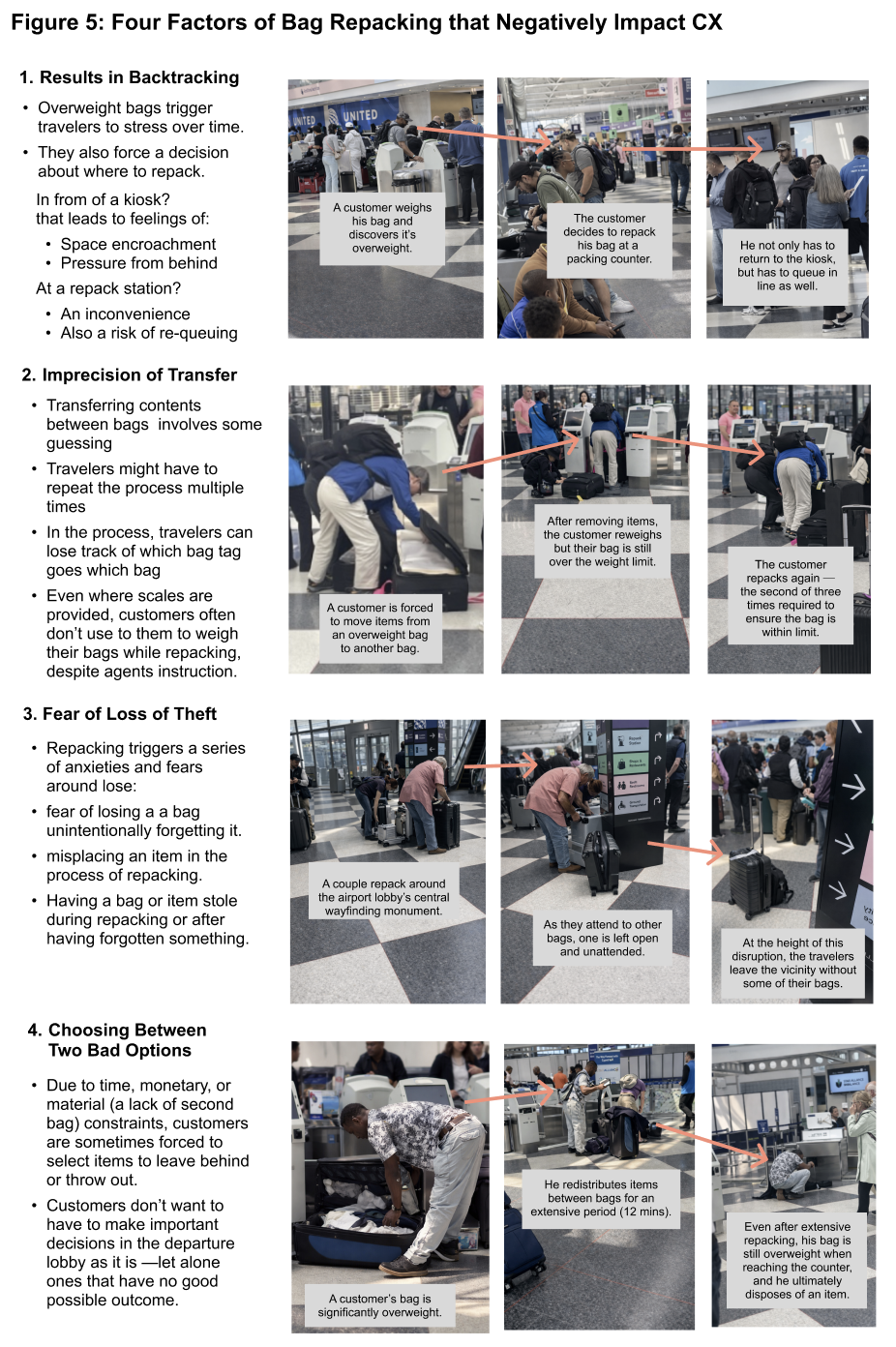
Our ethnographic research identified four recurring dynamics that drive the negative impact (Figure 5): loss of progress; uncertainty in the process; a heightened sense of exposure, including anxiety about losing, misplacing, or even having items stolen while bags are open and attention is divided; and, in worst-case scenarios, the need to make undesirable choices such as discarding personal belongings.
These dynamics, combined with the fact that the majority of repacking instances involve modest overages, suggest that the negative impact stems from what customers perceived as a mismatch between the extent of the violation and the consequences imposed, directly or indirectly.
This raised a fundamental question that drove the remainder of the study: if the impact is shaped by how limits are structured and enforced, what alternative ways of structuring those limits might better align with how people actually travel? That question guided the interview and concept-evaluation portion of the research.
3. Customer priorities center on progress and efficiency flexibility alone.
Most interview participants understood and accepted the validity of strict bag weight thresholds for safety and operational consistency. The main reason for past repacking incidents was not a lack of knowledge about the limits, but the variability involved in travel preparation—weather uncertainty, destination needs, inconsistent enforcement across trips, and discrepancies between home and airport scales. Although some participants acknowledged overpacking due to prior lax enforcement, repacking was rarely the result of an attempt to game the system; more often, it was a byproduct of the variability inherent in travel conditions, both at the airport and at their destination.
When asked how the baggage experience could be improved—without being provided any suggestions—the vast majority of participants proposed some version of tiered pricing: the idea that incremental weight above the limit should incur incremental additional cost (Figure 6). Only 3 of 23 total interview participants (across intercept and moderated interviews) suggested something resembling bag pooling.
The fact that most participants unprompted suggested price tiering as the best solution aligns with the finding that most repacking instances involve small weight violations. The suggestion reflected a practical priority: avoiding disruptive corrective action late in the check-in process. Price tiering reflected an instinct to preserve forward motion at minimal cost.

However, once bag pooling was introduced and clearly explained, reasoning shifted. Customers recognized that pooling addressed the problem earlier in the chain. By allowing combined weight across bags, pooling reduced the likelihood of triggering repacking at all—and therefore reduced the likelihood of additional payment.
Many customers saw the two solutions as complementary: pooling reduced the probability of failure, while price tiering managed the consequences only if bags still exceeded limits after pooling and any necessary adjustments. Price tiering was also seen as more acceptable when supported by pooling.
Strategic Impact
1. When Customer Logic Meets System Constraints
The study helped clarify the customer psychology around bag-weight limits, uncovering views about the legitimacy of weight thresholds, the fairness of the current system, and what ideal fairness looks like. It also clarified how customers think about flexibility (in the form of pooling) and efficiency (in the form of price tiering) during the day of travel.
In the process, the study also brought into clearer focus the operational and business stakes.
Will pooling actually reduce repacking, or simply shift where limits are enforced?
If tiered pricing becomes routine, will overweight behavior normalize??
How much flexibility can be introduced before revenue drivers and safety controls begin to erode?
With a clearer grasp of customer attitudes towards weight limits and bag repacking, the product team was better able to weigh the tradeoffs embedded in these interwoven questions.
2, Diagnosing the Right Level of Intervention
The research reinforced that not all friction warrants structural overhaul.
In the case of group ID verification, the intervention matched the scale of the problem. The previous system created recurring coordination work that affected nearly a third of travelers, as well as the agents serving them. ID pooling could clearly reduce structural inefficiency while eliminating an operational risk.
By contrast, overweight baggage exposure is limited in scope (<12% of passengers) and bag pooling would require substantial changes both digitally and physically, including kiosk flows, agent interventions, and weight-scaling controls.
The findings led to the implement of ID pooling. In place of bag pooling, the lobby team pursued a renewed policy of weight-limit enforcement through agent training.
3. CX Strategy in Constrained Systems
The study brought into focus a recurring tension in day-of-travel design. While digital adoption continues to eliminate long-standing inefficiencies across the customer journey, some sources of frictions—especially ones more physical in nature—elude clear solutions. Addressing them often requires deciding how much flexibility a constrained operational system can absorb without undermining its coherence.
In such contexts, customer experience strategy is not about removing every painful moment, but rather determining which moments justify structural change and which require restoring clarity and consistency within the existing system.