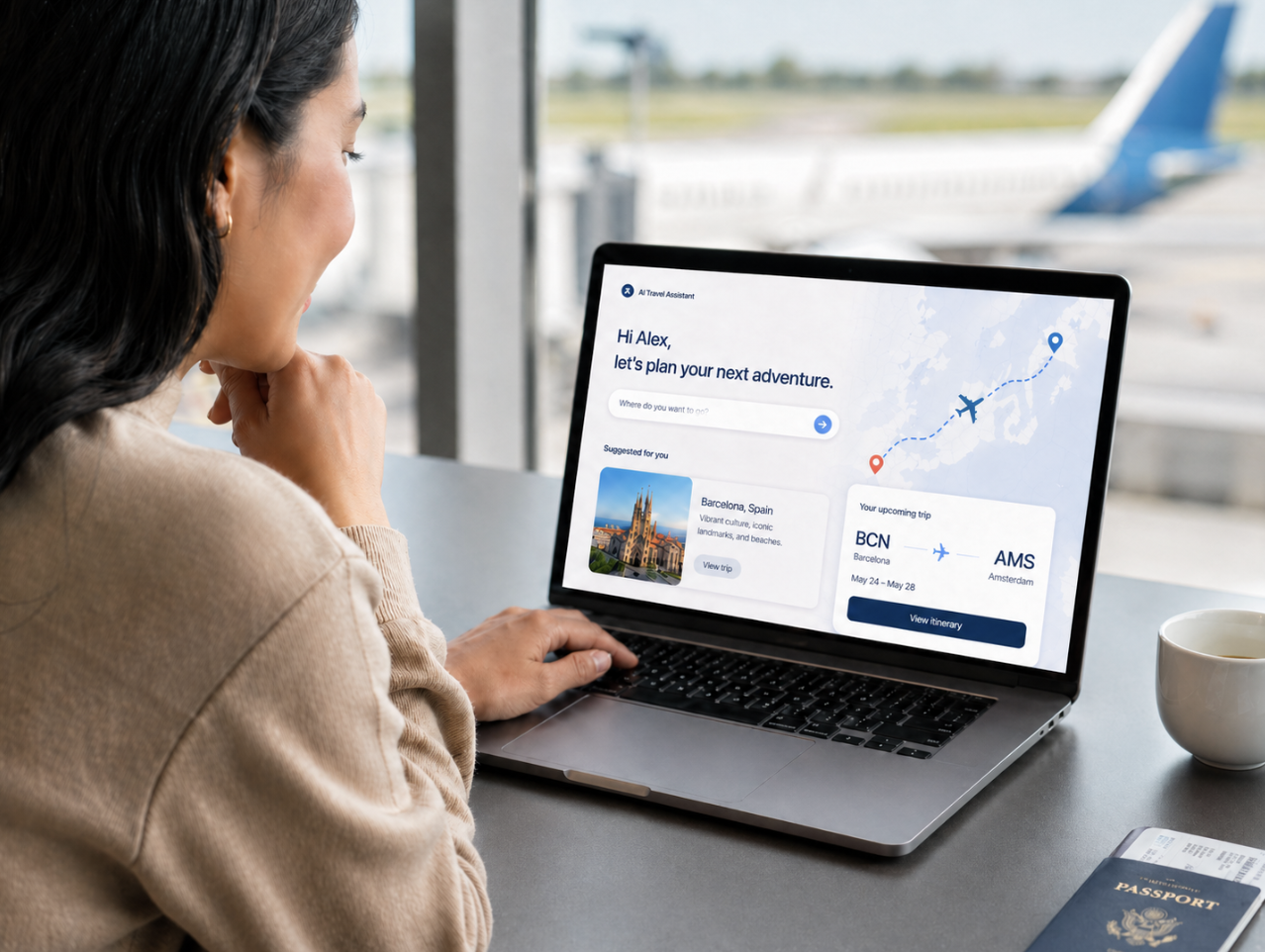
How AI is Reshaping the Travel Journey
How generative AI is changing how customers explore, plan, and decide about travel.
Role
Research lead,
CX Strategy & Innovation
Partners
Shopping
Digital Products
Scope
Foundational research
for internal AI CX strategy
* Certain details have been omitted or modified for proprietary reasons.
56%
of US travelers used AI for
trip planning last year.
74%
of millennials now use AI
for travel planning.
7%
of AI users find AI answers
alone sufficient.
Source: Phocuswright, March 2026.
Summary
Generative AI is reshaping how people approach travel. It has generated new ways of thinking about travel exploration, comparison, and planning that customers carry into every channel they reach afterward, including the airline's.
I led a study of AI-assisted travel conversations to understand how it is changing the travel experience from planning to the day of travel itself. The research showed that customers reach airline channels not just with shortlists and rough itineraries, but with mental models of the trip that AI helped construct.
The findings offer a new lens for understanding how travelers' intentions, preferences, and decisions are now being shaped by AI — and how airlines can adapt to remain part of how the future of travel takes shape.
Problem
For much of the last decade, airline digital strategy has been aimed at helping customers move between external and internal channels — guiding them from external entry points like search engines and online travel agencies, and coordinating with airport channels like maps and TSA. While driving discovery within owned channels has always been a focus, the broader digital landscape has been relatively stable, each channel playing a recognizable role in a customer's decision-making. Generative AI complicates this landscape in ways airlines are only beginning to understand.
While we know customers are using AI to navigate travel decisions, how exactly they are using it is both evolving yet unmapped. Part of the challenge is the open-ended capacity of generative AI itself. Unlike traditional external channels like OTAs or metasearch platforms like Google Flights, tools like ChatGPT and Claude let customers move seamlessly back and forth between exploratory thinking and concrete decisions, and anywhere in between.
More than simply displaying options, AI can generate perspectives on them — producing itinerary structures with rationales that speak to customers. It can surface tradeoffs the customer hadn't articulated and can build working theories of a trip in concrete detail: what fare bundles make sense, which airports are best, what an ideal itinerary looks like. Customers absorb those theories whether or not they're aware they're doing it, and carry them into their relationship with their airline of choice.
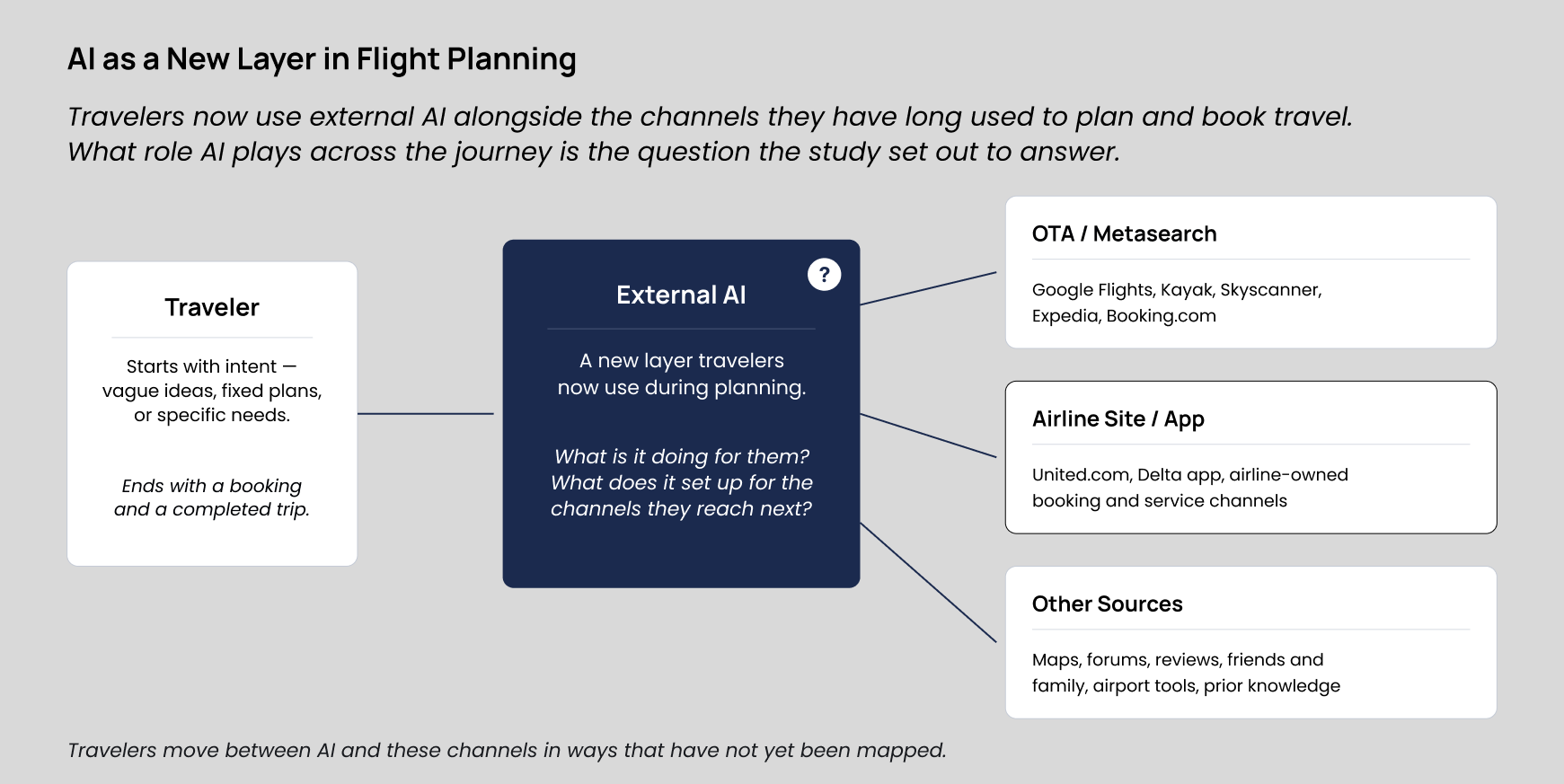
To understand the role AI plays across the travel journey, the study addressed:
Where in the travel journey are customers actually using AI?
What are they asking it to do, and what is it giving them back?
Which outputs increase their confidence, and which still require verification elsewhere?
What expectations, plans, and assumptions are AI-using customers bringing with them into the airline channel?
Answering these questions, and understanding the new role AI plays as an entirely new type of channel in the customer-airline relationship, is central to how airlines should be designing both to meet customers inside the AI tools where planning is increasingly happening, and to receive them when they arrive at owned channels with that planning already underway.
Design
The study used a retrospective artifact-based diary design to capture and examine real AI conversations about travel. It consisted of:
38 participants, each contributing one recent AI-assisted travel conversation
Conversation transcripts paired with screen-recorded walkthroughs and structured reflections
Coverage across the full arc of travel planning, from destination research through in-trip support
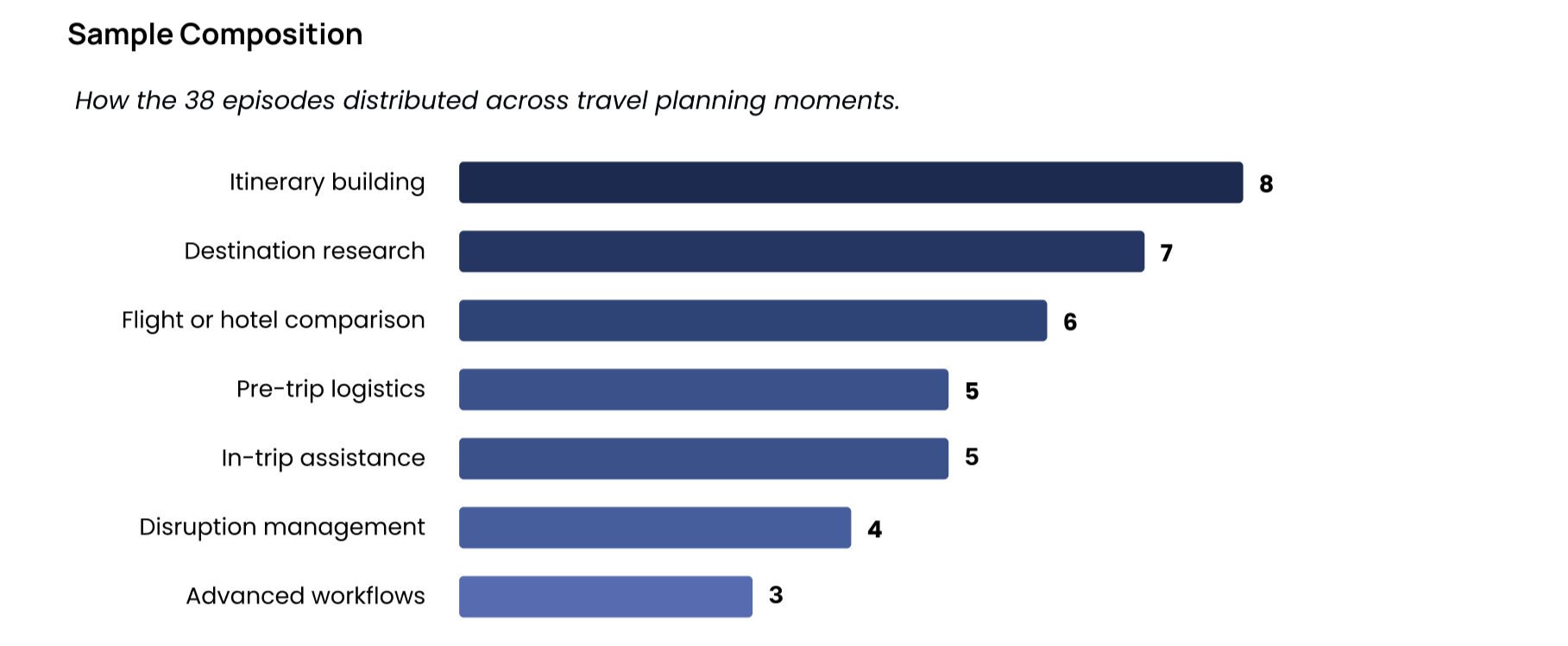
Participants submitted an AI conversation they had recently engaged in during some consideration over travel. This could be destination research, itinerary building, flight or hotel comparison, pre-trip logistics, in-trip assistance, disruption management, or advanced workflows like custom GPTs.
The study generated 38 chat artifacts and 76 additional video and typed reflections covering why participants consulted AI, what they trusted and didn't trust, and how they acted on that information.
Asking participants to walk through an actual past conversation with an AI made visible the conversational work AI was contributing, including aspects that, in many cases, participants hadn't previously realized or understood until they were asked to articulate the context of their conversation in the diary format. In several cases, the same conversation thread occurred over multiple days, as participants added more context, or drew on conversations they had started with different chatbots.
The analysis focused on four recurring dimensions:
What participants consulted AI for
How AI shaped their thinking about the trip
What they trusted, doubted, and verified elsewhere
How AI-shaped intent traveled into the airline channel
The goal was to understand how travelers’ knowledge and decisions are being shaped through their interactions with AI, and how that changes their interactions with airlines once they enter their direct channels.
Insight
Across episodes, three patterns emerged:
Participants used AI for a wide range of planning work, but the prompts shared a common pattern: they weren't searching, they were asking AI to help them think through what kind of trip to take.
Participants trusted AI for structuring decisions and explaining tradeoffs but turned to direct sources for anything tied to actual commitment.
Participants reported moving repeatedly between AI and other sources during planning, treating AI as one input among several rather than the place where decisions got made.
1. Participants predominantly asked AI to help them think, not search.
The kinds of planning work participants brought to AI varied widely. The chart in the Design section shows the distribution: itinerary building, destination research, flight and hotel comparison, pre-trip logistics, in-trip assistance, disruption management, and advanced workflows. Despite the range of topics, the prompts followed a recognizable pattern.
The conversations rarely opened with a search-style request. Instead, participants asked things like:
"We have a week in May, our daughter is six, my mom is coming with us — where should we actually go?"
"Help me figure out if Lisbon and Madrid in the same trip is too much."
"Is it worth flying into a smaller airport to save the layover, or is that going to add hassle?"
"What's the smartest way to do a four-day trip to Tokyo without losing two days to jet lag?"
The prompts asked AI to help reason through the trip. They didn't ask AI to find a flight or pull up a hotel list. AI's responses came with structure attached — proposed itineraries with day-by-day rationales, lists of tradeoffs to weigh, recommendations explained against the constraints the participant had named.
This pattern aligns with cognitive offloading research. Across other contexts, studies have documented users delegating not just memory and computation to AI, but the formation of frames and beliefs themselves (cf. e.g., the "belief offloading" framing in Hertwig & Engel, 2023). What the travel data showed was the specific shape this takes when the work at hand is planning a trip. Travelers used AI to externalize the part of planning that involves figuring out what you actually want — what trip is worth taking, what tradeoffs are worth making, what counts as a good answer.
2. Participants trusted AI for thinking, not for committing.
Participants described their trust in AI in terms that tracked the kind of work AI was doing for them. The diary reflections returned to a similar set of themes:
"It helped me see what I hadn't thought about."
"It was useful for narrowing things down — I'd been going in circles before."
"It explained things in a way that made me feel like I understood what I was choosing."
The trust came from legibility. Participants described AI as useful when it made the structure of a decision clearer — when it surfaced tradeoffs they hadn't named, organized fragmented planning into a smaller set of choices, or explained why one option might fit better than another. The trust didn't depend on AI being right about specifics. It depended on AI being useful for thinking through the planning problem.
But participants also described where that trust stopped. When the reflections turned to what they did after the AI conversation — what they verified, what they double-checked, where they went next — the pattern shifted:
"I wasn't going to book without checking the actual prices on United."
"For baggage stuff I always go to the airline site. I don't trust anything else with that."
"I'd ask ChatGPT to help me think about it, then I'd go to Google Flights to see what was actually there."
The verification behavior was concentrated around a recognizable set of items: real-time prices and availability, baggage and policy details, airport-specific procedures, and partner or codeshare rules. The pattern was consistent. Participants trusted AI to help them think through the trip and turned to direct sources for anything that had to be true on the day of travel.
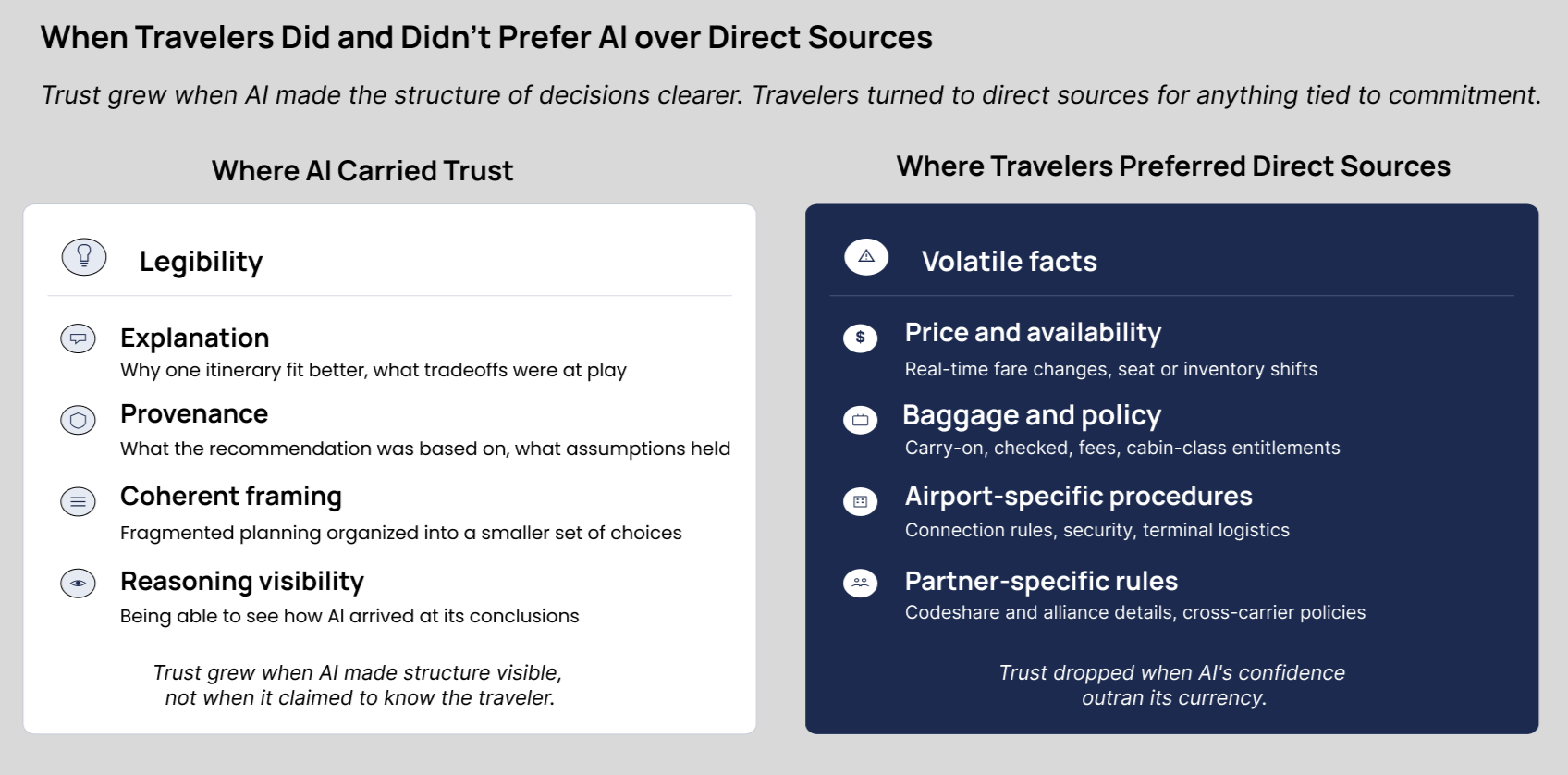
This conditional, stakes-sensitive trust is consistent with established research on AI in other high-stakes domains. Studies of AI use in healthcare and financial decision-making show the same pattern: trust holds when the stakes are low or the stakes belong to someone else, and drops when the stakes become personal and consequential [citation: e.g., Hudecek et al. on diagnostic AI trust shifts; Northey et al. on financial AI stakes]. What the travel data showed was where that break-point sits in a planning journey — and what kinds of decisions travelers consistently moved out of AI to make.
What participants wanted from AI was visibility into what it was basing its recommendations on. The strongest trust signals across the reflections involved being able to see why AI had suggested what it suggested, what it was weighing, and what assumptions it carried. The reflections didn't dwell on personalization or warmth. They dwelled on whether AI's reasoning was visible enough that participants could decide for themselves whether to act on it.
3. Participants moved between AI and other sources throughout planning
The reflections described AI as one source among several rather than the place where decisions got made. Participants reported using AI alongside Google Flights, airline sites, OTA platforms, friends, and prior travel knowledge — moving between them as different parts of the planning surfaced different needs.
The pattern recurred across the reflections:
"I'd use ChatGPT to think through the options, then go to Google Flights to see what was actually available."
"AI was good for narrowing things down, but I always ended up on the airline's site to double-check the details."
"I went back and forth a few times — asking AI a question, checking the answer somewhere else, then going back to AI with what I'd found."
"I'd been talking to friends about it for a while, then I asked ChatGPT to help me sort through what they'd said."
The movement wasn't a sign that participants were dissatisfied with AI. The reflections described AI's role as specific and useful but bounded. AI was the tool participants reached for when they needed to think through what to do, organize options, or get an explanation of a tradeoff. They reached for other sources when they needed current information, verification of a specific detail, or the authority of an official channel.
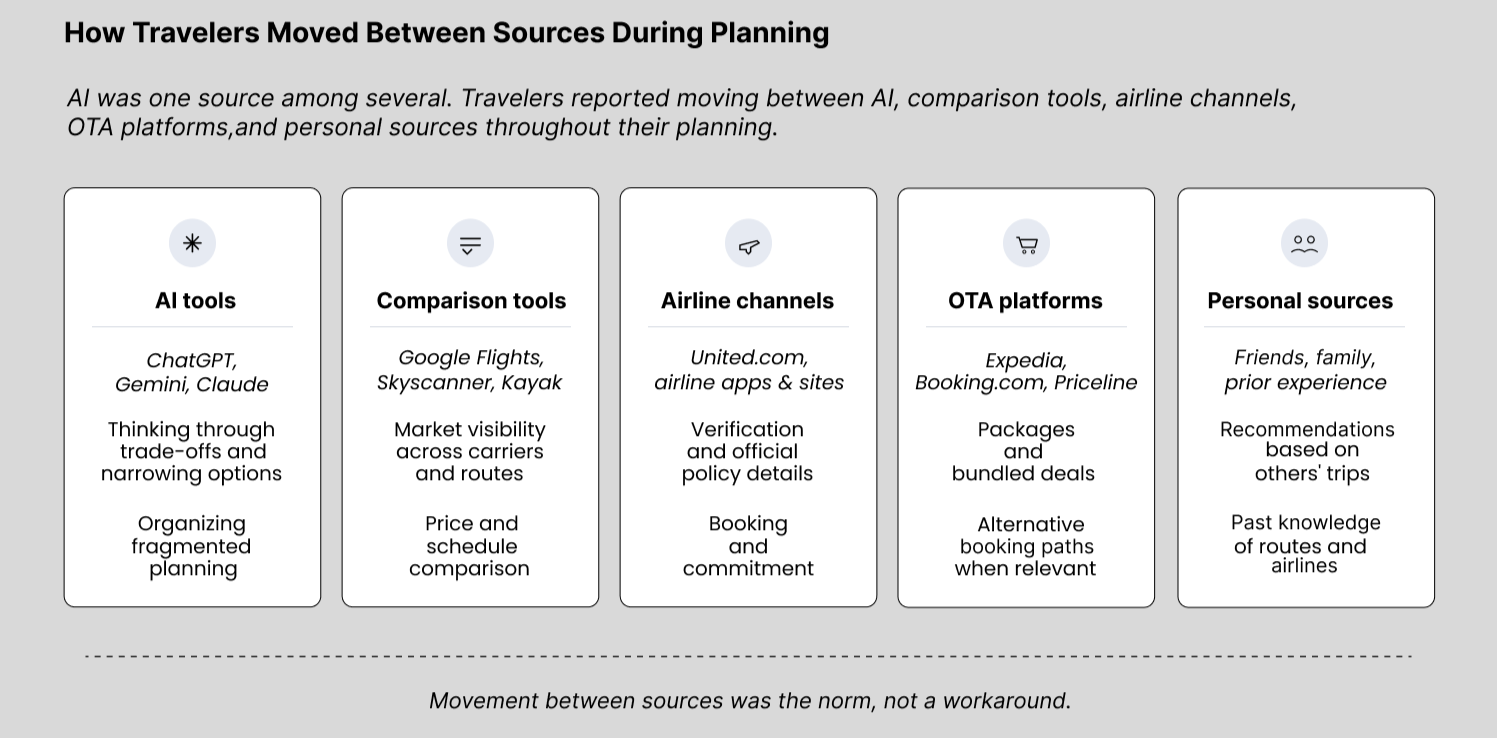
Across the sample, the typical planning episode involved at least two non-AI sources alongside the AI conversation itself. Participants described this as the normal shape of how they were planning trips, not as a workaround.Across the sample, the typical planning episode involved at least two non-AI sources alongside the AI conversation itself. Participants described this as the normal shape of how they were planning trips, not as a workaround.
Impact
The research helped clarify the way AI has changed customer behavior — AI now provides a new layer of explicit ideation that travelers have access to before, during, and even after travel. Most customers' AI conversations happen before engagement with airlines, often resolving decisions prior to booking and reshaping what they expect during direct channel engagement.
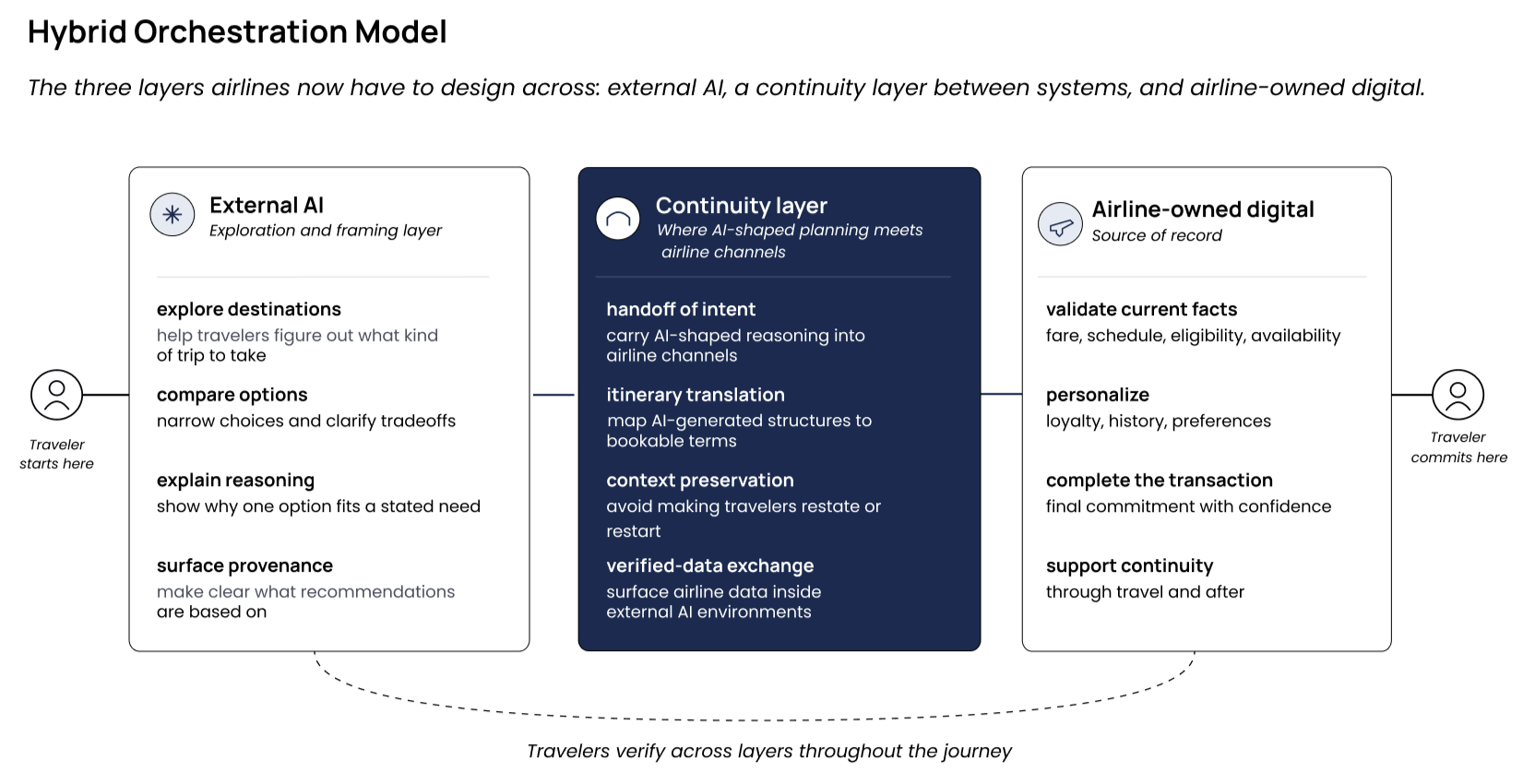
Customers are treating AI as a space for low-stakes thinking and rethinking, helping them work out plans that can find specific fit in airline channels. The introduction of this new space has reinforced the importance of airlines' direct channels as the source of truth and confirmation. Between these two layers sits a third: the continuity layer, where AI-shaped planning gets translated into terms airline systems can act on, and where verified airline data gets fed back into the AI tools customers use.
The findings are shaping work across each of these layers:
The airline's own AI products. The behavioral patterns are informing how United's customer-facing chatbots, agent-assist tools, and agentic AI development are being trained and positioned.
Ongoing CX research on AI. The study anchors continuing work on AI in service recovery, ancillary purchase, and other customer-facing applications.
Presence in third-party AI. How United's verified information — schedules, fares, baggage rules, policies, itinerary structure — appears inside ChatGPT, Gemini, Claude, and other AI tools is now part of the company's AI strategy.
The airline's role with AI no longer sits in a single product. It runs across all three of these layers, and the strategic work is across all of them.