AI in Travel Exploration
Summary
Travel planning has traditionally been understood as a multichannel journey moving across search, airline, OTA, and airport touchpoints. External AI assistants complicate that picture by shifting the earliest—and often most influential—parts of planning outside company-owned channels. I developed this study to understand how travelers use tools like ChatGPT, Gemini, Claude, and similar assistants to explore destinations, compare airlines, assemble itineraries, and frame purchase decisions before entering an airline’s app or site. Using a retrospective diary study built around one real AI-assisted travel conversation per participant, the research showed that AI is rarely the endpoint of purchase; instead, it acts as an upstream coordination layer that narrows options, bundles tradeoffs, and establishes new expectations for explanation, personalization, and continuity. Travelers still return to airline channels when price, policy, timing, and booking confidence become consequential, but they increasingly judge those channels against the speed and coherence of the AI planning experience. The work reframed the strategic question from whether an airline should “build its own ChatGPT” to how it should remain authoritative, legible, and bookable when planning now begins elsewhere.
Key words: external AI, travel planning, airline digital strategy, booking confidence, channel switching, itinerary assembly, provenance, trust, hybrid orchestration, customer experience continuity.
* Note: specific details of this project have been omitted or modified for proprietary reasons.
Problem Space
Multichannel customer experience research has typically assumed that travelers begin inside recognizable ecosystems: search engines, airline sites, OTAs, maps, airport tools, and service channels. That assumption is becoming less stable. External AI assistants are now absorbing many of the exploratory and interpretive jobs that used to be distributed across those environments, including destination ideation, itinerary drafting, airline comparison, travel prep, and even in-trip troubleshooting.
For airlines, this creates a new upstream problem. By the time travelers enter an airline’s app or site, they may already be carrying an AI-generated shortlist, a draft trip structure, and a set of expectations about how planning information should be explained. The challenge is no longer only whether an airline appears in the consideration set. It is whether that airline’s channels feel coherent once customers arrive with an AI-mediated understanding of the trip already in hand.
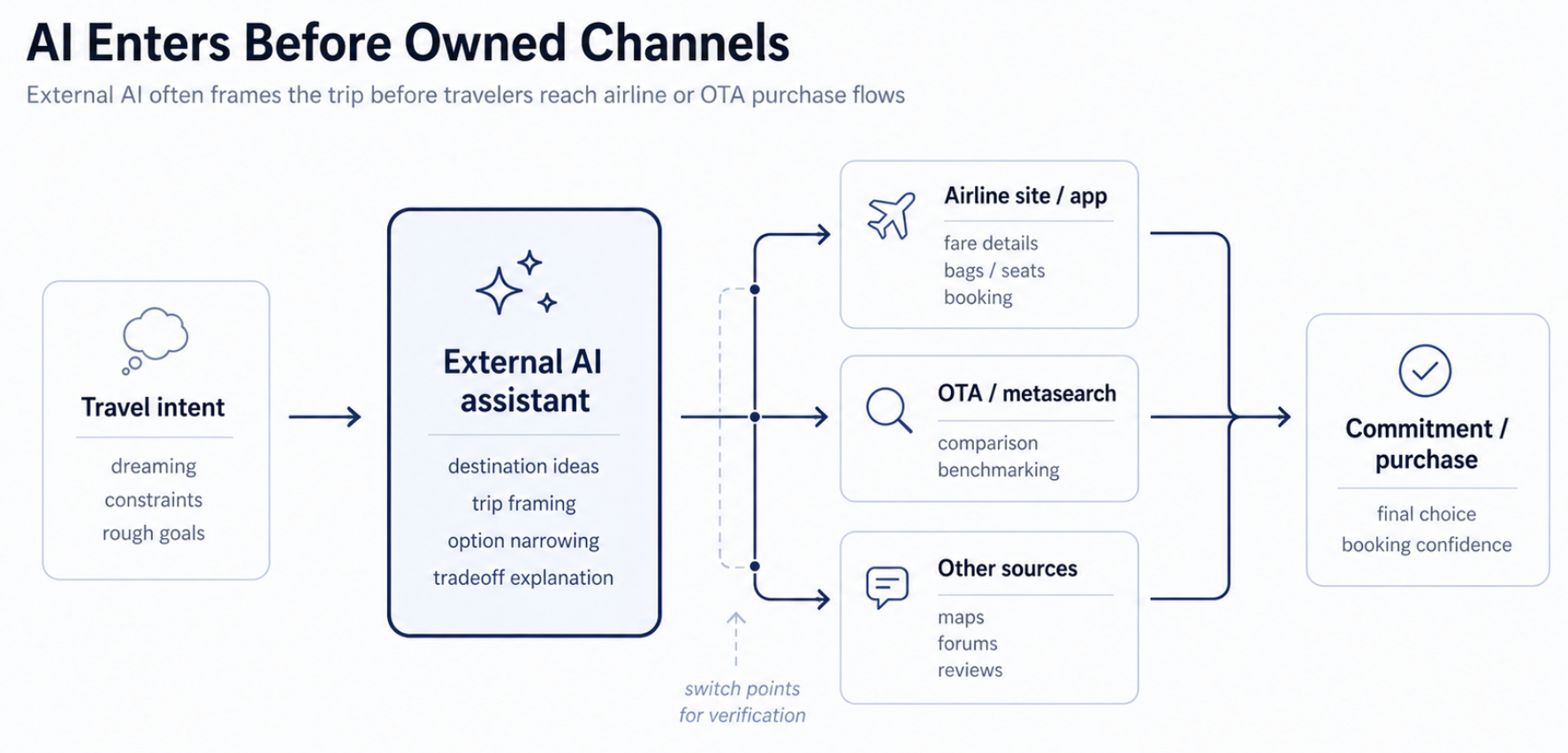
This raised a set of strategic questions about how AI is changing exploration, planning, and purchase in practice:
Where in the travel journey are customers actually using external AI?
What kinds of expectations do those interactions create before customers enter an airline’s channels?
Which AI outputs make travelers feel more confident, and which still require verification elsewhere?
Should an airline respond primarily through internal AI features, external AI partnerships, or some hybrid model that supports continuity across both?
The broader issue was not simply whether AI is helpful. It was whether travel planning is being reorganized around a new coordination layer—one that now shapes how customers interpret options, compare carriers, and decide when they are ready to commit.
Research Design
The study used a retrospective artifact-based diary design focused on one real AI-assisted travel episode per participant. Rather than ask people abstract questions about whether AI is useful, the research anchored every response to an actual conversation participants had already had while planning a trip, preparing for travel, navigating while in transit, or solving a travel-related problem.
The final sample included 38 travelers across a range of travel contexts and planning moments. By primary focal episode, 7 participants centered on destination research or early dreaming, 8 on itinerary building or activity planning, 6 on comparing flights, hotels, or ground transport, 5 on pre-trip logistics, 6 on in-trip assistance, 4 on travel problems or disruption management, and 2 on advanced AI workflows such as custom GPTs or Gems. In total, the study generated 38 chat artifacts, 38 screen-recorded walkthroughs of real AI conversations, and 76 additional video and typed reflections on what participants trusted, what they verified elsewhere, and what they actually did next.
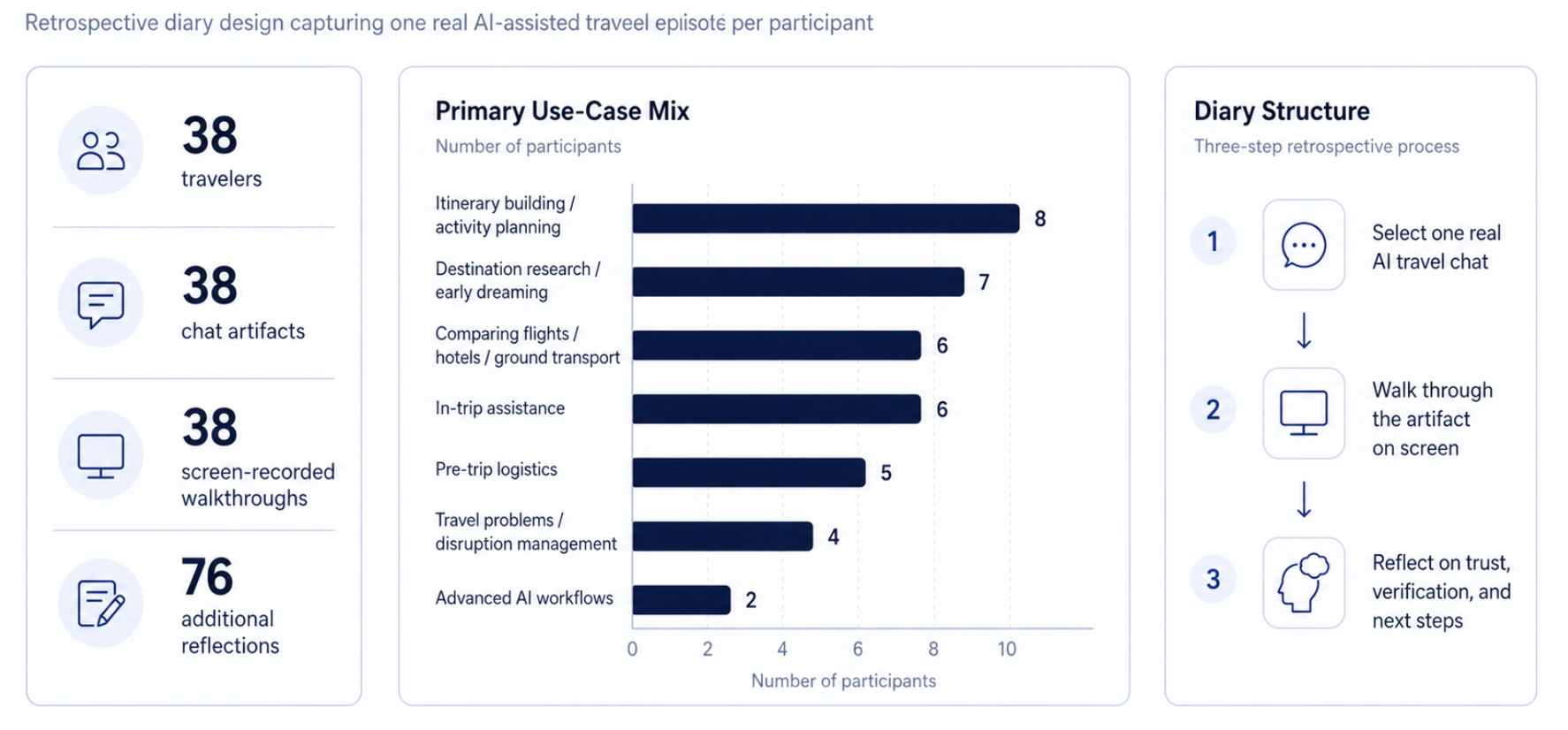
Because the goal was to understand where AI enters the journey and how expectations travel downstream, the analysis focused on four recurring dimensions: the job participants gave the AI, the point at which they switched into airline or OTA channels, the kinds of information they still felt they needed to verify, and the presentation formats that increased or reduced confidence. The objective was not incidence estimation at population scale, but structural pattern finding: identifying how AI-assisted planning is reorganizing exploration and purchase behavior before the customer reaches the airline’s owned ecosystem.
Research Insights
1. External AI is becoming an upstream planning layer, not just a novelty search tool.
Across the 38 diary episodes, AI most often entered the journey before any airline touchpoint did. In 30 of the 38 focal episodes, participants turned to an external AI assistant before visiting an airline site or app. The prompts were rarely limited to “find me a flight.” More often, participants used AI to translate a vague travel intent into something more structured: what kind of trip made sense, what sequence of destinations was realistic, which airports or neighborhoods were worth considering, and how to balance time, cost, convenience, and interest.
This was especially visible among destination research, itinerary building, and comparison participants, but it also surfaced in pre-trip logistics and in-trip help. Occasional travelers used AI to reduce setup and uncertainty; more experienced travelers used it to compress work they already knew how to do. In both cases, AI was valued less for perfect precision in the first pass than for reducing the cognitive overhead of getting started.
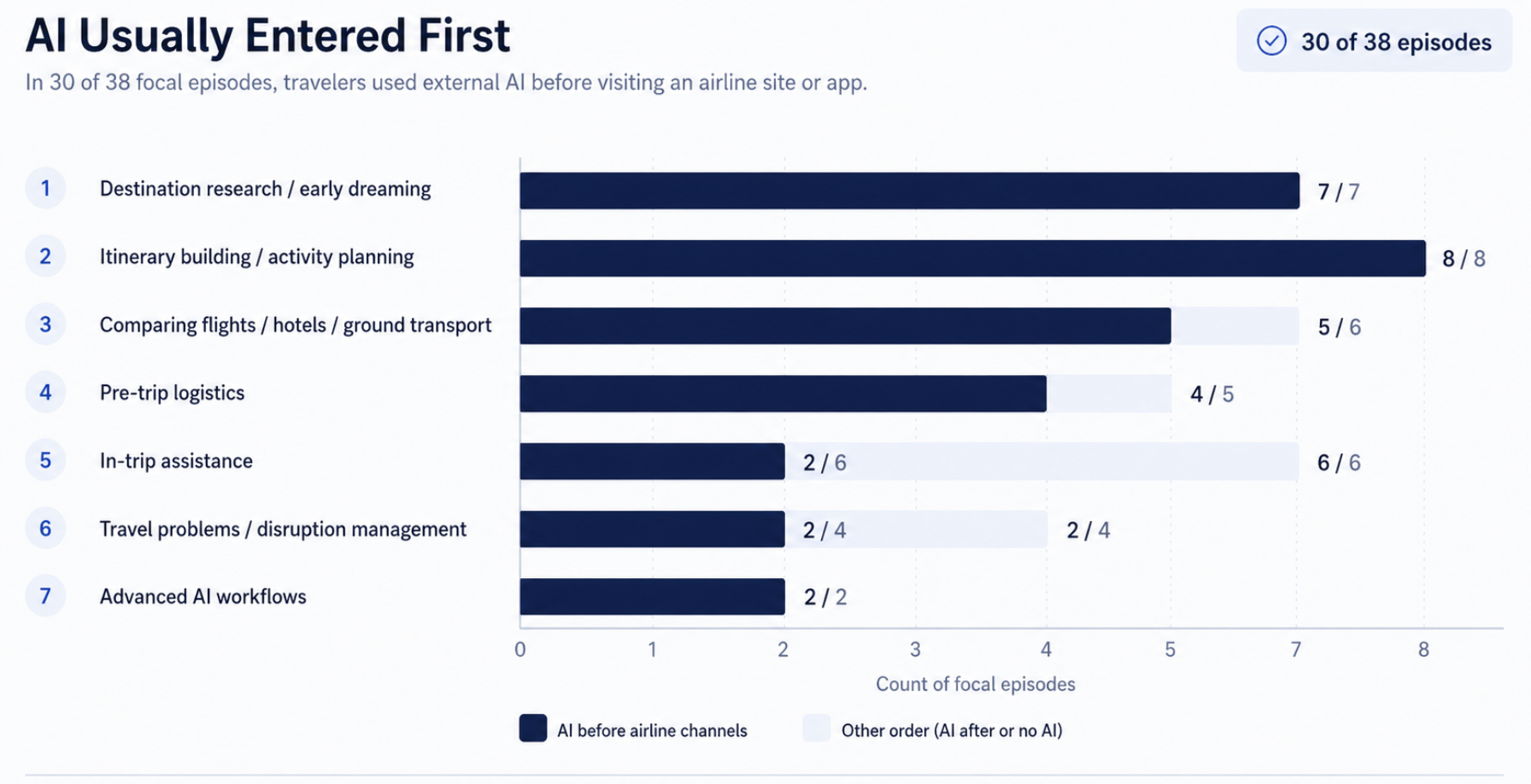
What mattered strategically was that airline consideration often entered only after this compression had already taken place. By the time participants reached airline or competing carrier channels, they often already had a working theory of the trip: a shortlist of options, a rough itinerary, a bundle of tradeoffs, and a sense of what counted as a “good” recommendation. In that sense, AI was not just another source in the funnel. It was increasingly the place where the planning problem itself was being framed.
2. Travelers return to airline channels when decisions become consequential.
Participants did not generally treat AI as a booking endpoint. Instead, they treated it as a planning and reasoning layer that helped them narrow and interpret options before moving into more authoritative environments. In 27 of the 38 episodes, participants verified at least one consequential detail outside AI before acting. In 24 episodes, that verification specifically involved returning to an airline-owned channel for fare details, schedule confirmation, baggage rules, seat selection, policy clarity, or final booking confidence.
This switch point was less about rejecting AI than about understanding when the stakes had changed. Participants consistently described AI as strong at narrowing, explaining, and organizing. Airline channels, by contrast, were still treated as the source of record when price, eligibility, timing, and transaction risk became real. Several participants moved back and forth repeatedly, using AI to interpret their options and airline sites to confirm what was currently true.
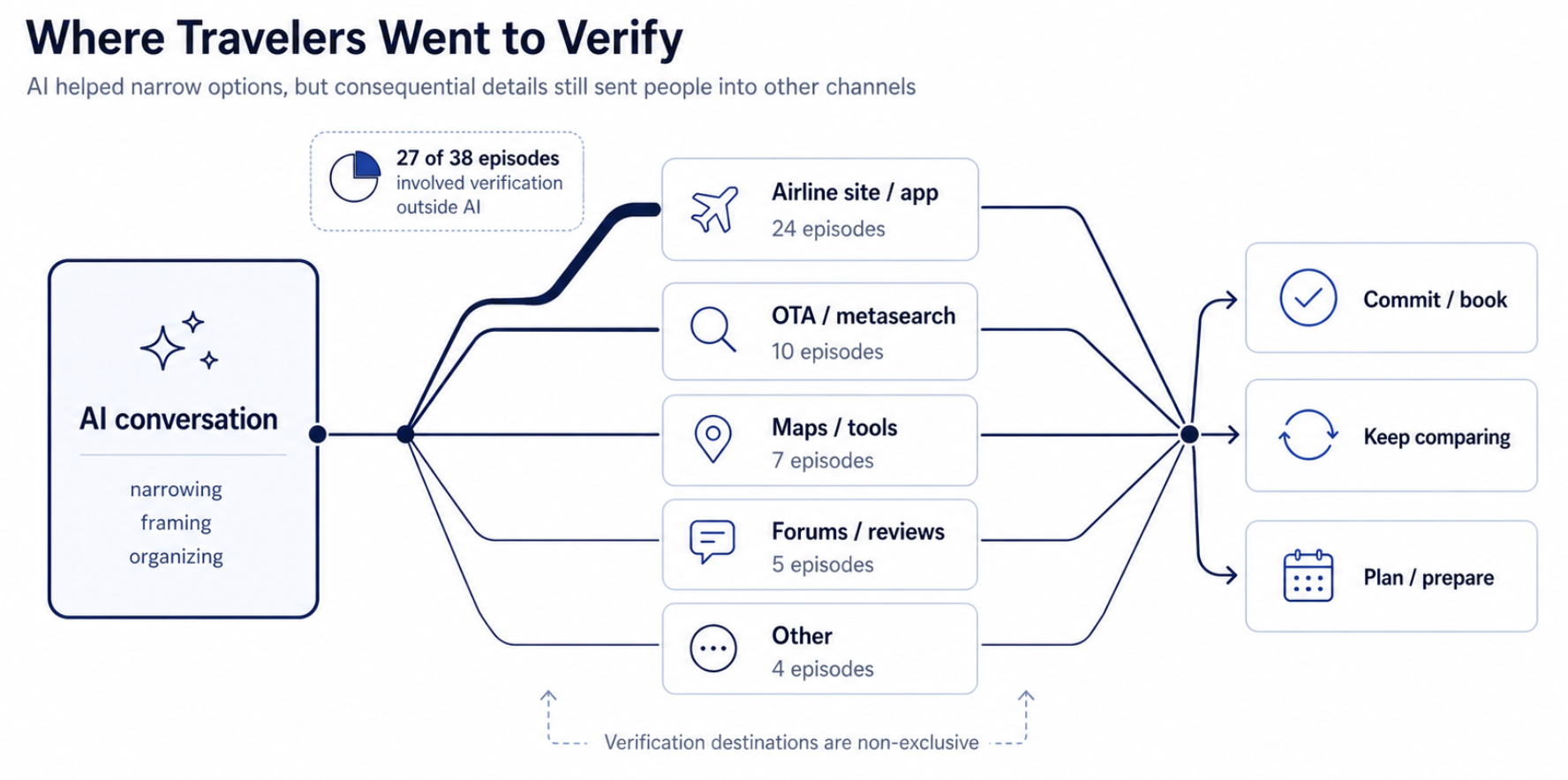
The main friction was not the existence of a switch itself, but the lack of continuity across it. Participants often had to reconstruct preferences, restate constraints, or manually translate an AI-generated itinerary into booking terms. When that happened, the airline experience was compared not only to competing airlines, but to the coherence of the AI planning experience that preceded it. The planning work had already been done; the owned channel often required travelers to do parts of it again. That gap was felt as product friction, not merely as ordinary channel switching.
3. Trust depends less on personalization alone than on explanation, provenance, and continuity.
Participants trusted AI most when it made the structure of the decision clearer. They responded positively when the AI explained why one itinerary fit better than another, highlighted tradeoffs, or organized a messy travel problem into a smaller set of plausible choices. In 29 of the 38 episodes, participants explicitly described AI as most useful when it turned fragmented planning work into a coherent frame for decision-making.
Trust dropped quickly, however, when the output touched volatile or policy-sensitive information without cues about source, recency, or uncertainty. Price, availability, baggage rules, airport-specific procedures, and partner-policy details were the most frequently rechecked items. Only 9 of the 38 participants said they would have acted on the AI output alone for a time-sensitive booking decision without verifying at least part of it elsewhere. Business-leaning and more frequent travelers were especially intolerant of ambiguity around these details.
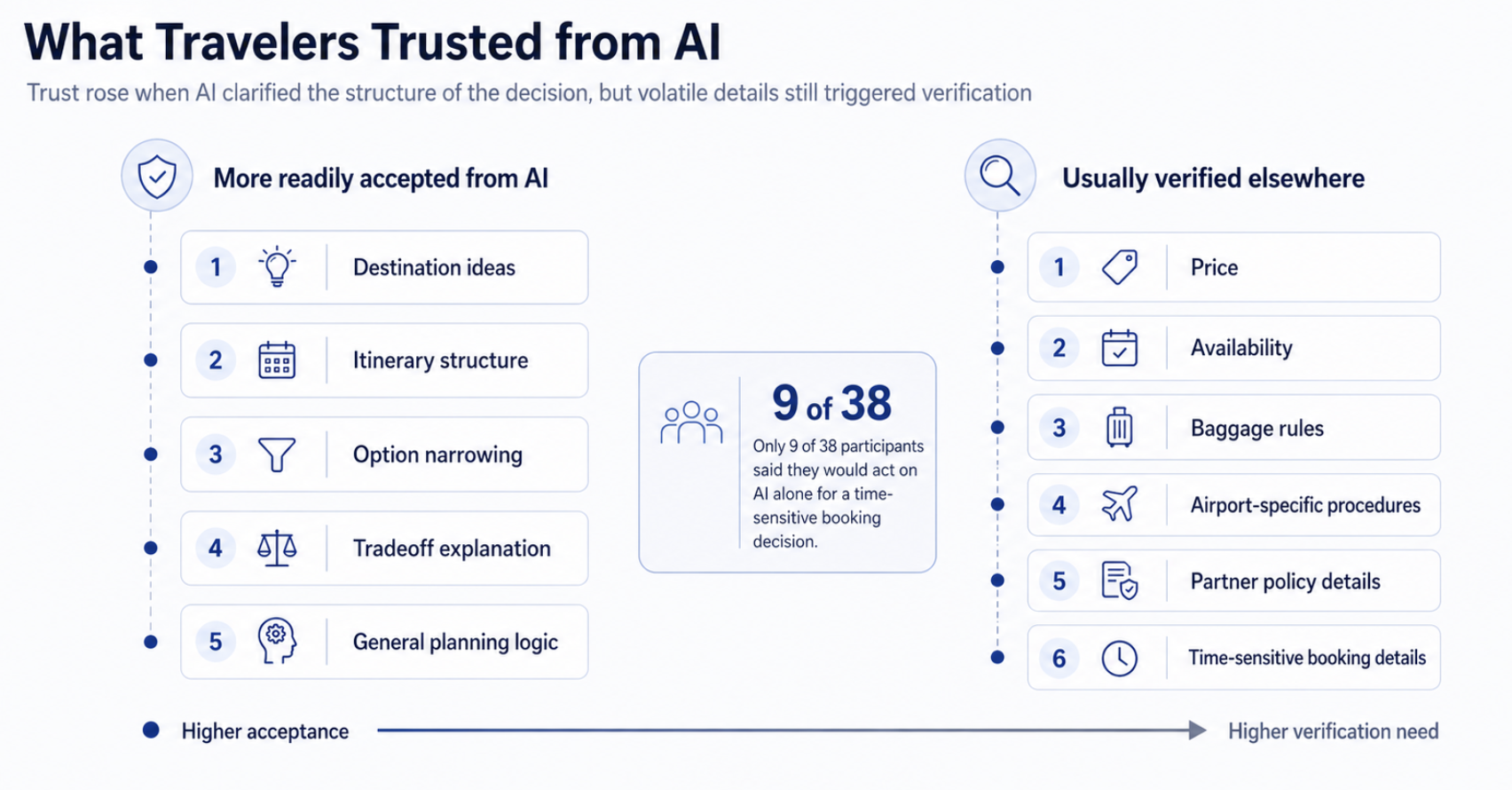
A consistent tension emerged when AI output and airline channels appeared to conflict. Participants rarely treated that mismatch as proof that AI itself was useless. Instead, they experienced it as a breakdown in the broader planning ecosystem. The AI might be easier to interpret, while the airline site was more authoritative; the burden then fell back on the traveler to reconcile the difference. This is where provenance mattered most. Participants wanted to know what the recommendation was based on, what assumptions it carried, and which parts still required confirmation. In practice, “good AI” was not just conversational. It was legible enough to support confident handoff into booking.
4. The strategic opportunity is hybrid orchestration, not full replacement.
Only a small minority of participants used advanced workflows such as custom GPTs, saved travel assistants, or more elaborate prompt chains. The mainstream behavior was more straightforward: travelers wanted external AI to help them think, compare, and organize, and then wanted airline systems to validate, personalize, and complete the transaction. That made the strategic opportunity look less like “own the entire AI planning journey” and more like “remain authoritative when customers arrive with AI-shaped intent.”
This points toward a hybrid model. An airline does not need to reproduce every external AI behavior inside its own channels. It does, however, need to selectively mirror the strengths of external AI in the moments where decision friction is highest. These include clearer itinerary logic, side-by-side tradeoff explanation, conversational clarification of fare and policy questions, and more intelligible presentation of dynamic travel facts. At the same time, the airline has reason to consider how verified data, itinerary structure, and policy information can be surfaced more accurately in the external AI environments where planning increasingly begins.
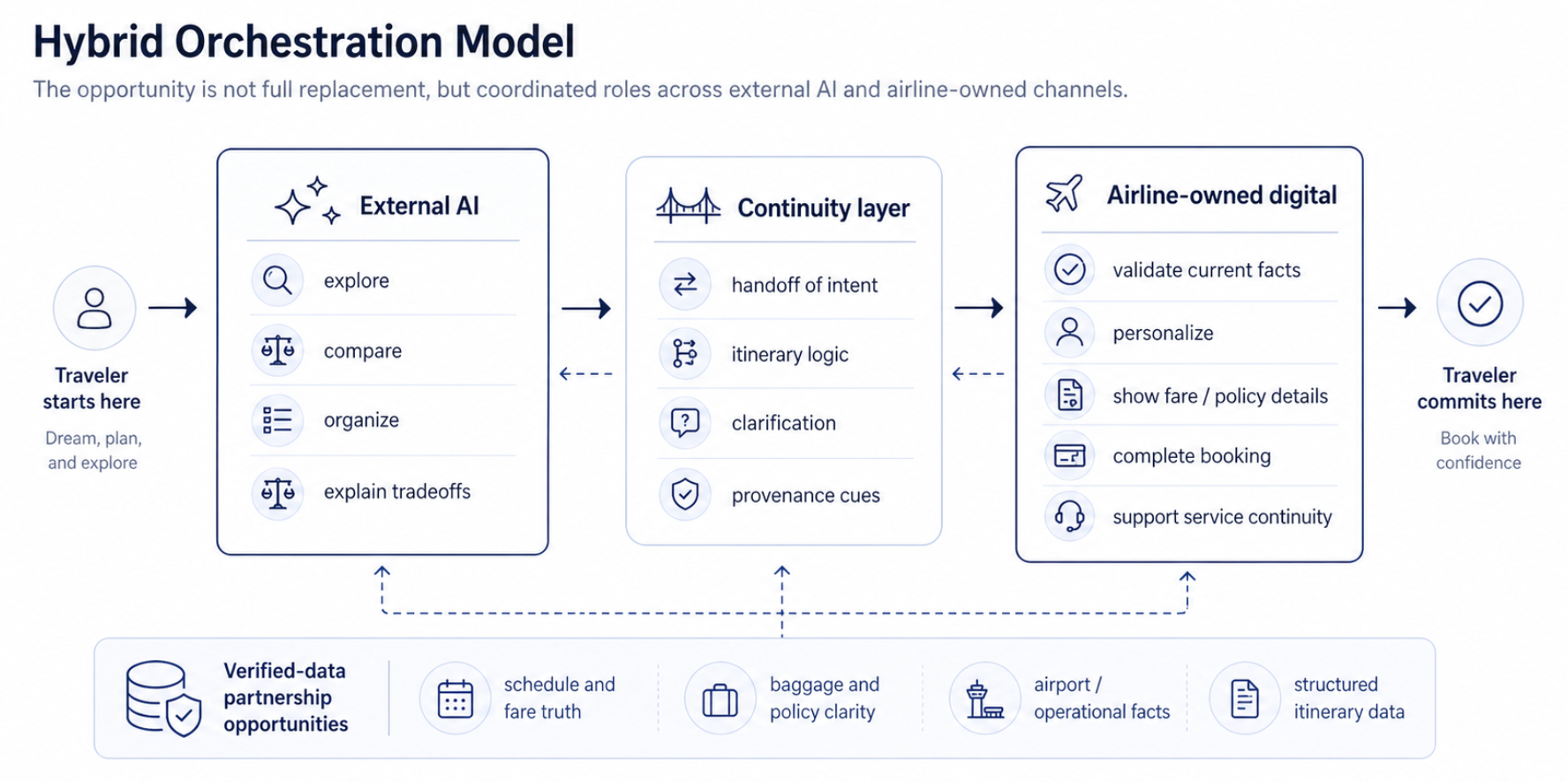
The clearest opportunities were not abstract chatbot experiences. They sat at the handoff points. Participants needed better continuity from AI-assisted exploration into purchase, better explanation of why one itinerary or fare bundle fit a stated need, and clearer cues about what could be trusted as current. Framed this way, the question shifted from internal AI versus external AI to where each should play a different role. External AI is already becoming part of how travelers initiate planning. The airline’s job is to make commitment, confidence, and service continuity feel equally intelligent once the traveler enters its ecosystem.
Strategic Impact
This work reframed the problem from one of AI visibility to one of AI-mediated continuity. The most important risk was not that travelers would never arrive in an airline’s channels. It was that they would arrive having already experienced a clearer, faster, more interpretable planning layer somewhere else. In that environment, the airline is no longer judged only on inventory and transaction capability, but on whether it can absorb AI-shaped intent without forcing the customer to start over.
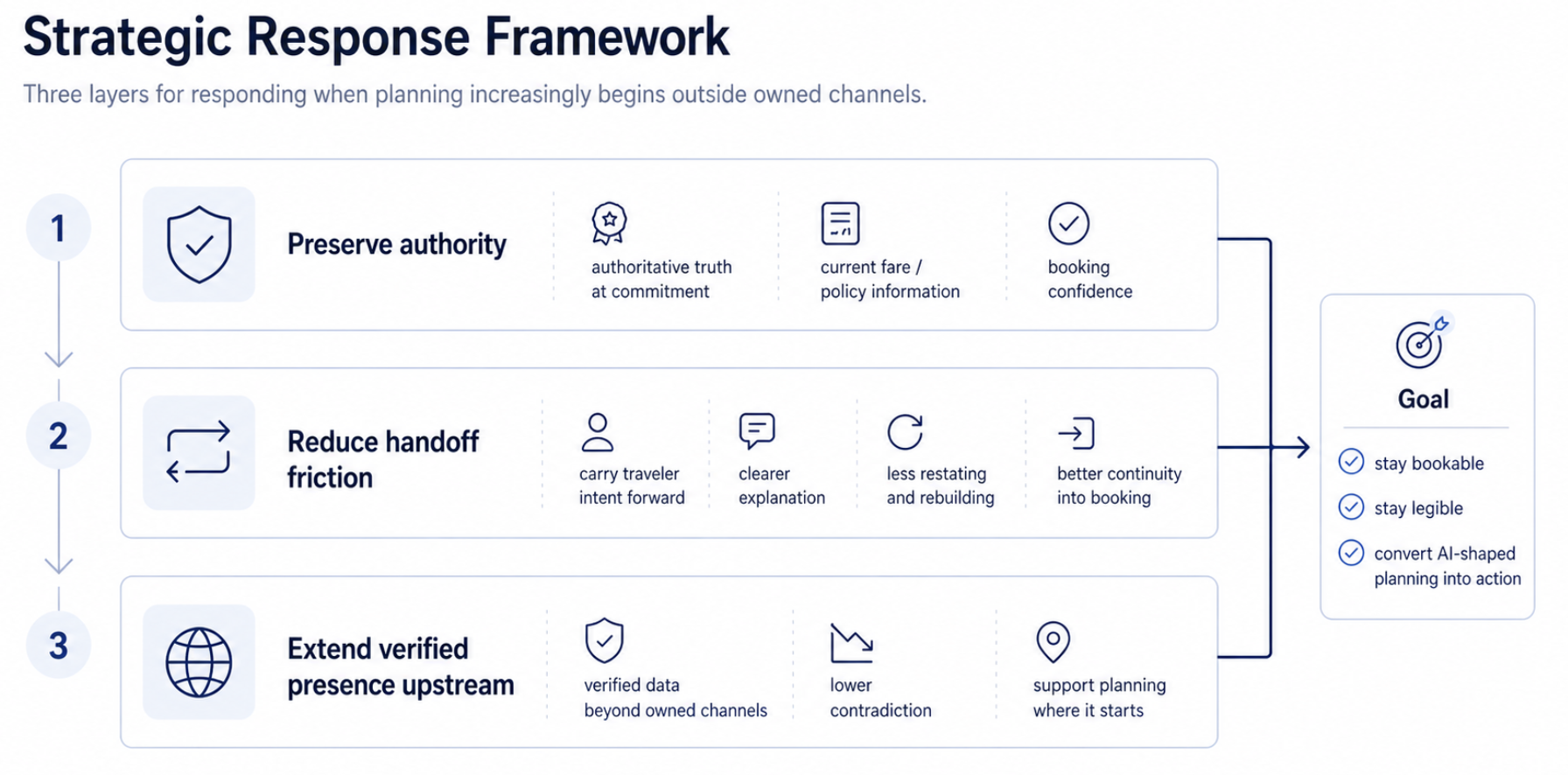
The implication was not a binary choice between building an internal assistant and partnering externally. It pointed instead to a layered strategy: preserve authoritative truth at the point of commitment, selectively add AI-style explanation where decision friction is highest, and explore verified-data pathways that reduce contradiction when travel planning begins outside the airline’s owned ecosystem. In practical terms, that means better continuity from exploration to booking, more transparent provenance for dynamic travel information, and product patterns that help travelers move from “this sounds like the right trip” to “I feel confident booking it here.”
More broadly, the study repositioned the airline from trying to be the place where planning always starts to ensuring it remains the place where AI-shaped planning can convert confidently into action. That is a narrower but more durable ambition. It treats external AI neither as a threat to be copied wholesale nor as a novelty to be ignored, but as part of the customer’s real planning environment—one that now helps define what a coherent travel purchase experience should feel like.