Designing for Uncertainty:
Security Wait Times and
Upstream Travel Behavior
Summary
As recent TSA disruptions demonstrated in an extreme way, few aspects of the day-of-travel experience are as impactful as airport security. Even though airlines do not control screening directly, security is one of the strongest drivers of day-of-travel satisfaction, shaping decisions and impressions that influence how the rest of the trip is experienced. I led a multi-phase research effort to understand how uncertainty around security influences traveler behavior and whether pre-arrival wait-time information in the app could help. Spanning two years, the work combined generative research, concept and content testing, and live pilot evaluation. The research established a behavioral framework for understanding why congestion forms unnecessarily at security and how wait-time information can play different roles across the planning window. In pilot use of a prototype, both reported behavior and observed arrival patterns shifted later, showing how a targeted product intervention can influence behavior upstream and reduce precaution-driven congestion without added capacity.
Key Words: airport security, day-of-travel experience, uncertainty reduction, wait-time information, pre-arrival planning, behavior change, mobile product strategy, pilot evaluation.
* Note: specifics details of this project have been omitted for proprietary reasons.
Problem Space
Travelers’ experiences of airport security—and the terminal experience leading up to it—are poised to shift significantly over the next decade. Rising passenger volumes and structural constraints at major hubs are reshaping how security and pre-security spaces operate. As major carriers exert greater influence over airport expansion and how security operations are integrated into the terminal, airlines increasingly shape how travelers prepare for screening, including before they arrive at the airport.
From the customer perspective, security poses a distinct challenge for airline experience design. Alongside delays, it is one of the strongest drivers of day-of-travel satisfaction, largely because it shapes when travelers decide to leave for the airport and how they experience arrival. Yet security screening is the one stage of the journey airlines do not control directly. It sits between parts of the experience the airline does influence, such as check-in, bag drop, and boarding. However, travelers do not separate these boundaries when evaluating their experience. Stress at security produces a halo effect that the airline ultimately absorbs.
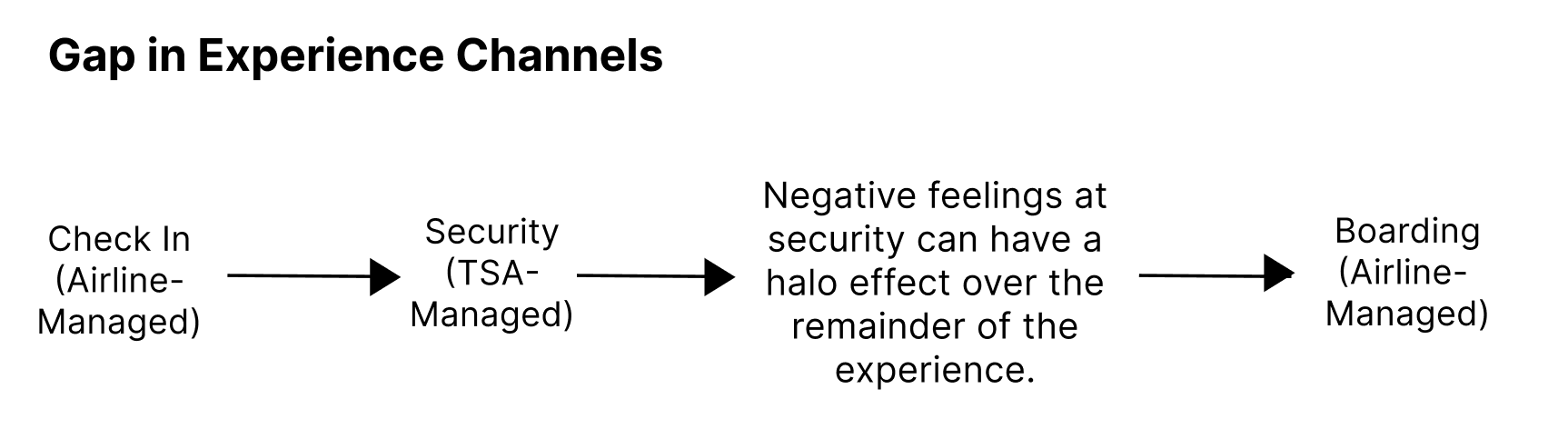
Rising passenger volumes make this tension more acute. Higher throughput increases congestion in and around security, driving the need for airport expansion, reconfiguration, and tighter integration between security and the surrounding terminal. As these spaces are redesigned, decisions about layout, circulation, and capacity become increasingly sensitive to arrival patterns.
This case study reflects a multi-phase research effort conducted over two years, spanning multiple initiatives related to airport arrival, lobby behavior, and security planning. Rather than a single study, the work unfolded across successive research efforts as the problem evolved—combining early exploratory research, concept evaluation, and follow-on validation as operational constraints, passenger volumes, and product strategy matured over time.
Together, these conditions established a clear research and design challenge. If airlines are to increase customer confidence and improve operational performance without relying solely on infrastructural change, they need ways to influence customer behavior upstream, before airport arrival. That requires understanding how travelers plan around security, and whether providing credible security wait-time information before arrival could change that behavior.
This work examined whether pre-arrival security information, delivered through a security wait-times feature in the airline mobile app, could reduce uncertainty at the point of planning—encouraging later, more distributed arrivals while helping airlines reduce precaution-driven congestion and make the security experience more predictable.
Research Design
This work was conducted as a multi-phase research program, with each phase addressing a distinct uncertainty about how security information could shape traveler behavior and experience.
Phase 1: Generative Research
Foundational research examined how uncertainty around security shapes traveler emotions, planning behavior, and perceptions of fairness. This phase focused on how travelers decide when to leave for the airport, how they build buffers, and how security outcomes influence downstream satisfaction with the airline—despite security not being airline-controlled.
Phase 2: Concept and Content Testing
Concept testing evaluated whether providing security wait-time information through the airline mobile app could credibly reduce that uncertainty and influence planning decisions. Content testing then refined the language, ranges, timestamps, and presentation needed for travelers to trust the information enough to act on it, rather than treating it as generic signage.
Phase 3: Live Evaluation
Following design refinement, the security wait-times feature was evaluated in live conditions to assess its real-world impact on customer satisfaction, arrival behavior, and use of the app during the pre-arrival window. This phase was conducted in conjunction with geofencing to ensure wait-time information was delivered at the moment it could most plausibly influence behavior—before customers committed to leaving for the airport.
Research Insights
Phase 1: Generative Research
First, we had to understanding how travelers experience airport security, and how their experience shapes behavior before, during, and after screening. The research drew on traveler interviews, in-airport intercept conversations, journey walkthroughs, an attitudinal survey, and on academic and industry research on the psychology of waiting, and the associated concepts of perceived wait-times, perceived fairness/unfairness, and perceived justice/injustice.
What emerged was a behavioral cycle that exist due to wait-time and procedural unpredictability. At the center of this pattern is a self-reinforcing cycle driven by perceived wait time, uncertainty, and fairness:
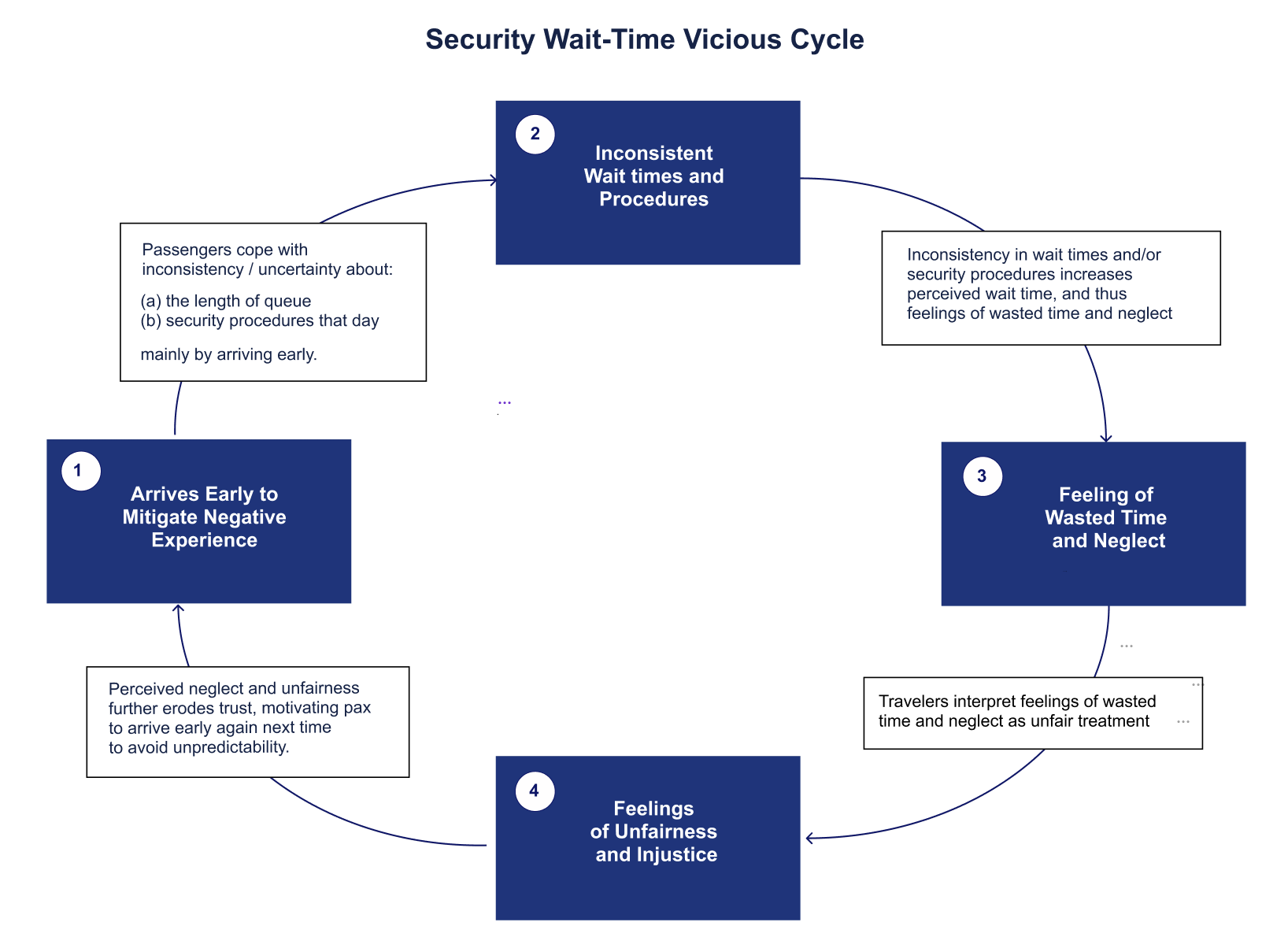
When travelers lacked credible expectations, they compensated by arriving early. Earlier arrival increased dwell time and sensitivity to delay. As waiting stretched without explanation, frustration escalated and was interpreted as unfairness or neglect. That experience only reinforces precautionary behavior and restarted the cycle.
The research also showed a clear pattern around confidence and planning. Travelers who did not feel confident about what to expect in terms of their security experience arrived earlier and rated the security experience more negatively, even when their reported wait times were similar to travelers who felt knowledgable about what to expect at security and were not concerned. Secondary research helped explain this pattern. Predictability and explanation often matter more for perceived control than absolute duration. When travelers can see how the situation is unfolding and understand why it looks the way it does, they can judge risk, time their actions, and decide what to do next. When they cannot, even short waits feel threatening, because there is no stable basis for planning.
The practical insight was straightforward. Travelers don’t need certainty—they need their expectations set and updated in n ways that let them act with confidence.
Phase 2: Concept and Content Testing
With the behavioral foundation established, research shifted from understanding uncertainty to testing whether wait-time information could credibly reduce it. The central question was whether wait-time estimates could earn trust across different planning styles and points in the journey.
Research showed that travelers wanted to understand what the wait-time estimate represented, how it was generated, and how current it was. Early concept testing using a basic prototype surfaced meaningful differences in how travelers valued the feature depending on when they encountered it, with perceived usefulness varying across planning timeframes prior to departure. This helped clarify when wait-time information functioned as reassurance versus when it supported concrete planning decisions.
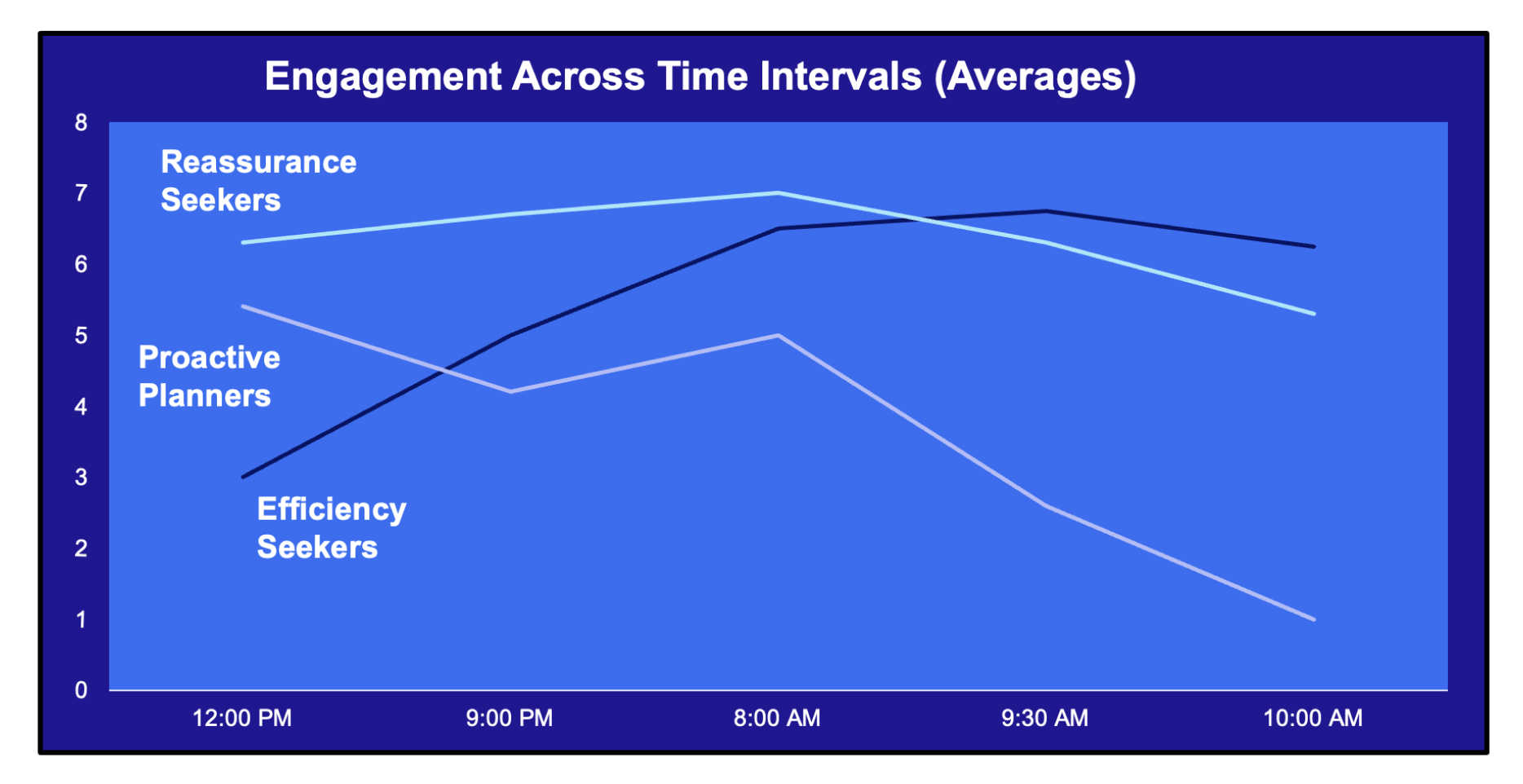
As shown in the visual above, these engagement patterns reflect how participants responded when asked when they would engage with a Security Wait-Time feature during the planning window. Participants indicated different modes of engagement depending on temporal proximity to departure. Earlier in the planning window, many described using the feature primarily for reassurance—checking wait times to reduce uncertainty without necessarily changing their intended arrival time. Closer to departure, responses shifted toward efficiency-oriented use, with wait-time information informing more immediate timing decisions. A third pattern—proactive planning—appeared more stable across intervals, with participants indicating consistent engagement but heightened sensitivity to framing and precision. These reported patterns clarified that the feature was not serving a single behavioral function, but multiple functions that varied by time-to-departure.
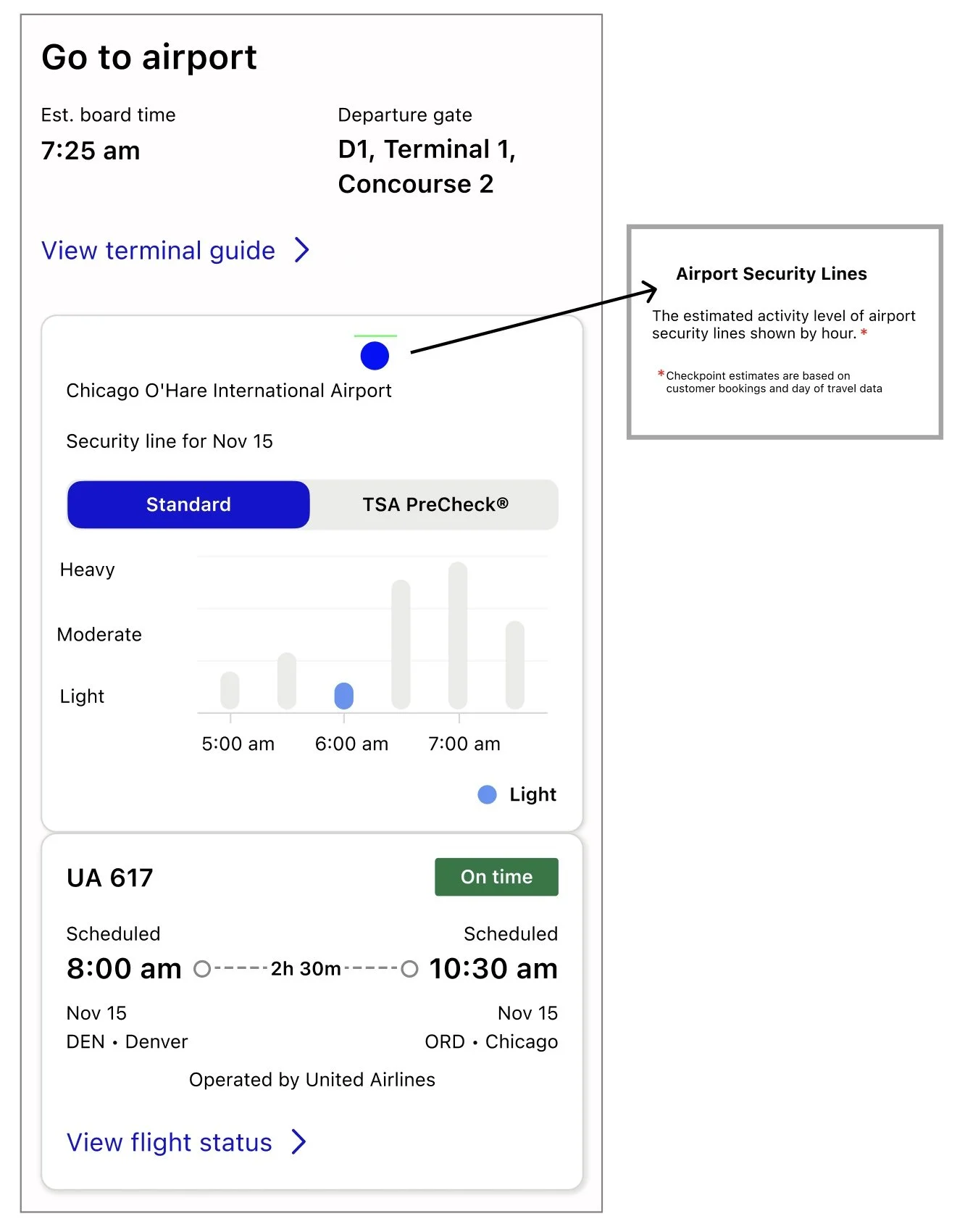
Content testing then focused on refining a prototype to ensure clarity, trust, and compliance. This phase tested variations in nomenclature, explanatory language, timestamp presentation, and range formatting to avoid implied precision and reduce legal risk. Particular attention was paid to how the estimate was labeled, how variability was communicated, and how recency cues were displayed. We assessed whether travelers understood what the estimate represented and how to interpret time ranges under changing conditions.
Testing also examined how phrasing influenced perceived accuracy and accountability. Point estimates were often interpreted as promises, while ranges signaled variability more credibly but required careful formatting to remain actionable. Timestamp wording and placement were evaluated to ensure the estimate felt current rather than static. The objective was not simply usability, but interpretability—ensuring travelers could understand what the estimate meant, what it did not mean, and how confidently they could act on it without assuming certainty the system could not support.
Phase 3: Live Evaluation
Live evaluation focused on travelers flying on selected pilot flights where the Security Wait Time feature was available in the mobile app. Post-security SMS surveys and intercept interviews were paired with geofencing-based arrival timing to assess both reported behavior and observed arrival patterns.
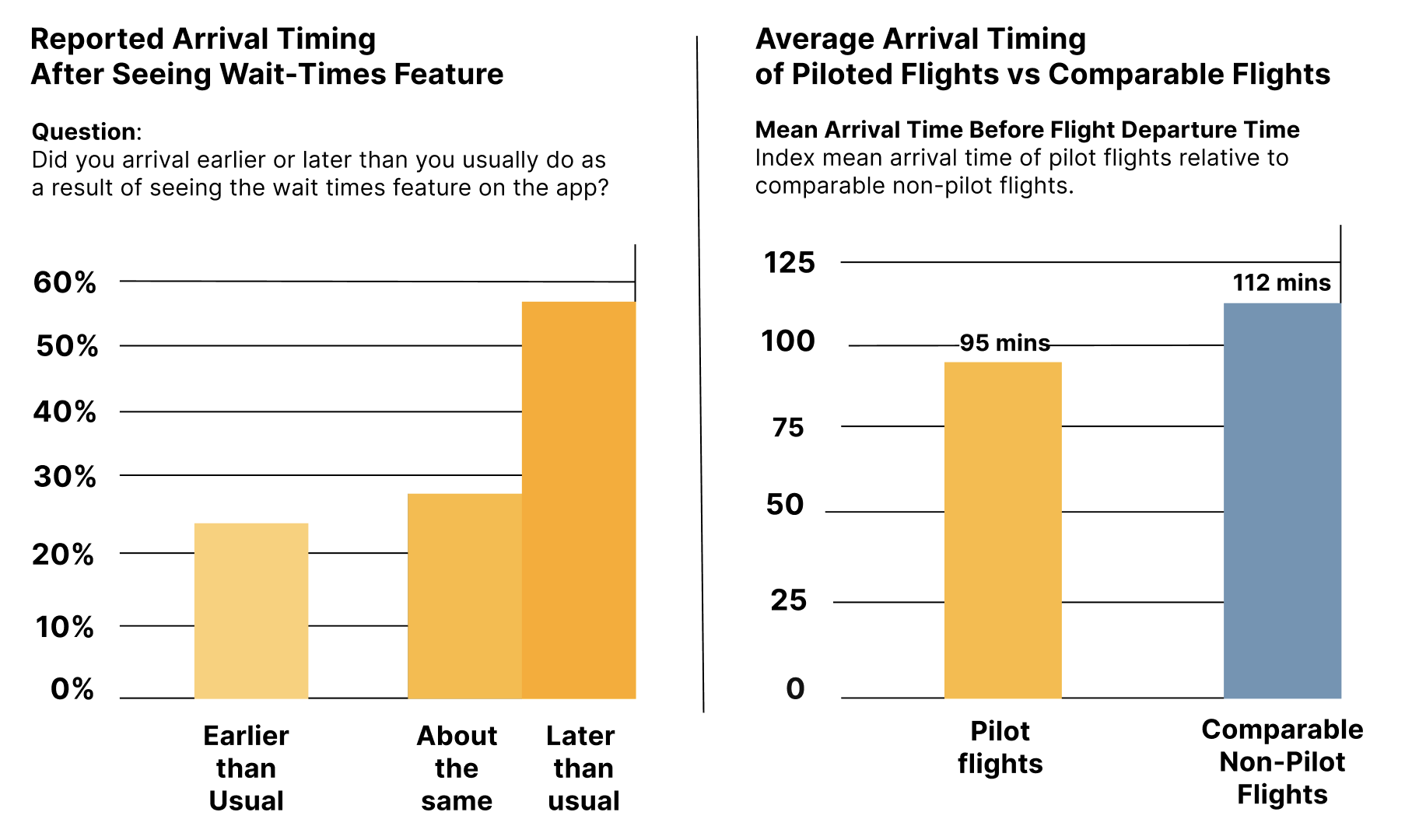
Survey results indicated clear awareness and behavioral impact. 71% of respondents noticed the feature, and among those, a majority reported using it to help decide when to go to the airport or approach security. Geofencing analysis provided early behavioral corroboration: during the 21-day pilot, arrival times for customers on pilot flights shifted later on average compared to travelers on comparable flights at the same terminal and departure windows where the feature was not available.
While the pilot duration and sample size limit definitive conclusions, the direction of the shift aligned with both survey responses and the underlying behavioral model. Together, these measures established a baseline for continued evaluation as the feature scales.
Strategic Impact
From a customer-facing perspective, the research showed that addressing security concerns does not require eliminating variability at the checkpoint, but making that variability intelligible early enough for travelers to plan around it. When customers can form and revise expectations with confidence, they rely less on precautionary early arrival and more on information.
Operationally, this creates leverage without infrastructure change. Reducing precaution-driven arrivals helps smooth demand across security-adjacent spaces, improve circulation, and ease peak congestion even when screening throughput remains constant. Over time, it also supports more informed decisions about terminal layout, staffing, and capacity as hubs expand.
This research complemented a broader study of day-of-travel app engagement conducted for the development of a new app travel mode activated in the 24 hours before departure (see other case study).
That work showed that, alongside delays, security is one of the two primary concerns shaping how travelers plan and time their arrival at the airport. When security information is missing or unreliable, travelers compensate by arriving early and by juggling between their airline’s app and other sources, esp. Google Maps, airport websites, the TSA app, or third-party security wait-time sites . The broader patterns of mobile engagement and pre-arrival coordination explored in that work are detailed further in the related case study, linked at the end of this page.