Designing Diachronic Orientation
in Travel Apps
Summary
To better address the unique confluence of challenges inherent to the day-of-travel experience, a major initiative at United was to define a dedicated app mode designed to support customers within the 24-48 hour journey between pre-departure through to arrival. To inform that effort, I led a cross-airline generative study of over 20 U.S.-based travelers across major carriers, combining a diary study, journey mapping, and moderated interviews. The research documented how day-of-travel breakdown stems less from a lack of information than from the difficulty of coordinating fragmented timing signals across traffic, ride-share planning, lobby tasks, security, delays, and boarding. Cognitive load peaks before the airport, when travelers often reconstruct the plan across five or six apps. Once inside the terminal, most want the app to have oriented them well enough that they can rely more on signage and physical momentum than on repeated checking. Security and delays emerged as the dominant worries and strongest drivers of overall travel-day judgment, while post-security and arrival revealed opportunities around food, guidance, and partner services. These findings informed later evaluative testing, and established product direction for future capabilities including security wait times, delay communication, partner integration, location-supported alignment, and AI-assisted coordination of multiple time windows.
Key words: day-of-travel UX, temporal orientation, pre-arrival planning, cognitive load, cross-app switching, continuity, security wait times, delay communication, location sharing, AI orchestration, asynchronous engagement, phygital journey, Travel Mode, airline mobile strategy
* Note: specifics details of this project have been omitted for proprietary reasons.
Problem Space
The 24 hours leading up to a flight pose a distinct challenge for airline apps. During this window, travelers shift from planning to execution, coordinating a sequence of time-sensitive actions as the journey unfolds. As departure approaches, engagement narrows and intensifies—check-in, seat confirmation, weather, traffic, security preparation, and boarding timing become tightly linked. After arrival, engagement shifts toward closure: confirmation that bags arrived, connections are clear, or no further action is required. Within this window, travelers need support that helps them stay oriented as conditions change and timing becomes increasingly consequential.
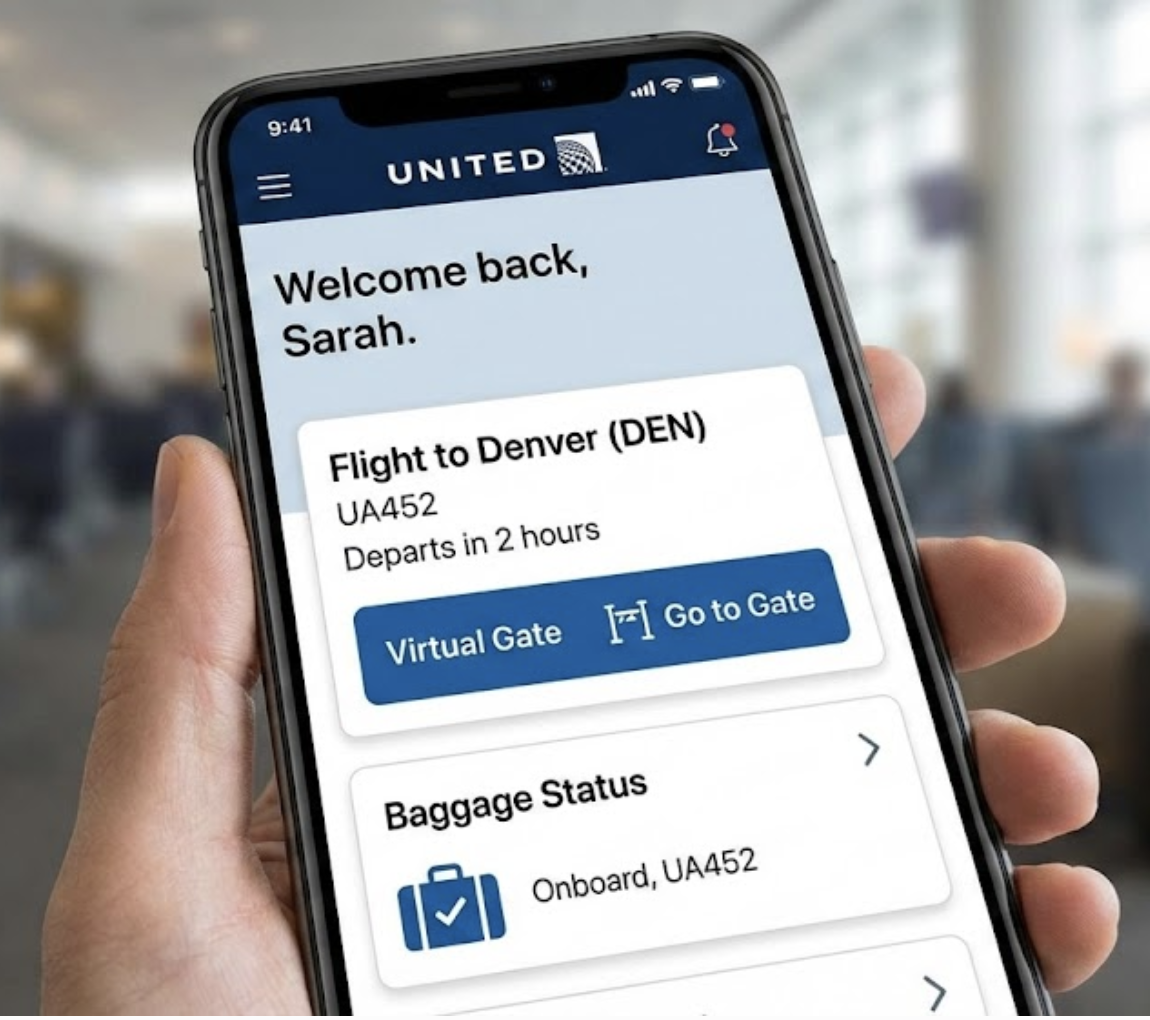
Creating a dedicated experience mode for this window became a multi-year initiative at United Airlines, culminating in the launch of Travel Mode in December 2025. The goal was to support travelers when attention is divided and timing matters most—by helping them remain oriented as plans solidify, shift, or require adjustment.
The objective of Travel Mode was to take a more comprehensive view of the day-of-travel experience—one that challenged assumptions about how and when information should appear and that could support ongoing learning and refinement over time. To guide this effort, the research defined criteria for what should earn priority placement in Travel Mode—and what could remain available without competing for attention—balancing an understanding of how travelers navigate the experience today with the need to uncover unmet needs that existing app structures had not yet addressed.
Research Design
The study took a cross-airline, behaviorally grounded approach to understand the lived experience of airline app usage across key traveler segments—including leisure, business, and family travelers, as well as frequent and infrequent flyers.
Cross-airline day-of-travel diary study spanning pre-arrival through post-flight
Engagement mapping across airline apps, maps, ride-share tools, wallets, signage, and third-party services
Moderated follow-up interviews with selected participants
The research positioned the airline app within the broader ecosystem travelers use to manage the day of travel. A cross-airline lens helped us understand how well United’s app supported customers compared to other main competitors.
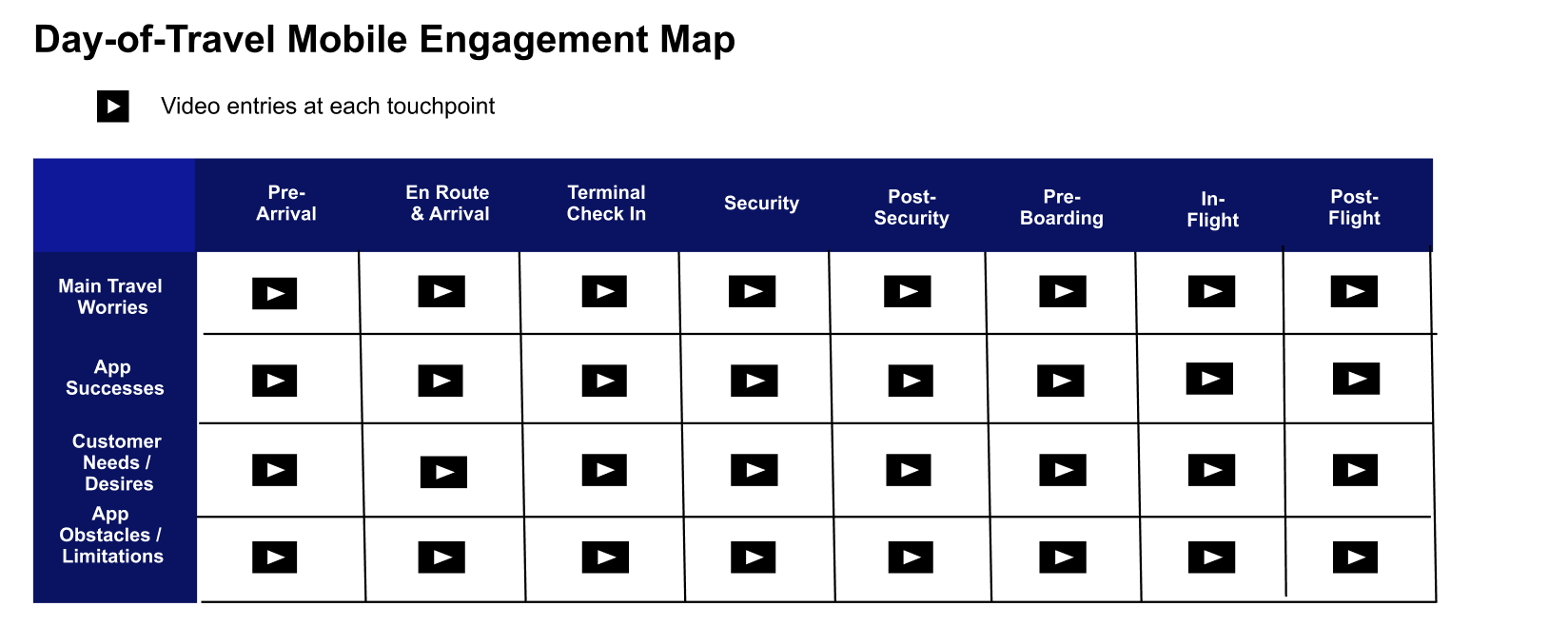
The journey map was used to identify where orientation was supported and where it deteriorated This framework focused on uncovering:
How travelers supplement the United app,
Which journey stages carry the greatest cognitive load,
Where the United app is succeeding and where could better support these most demanding stages, and
Where the app could expand into the future to support customers more discretionary desires and choices (where to eat, what to explore, how to orientation oneself at their future destination post-airport.
These generative insights were used to inform a later stage of evaluative research aimed to the forms of orientation uncovered in the foundational work, without constraining how the experience could evolve over time.
Research Insights
1. Most customer orientation problems occur before the airport.
The most cognitively demanding moments in the day of travel experience occurred before travelers ever entered the airport.
During pre-arrival, travelers were simultaneously factoring in traffic conditions, ride-share timing, weather risk, lobby tasks like bag drop, and security wait times. Travelers routinely moved between as many as five apps—and including an AI chatbot, as many as six apps—to balance timing, often while in transit.
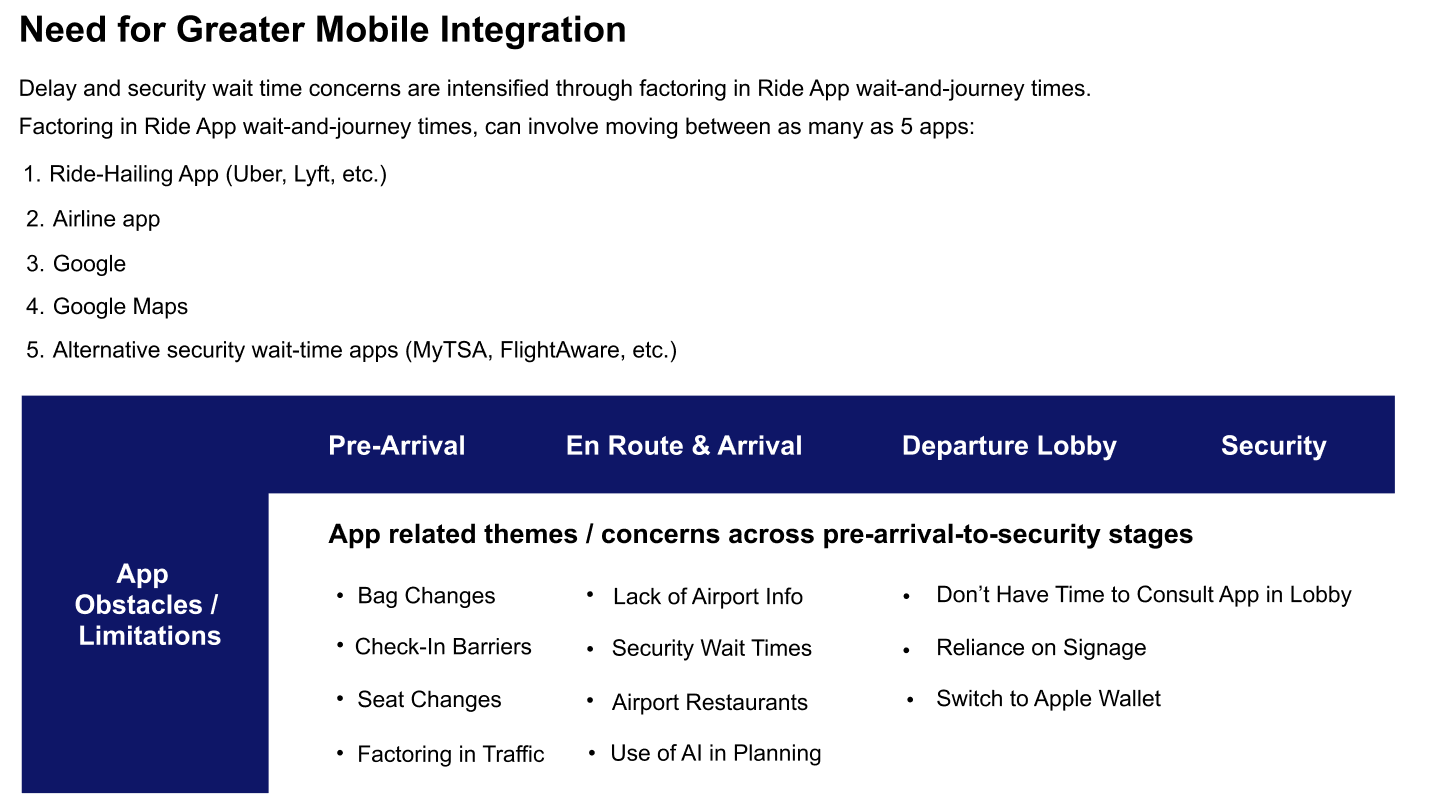
When the airline app’s signals were insufficient, delayed, or inconsistent updates, travelers compensated by cross-checking additional sources. The airline app’s value during this stage depended on whether it helped align and consolidate timing and sequence, or whether it just added another signal to reconcile. When orientation broke down during pre-arrival, it often cascaded forward. Likewise, when travelers felt oriented early, downstream moments were and felt more manageable.
2. Travelers prioritize app engagement before the terminal, not while navigating it.
Many travelers explicitly described not wanting to consult their phones once they entered the terminal. Time pressure, physical movement, and environmental demands naturally make in-airport app usage feel burdensome or impractical. Moreover, many if not most travelers expressed preference for consulting physical signage rather than for app-related directions.
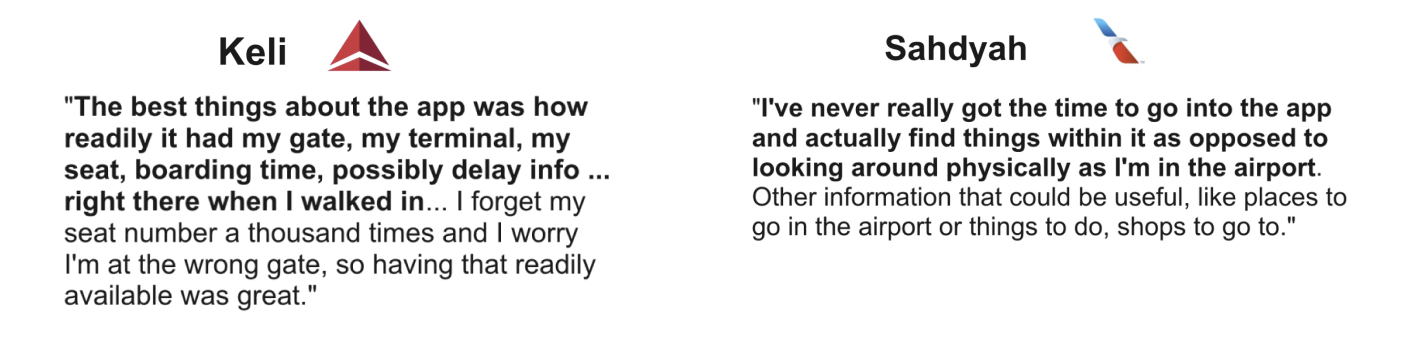
Building app continuity and trust from pre-arrival to post-security is central to not only improving customers’ experiences in the moment (as in the case of Aditya), but also to influencing their earliest decision making in ways that determine the entire success or failure of those experiences. Pre-security, participants wanted their airlines’ apps to all but eliminate functional decisions when it comes to timing and navigation (e.g., not just which security touchpoint, but which lane to queue).
3. Security and delays are customers’ main worries and have the biggest impact on travel evaluation.
The two largest concerns for travelers throughout the day-of-travel are security wait times and potential delays. Likewise, those two factors can largely determine customer overall satisfaction with their day-of-travel experience and with the airline.

App success for this stage of the journey is largely determined by how well it prepares travelers prior to it by orienting them for their physical experience in the terminal and coordinating with signage. Successfully doing so allows customers to think ahead to post-security activities, opening up opportunities for them to make more discretionary decisions like whether to upgrade their seat or where to eat.
4. After security, customers become more interested in exploring activities through guidance.
Once travelers clear security, the character of attention changes. The intense coordination of traffic, timing, bags, and boarding windows gives way to something looser. Aside from necessities like restroom stops or change stations, travelers begin to think about food, lounge access, or simply how to pass the time. Appetite—literal and figurative—re-enters the picture.
The similar pattern appears again after landing. While more task heavy— travelers must retrive baggage, locate ground transportation, understand connection status—they may be thinking ahead to choices beyond the airport.
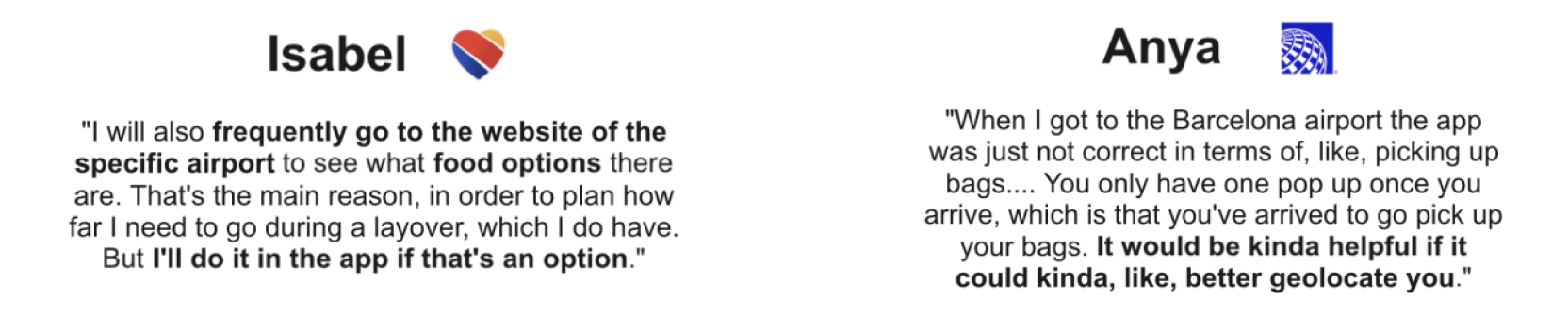
These post-security and arrival windows revealed opportunities for Travel Mode enhancements. Food discovery, airport retail, lounge prompts, post-arrival guidance, and partner integrations are spaces of customer demand that every main carrier in the study did not yet fully or adequately support.
Strategic Impact
The generative research established a clear product direction for Travel Mode: support customers early enough in the day of travel that they can enter the airport with confidence, rely more on signage and physical momentum once inside, and stay oriented through the most consequential moments of the journey. This framing also shaped later evaluative work. Early Travel Mode concepts were tested against the forms of orientation uncovered in the foundational research—especially whether they helped travelers understand timing, anticipate what came next, and reduce the need for repeated checking.
Immediate Implications
The strongest implication of the study was the importance of preparing travelers before they enter the terminal and carrying that clarity through security. Pre-arrival is where timing pressure, uncertainty, and cross-app switching are most concentrated; it is also where better guidance can have the greatest downstream effect. The research therefore reinforced the product value of features that help customers act earlier and more confidently, especially around security wait times, traffic sensitivity, and delay communication.
Security and delays stood out not only as the main worries of the day of travel, but also as the factors with the greatest influence on how travelers later judged the experience as a whole. This made them especially important candidates for coordinated, high-visibility communication. The same logic applies to partner integrations such as Lyft and Uber, and potentially others: their value lies in helping customers complete essential travel tasks at the right moment, not in surfacing offers that feel peripheral or promotional. The opportunity is to support real needs without disrupting the throughline of orientation.
Future Directions
A related area of development is location. Alongside investments such as Virtual Gate, the next question is how consent-based location sharing might improve alignment between the app and the traveler’s lived situation. Used well, location could sharpen timing guidance and support more relevant assistance across departure, security, post-security, and arrival. The challenge is ensuring that this feels genuinely assistive rather than intrusive.
The research also points to a focused role for AI as a coordination layer. Travelers already use AI tools when they need help synthesizing traffic, ride-share timing, security, delays, boarding, and connection risk across multiple time windows. Further research should examine how AI might reduce mental calculation and translate fragmented signals into timely guidance—without becoming another layer travelers must manage.