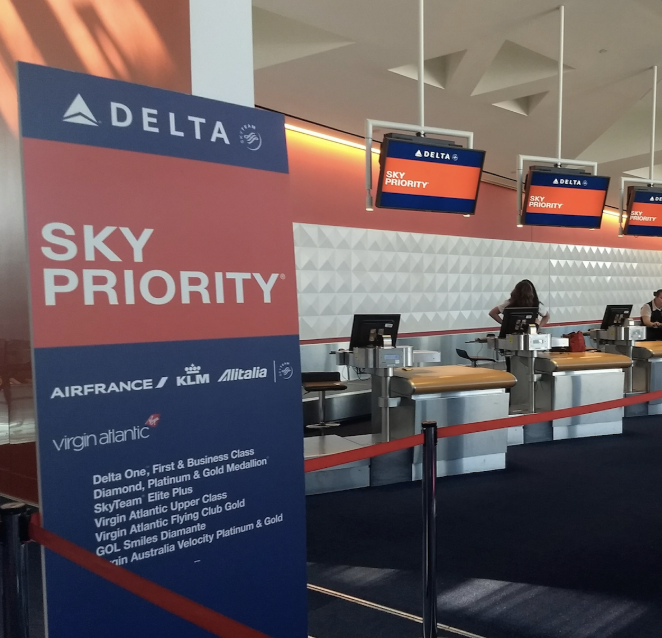
Inside a Competitor's Premium Experience
What Delta's Sky Priority lobby tells us about elite value drivers —
and what it means for premium investment.
Role
Research lead, Customer Strategy & Innovation
Partners
Airport Experience
Loyalty
Scope
Competitive evaluation of Delta's Sky Priority lobby experience
* Certain details have been omitted or modified for proprietary reasons.
$22.1B
Delta's 2025 premium cabin revenue,
on track to overtake
main cabin revenue in 2026.
+27%
Growth in premium seats on
US domestic flights since 2020,
nearly triple the rate of main cabin.
#1 of 7
ranks first among seven
airport satisfaction drivers,
above facilities, staff, and amenities.
Sources: Delta 2025 financial results;
Wall Street Journal industry analysis;
J.D. Power 2025
North America Airport Satisfaction Study.
Summary
When a high-value loyalty member enters an airport, the stretch between the front door and the security checkpoint is brief but consequential. It is where a few necessary tasks get done — dropping a bag, verifying a document, resolving a seat or a same-day change — and an airline has to make that stretch do two things at once: move the traveler through those operational tasks quickly and easily, and make the experience feel like a reflection of the status they hold. Sky Priority is the premium departures experience Delta extends to its Medallion members and premium-cabin travelers. As airlines invest in their premium experiences, understanding how competitors deliver those experiences — and how their customers evaluate them — is crucial for making decisions about premium service, self-service technology, and the design of the premium day-of-travel experience.
I led a mixed-methods study to understand how Delta's Sky Priority customers experience this short but crucial space, and to provide strategic direction for United's own premium experience. The research served as a study in the psychology of what premium travelers, and customers more broadly, want in the transitional spaces of a journey. The findings showed that Sky Priority customers value an efficient and easy self-service process above direct personal assistance — supported by a human-agent presence that is ready and responsive, but only when necessary.
The work provided senior leadership with a comprehensive cross-section of a major competitor's approach to premium experience and its customers' current assessment of it, and it directly informed United's premium experience strategy and investment in self-service technology.
Problem
A premium departures area does a particular kind of work in the day-of-travel experience. It is an operational space — travelers drop bags, verify documents, fix a seat or ticketing problem, travel with a minor, or handle a same-day change, all in the time-pressured stretch before security. It is also the first physical place on the trip where a traveler's status is experienced. A fast, calm, well-supported start reinforces a traveler's confidence in the airline. A crowded or understaffed one, or one that feels no different from the standard line, weakens that status at the first point in the trip where a traveler expects it to count.
Across the industry, advances in self-service technology are making the swath of tasks conventionally referred to as "check-in tasks" easier for customers to complete on their own. Airlines face genuine questions about how human staff can most effectively serve customers, especially those who expect premium treatment: what is the right amount of agent presence, how should it be distributed, and what type of support should it provide? A priority for senior leadership was understanding how a key competitor, in this case Delta, is addressing these questions.
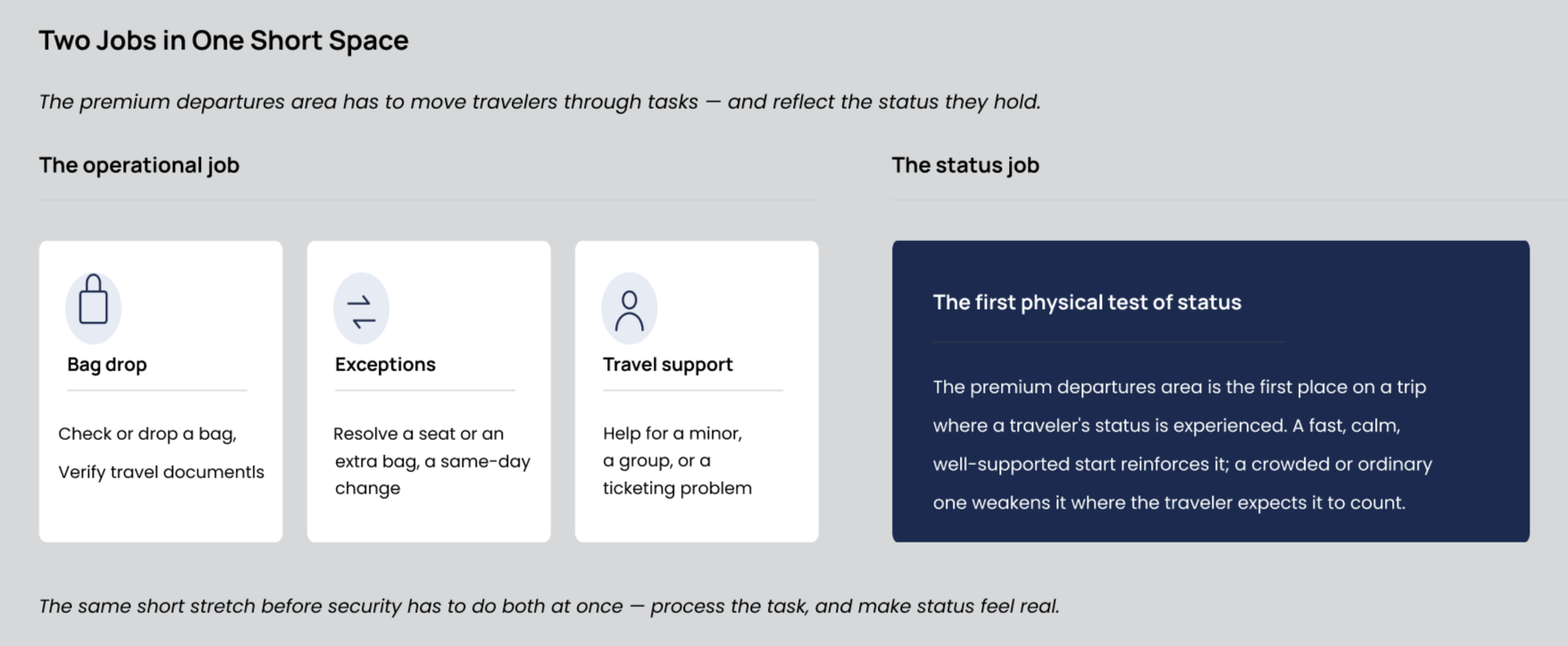
The study set out to answer four questions:
What do premium travelers notice about staffing, and how do they interpret what they see?
When self-service handles the routine, what is human support actually for, and where does it earn its place
When self-service handles the routine, what is human support actually for, and where does it earn its place?
Does the experience make elite status feel meaningful in a space whose primary job is operational?
Answering them called for a close-up view of how travelers actually moved through the space, and a wider understanding of how prevalent those patterns were among Sky Priority customers.
Design
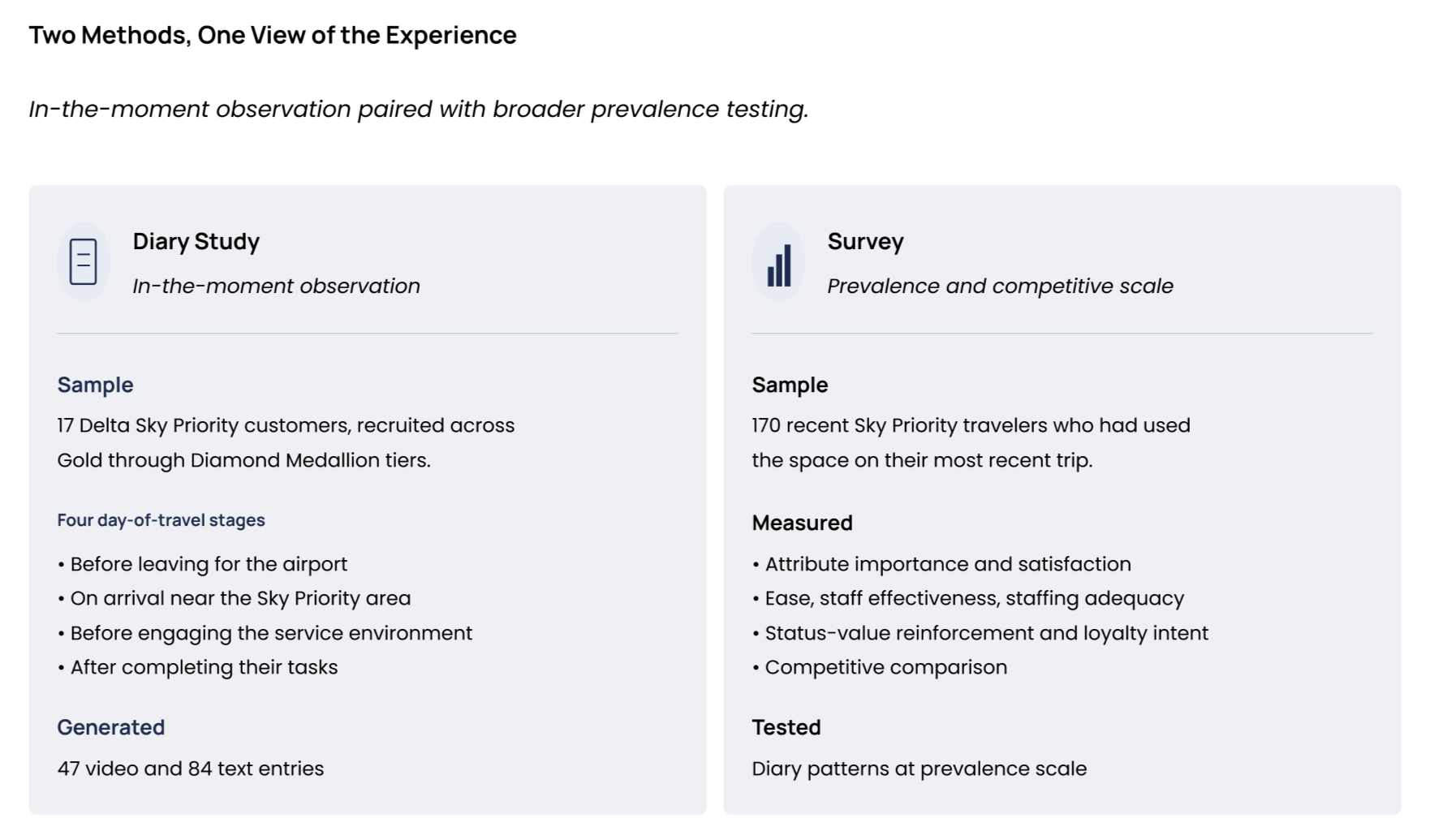
The study employed a diary study to capture what Delta Sky Priority customers were noticing and interpreting as they completed real tasks in the Sky Priority area, and a survey to test those observations against a broader sample of recent Sky Priority users.
17 Delta Sky Priority customers were recruited and documented their experiences across four stages of the day-of-travel experience: before leaving for the airport, on arrival near the Sky Priority area, immediately before engaging the service environment, and after completing their tasks. The study generated 47 video and 84 text entries spanning pre-arrival expectations, environmental observation, staffing reflections, task walkthroughs, comparison with other airlines, loyalty-value reflection, and improvement suggestions.
The survey sample comprised 170 recent Sky Priority travelers who had used the space on their most recent trip. It measured, among other things, attribute importance, satisfaction, ease, staff effectiveness, staffing adequacy, status-value reinforcement, loyalty intent, and competitive comparison.
Answering our research questions meant understanding how premium travelers evaluate aspects of their experience that they rarely separate conceptually:
the layout of the space
the behavior of agents
how well the space was being managed
whether the experience reflected the status they hold
Insight
Three patterns emerged from the research:
Efficiency was Sky Priority customers' first priority — getting through the space quickly and with little effort.
What registered with customers was whether help was available, not whether they used it; once they saw support was ready, using it changed little.
Customers felt their status was honored through being handled competently; an efficient experience is what made elite status feel meaningful.
1. Premium Customers' First Priority was Efficiency
Asked to rank what mattered most in the Sky Priority area, customers placed getting through quickly first and being recognized as a priority customer last. Other questions that touched the same ground returned the same order: getting through without delays was the most-selected marker of the experience working at its best (122 of 170); speed of the process was the most-selected driver of how customers rated their satisfaction (103 of 170). Similarly, when diary participants were asked to rank what they valued most in the space, they ranked efficiency first and recognition of status last.
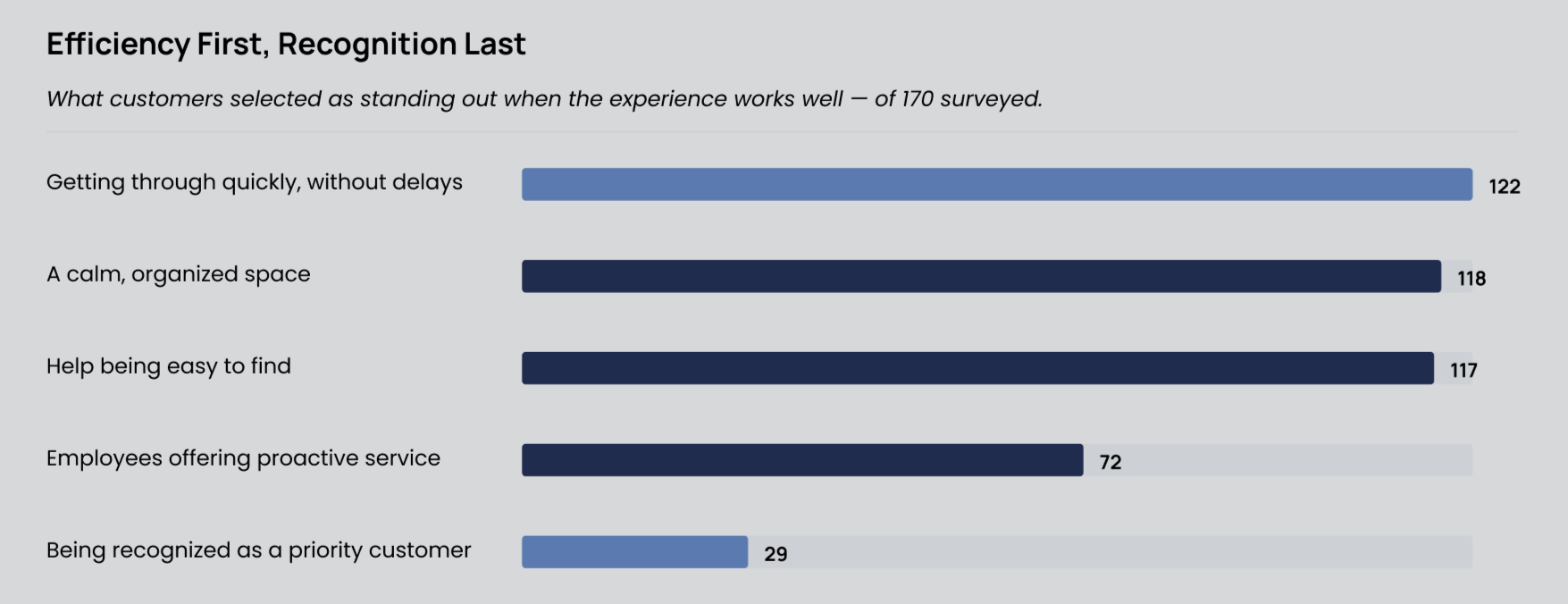
The five ranked priorities fell into three clear tiers. At the top, nearly tied, were getting through quickly and a calm, organized environment — customers' first concern was an efficient passage through an orderly space. A full rank below sat the two staff-related priorities: help being easy to find, and employees stepping in proactively before being asked. Recognition came last, and alone — 69 of 170 ranked being acknowledged as a priority customer dead last, far more than placed any other item there. Customers valued the space and the speed of moving through it first, the presence of staff second, and being recognized a distant third.
2. Customers Valued the Availability of Help More Than Its Use
Nearly every Sky Priority customer interacted with staff in some way: 120 of 170 were greeted by an agent at entry, 92 had an interaction for a task beyond bag drop, and 72 interacted while dropping a bag. But the core kiosk task rarely required an agent — 155 of 170 completed it on their own. Agent interaction, when it went beyond a greeting, was for a specific exception: an extra or overweight bag (64), a document or international-travel check (32), a boarding-pass or ticketing problem (50), a seat or upgrade question (51).
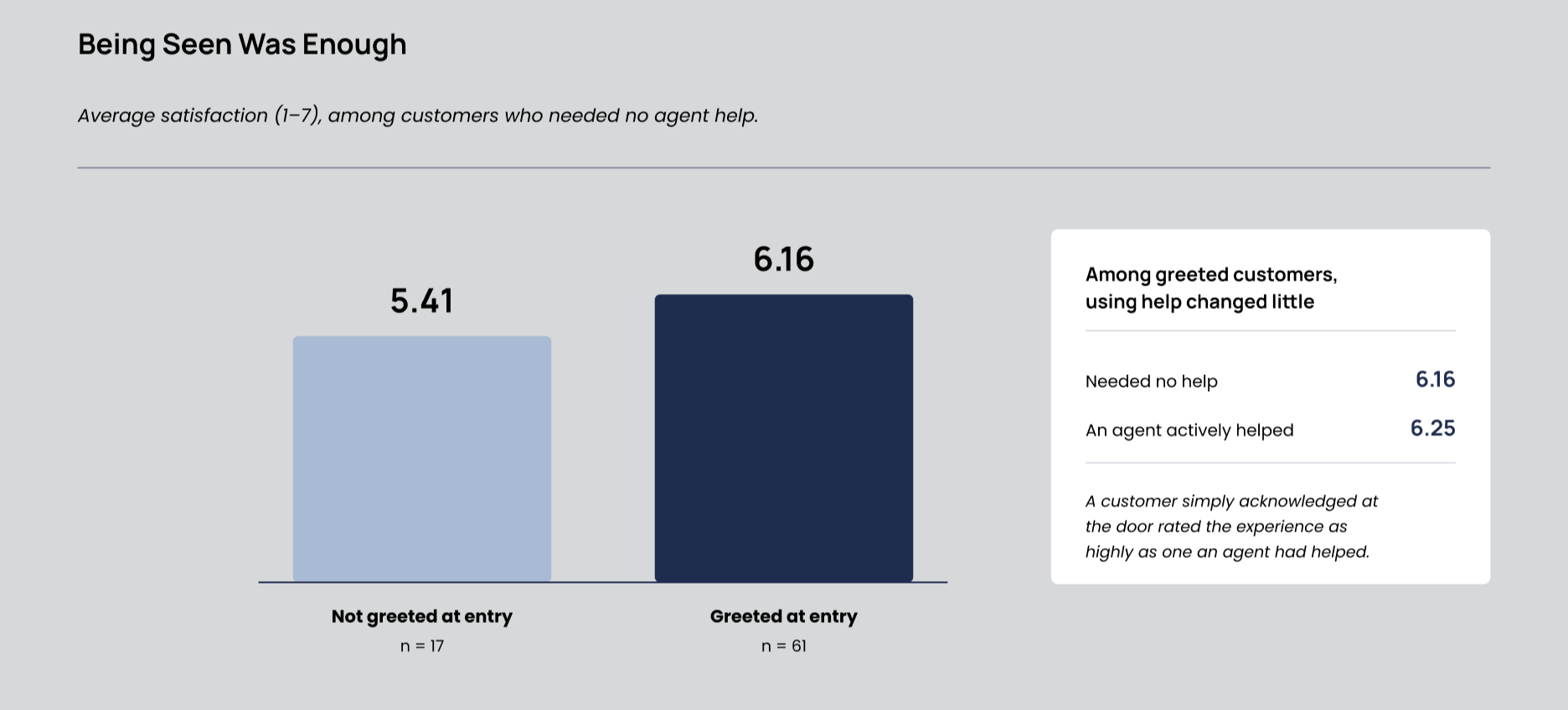
The most common interaction — being greeted by an agent on arrival (120 of 170) — involves no task assistance, yet whether a customer was greeted separated higher satisfaction from lower more sharply than any other form of staff contact. Among customers who needed no agent help at all, those who were greeted rated their satisfaction at 6.16, while those who were not rated it 5.41. And among customers who were greeted, it made little difference whether they went on to need help — 6.25 for those who did, 6.16 for those who did not. A customer who had simply been acknowledged at the door rated the experience as highly as one an agent had actively helped.
The survey's other questions show the same priority. Asked what most influenced their satisfaction, customers named the availability of help — employees clearly present and easy to reach — more often than the ability of employees to resolve issues (85 customers to 68). Asked what stood out when the experience worked well, they chose help being easy to find far more often than employees stepping in to assist (117 to 62). Customers placed help being reachable above help being delivered.
The diary study corroborated the survey findings. Participants who saw a well-staffed space described what it gave them, and it was reassurance, not help:
Sydnee had only a bag to check, yet the agents shaped her whole experience: "it just helped make the overall experience feel a little bit more calm because I knew that there were people there that could help me, and there was quite a few people there that could help me."
Tina, watching the space before getting in line, read the agents as a signal the operation was sound: "when you see people are happy to be at work, when you see that things are going well, it's just a more reassuring experience. It's what you wanna see."
Jay located their value in what their absence would mean: "without them, I probably would have to wait in the regular line, which would have been way longer and way more chaotic since there is no order."
What customers valued first in agent presence was the reassurance it provided — the visible sign that the space was staffed and the experience under control. Hands-on support mattered too, but second, and chiefly in the specific cases the kiosk could not resolve. For a customer completing a routine task, a visible agent was valuable not for what the agent did, but for what their presence signaled.
3. Premium Status Is Validated by Competent Handling, Not Special Acknowledgment
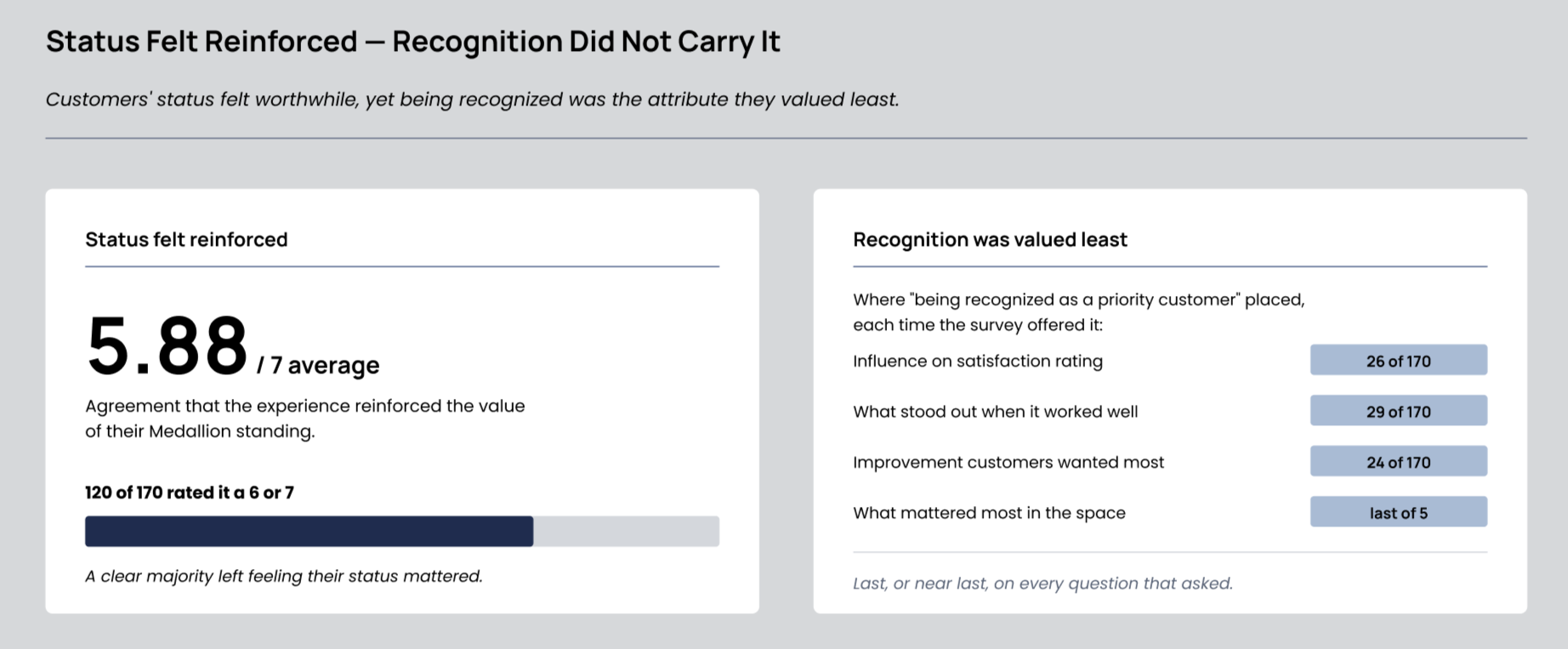
While being greeted upon entry correlated with an overall positive experience, customers did not equate that greeting with a recognition of their status. Across the survey, being recognized as a priority customer was the attribute customers valued least. Asked to rank what mattered most in the Sky Priority area, customers placed "feeling recognized as a priority customer — being acknowledged in a way that reflects my status" last of the five options. It was also the least-selected marker of the experience working well (29 of 170), of what influenced their overall satisfaction rating (26 of 170), and of what improvements they wanted to see most (24 of 170).
Even so, the experience made most customers' Medallion status feel worthwhile. Asked to rate, from 1 to 7, whether their Sky Priority experience reinforced the value of their Medallion standing, customers averaged 5.88, with 120 of 170 rating it a 6 or 7. That rating rose in step with overall satisfaction: customers who rated the experience a 5 for satisfaction averaged 4.93 on status reinforcement, those who rated it a 6 averaged 5.80, and those who rated it a 7 averaged 6.72. Status was reinforced for the customers the experience had gone well for. It was not reinforced through recognition: of the seven factors customers could name as shaping their satisfaction, recognition of status was chosen least often, by 26 of 170.
Being recognized as a priority customer was not without effect, but its reach was narrow. Question 3.2 of the survey asked customers to select up to three factors that most influenced their satisfaction rating; the 26 customers who selected recognition of status among them rated their Medallion status more strongly reinforced than the customers who did not — an average of 6.31 against 5.80. Recognition mattered to a minority attuned to it, and the diary study bore this out: several participants credited being acknowledged as a Medallion member, and the most status-conscious among them asked for more of it, proposing a separate line for top-tier members. For most customers, though, status was reinforced by what the experience did rather than by being recognized — when agents resolved what they needed and the process moved with little effort.
Impact
The work produced four outcomes.
A clearer answer to the question that prompted the study. One of the driving questions for leadership was whether Delta had expanded its agent footprint in its Sky Priority spaces. The research found little evidence that it had. More useful than the answer was the shift in the question: from how many agents a premium space has to whether customers experience it as staffed and handled. The conversation moved from how heavily to staff the space toward how to organize the agents, kiosks, and signage within it.
A new competitive-intelligence research pillar. This study, along with complementary research on Southwest Airlines' move to assigned seating, helped establish a standing competitive-intelligence function within Customer Insights & Analytics at United. It demonstrated the value of studying a competitor through the direct experience of customers using its service, rather than through fares, route maps, and public reporting alone.
Direct input to the Premier self-service strategy. The findings reinforced United's self-service strategy within the Premier experience and directly informed an 8% increase in self-service capability at Premier counters across six hubs.
A competitive assessment of Delta's premium experience. The study established what produces the strength of Delta's Sky Priority experience in the eyes of its highest-value customers. That strength rests on a genuinely separate lane that moves and agents customers find effective.