Understanding Customer Acceptance of Assigned Seating in Air Travel
Summary
Southwest’s shift from open seating to assigned seating offered a rare opportunity to study how customers respond when a familiar airline model is replaced by a more structured, more monetized, and more conventional seating experience. To understand how the change was landing, I led a two-part survey study combining a post-booking survey of 470 customers with a post-trip survey of 805 customers. The research examined how customers understood the new seat categories, how they made seat-related decisions, how the new model compared to prior Southwest experiences, and how the change affected boarding, families, group travel, satisfaction, loyalty, and brand perception.
The findings showed that customers were broadly receptive to the shift, but the more important insight was why. Assigned seating worked because it gave customers a more predictable travel experience. Customers valued knowing their seat in advance, feeling more control during booking, and experiencing a smoother boarding process. The strongest customer benefit was certainty, not premium seating. At the same time, the research surfaced a more fragile layer of the experience: customers questioned whether the paid seat hierarchy felt worth it, whether Standard seating remained acceptable without upsell pressure, and whether the new model still felt distinctively Southwest. The study helped clarify that the strategic risk was less about basic adoption of assigned seating and more about value perception, brand fit, group adjacency, and how well the system supported exceptions after booking.
Key words: airline seating, assigned seating, competitive research, customer experience, value perception, seat selection, boarding experience, group travel, family travel, loyalty segmentation, brand distinctiveness, premium seating, journey evaluation, operational recovery, airline retailing
Note: Specific details of this project have been omitted or generalized for proprietary reasons.
Problem Space
For decades, Southwest’s open-seating model shaped more than where customers sat. It structured the booking experience, the check-in ritual, the boarding process, and the way customers understood fairness, control, and brand difference. Customers knew that boarding position mattered. They knew that early check-in, EarlyBird, loyalty status, and speed at the gate could shape the outcome. The system could be stressful, but it was also familiar and central to how Southwest stood apart from other major U.S. airlines.
The move to assigned seating changed that logic. Customers now had to interpret a seat map, evaluate new seat categories, decide whether to select or pay for a seat, and understand what would happen if they accepted a later assignment. Long-time Southwest customers had to compare the new system against an older mental model. First-time Southwest customers compared it against other carriers. Families and groups had to assess whether assigned seating would make it easier to sit together or create new pressure to pay. The change created a new customer decision environment, not merely a new seat map.
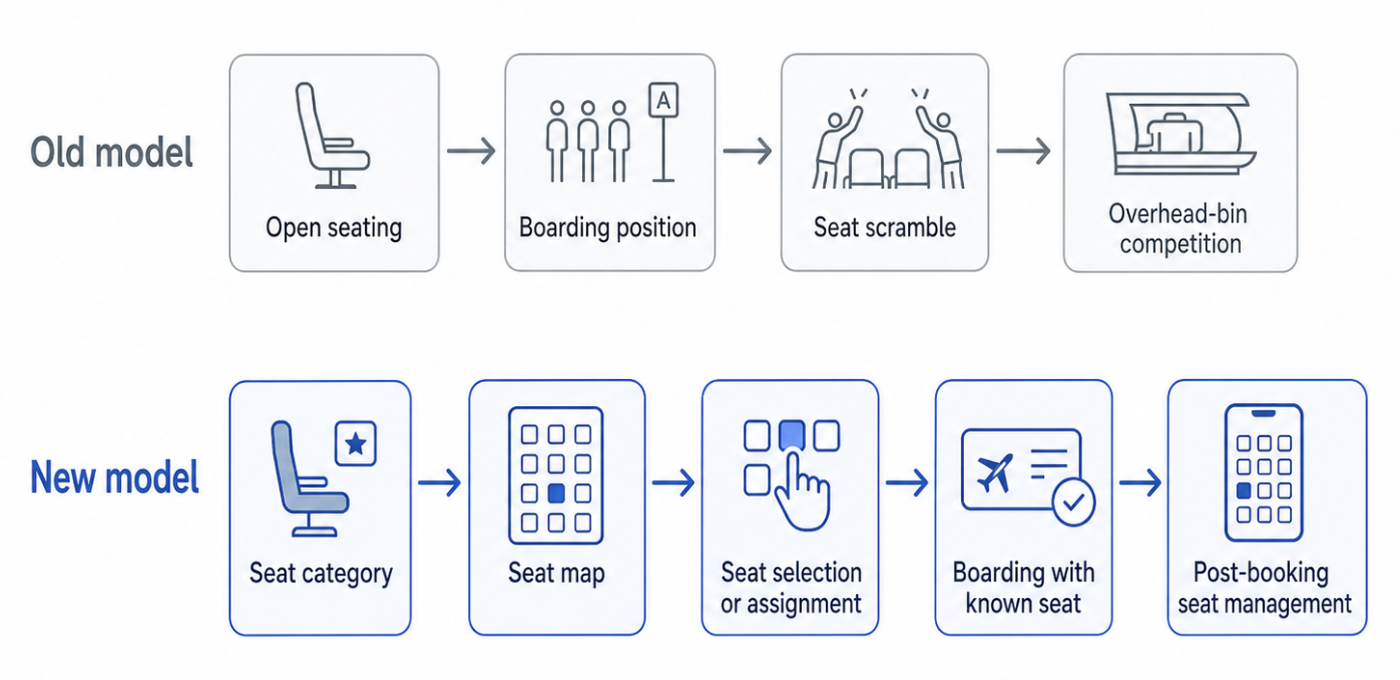
This made the research question broader than whether customers liked assigned seating. We needed to understand how customers interpreted the change, where it created value, where it created resistance, and what the experience suggested for United’s own seat strategy. The most important question was not whether assigned seating could be accepted. The more useful question was what made it feel acceptable, valuable, and customer-friendly.
Research Design
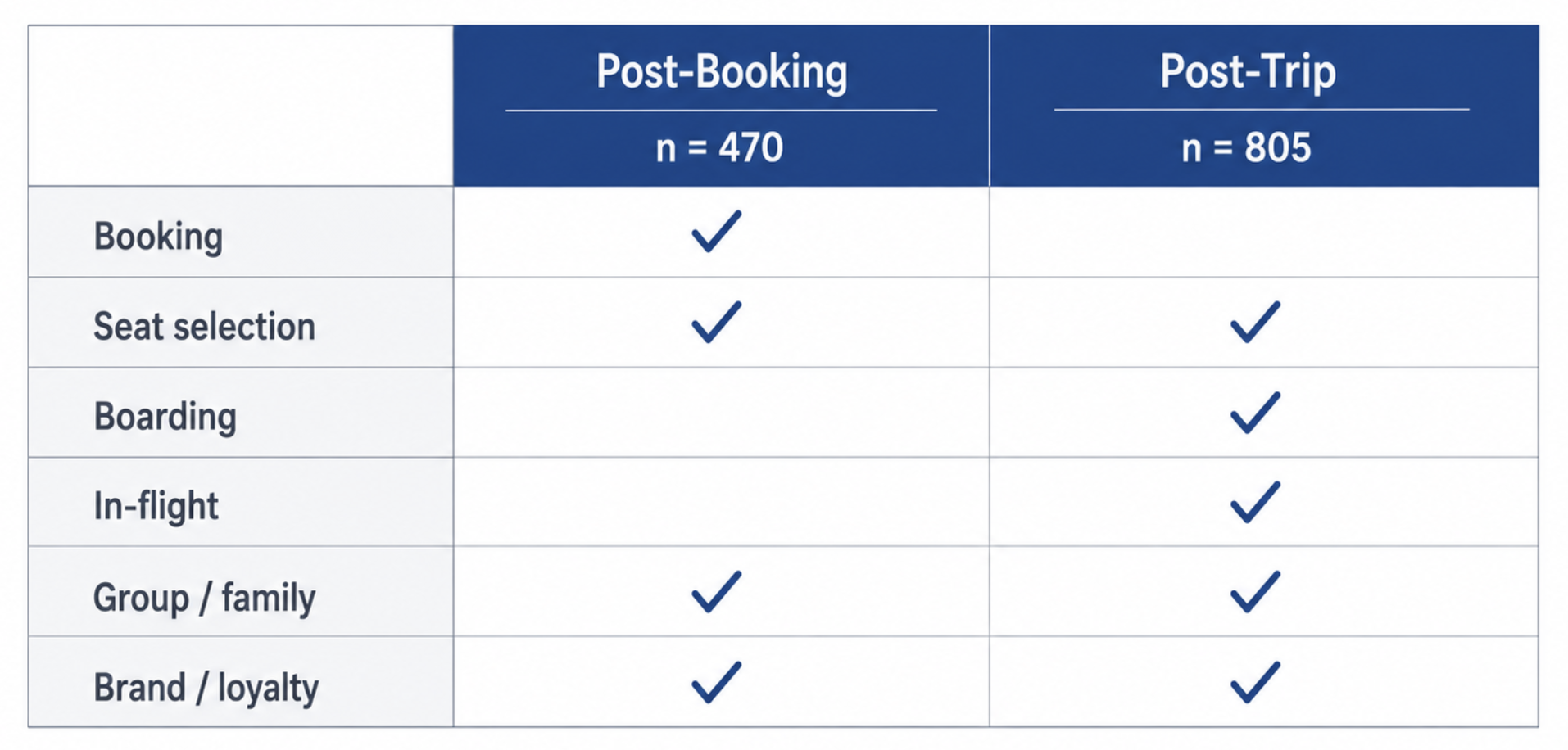
The study used two complementary surveys to capture customer reaction at different points in the journey. The post-booking survey measured immediate reactions after customers encountered the seat-selection flow. The post-trip survey measured how those expectations and decisions held up after boarding, sitting in the assigned seat, and completing the trip.
Post-booking survey: 470 respondents who had recently booked a Southwest flight
Post-trip survey: 805 respondents who had recently completed a Southwest flight
Combined survey responses: 1,275
The surveys were designed around four research goals: understanding how customer type shaped interpretation of the change, assessing expectations and value across seat types, establishing baseline sentiment across the journey, and identifying the strongest drivers of acceptance and resistance.
The sample gave us a strong read from customers with meaningful Southwest context. Across the two surveys, 93% of respondents were returning Southwest flyers, while 7% were first-time flyers. Travel party composition was also important: 44% traveled solo, 48% traveled with other adults, and 9% traveled with at least one child under 13. The sample was loyalty-heavy as well, with 20% A-List Preferred, 48% A-List, and 33% either not Rapid Rewards members or unsure. This mattered analytically because the results were not driven by people with no prior Southwest frame of reference.
Research Insights
1. Assigned seating was accepted because it made the journey feel more predictable.
Customer response to the new seating model was positive across the journey. In the post-booking survey, 57% said the assigned-seating part of booking was better than expected, and 88% rated the overall booking experience Good or Excellent. After travel, 90% were very or somewhat satisfied with their Southwest trip, and 54% were promoters.
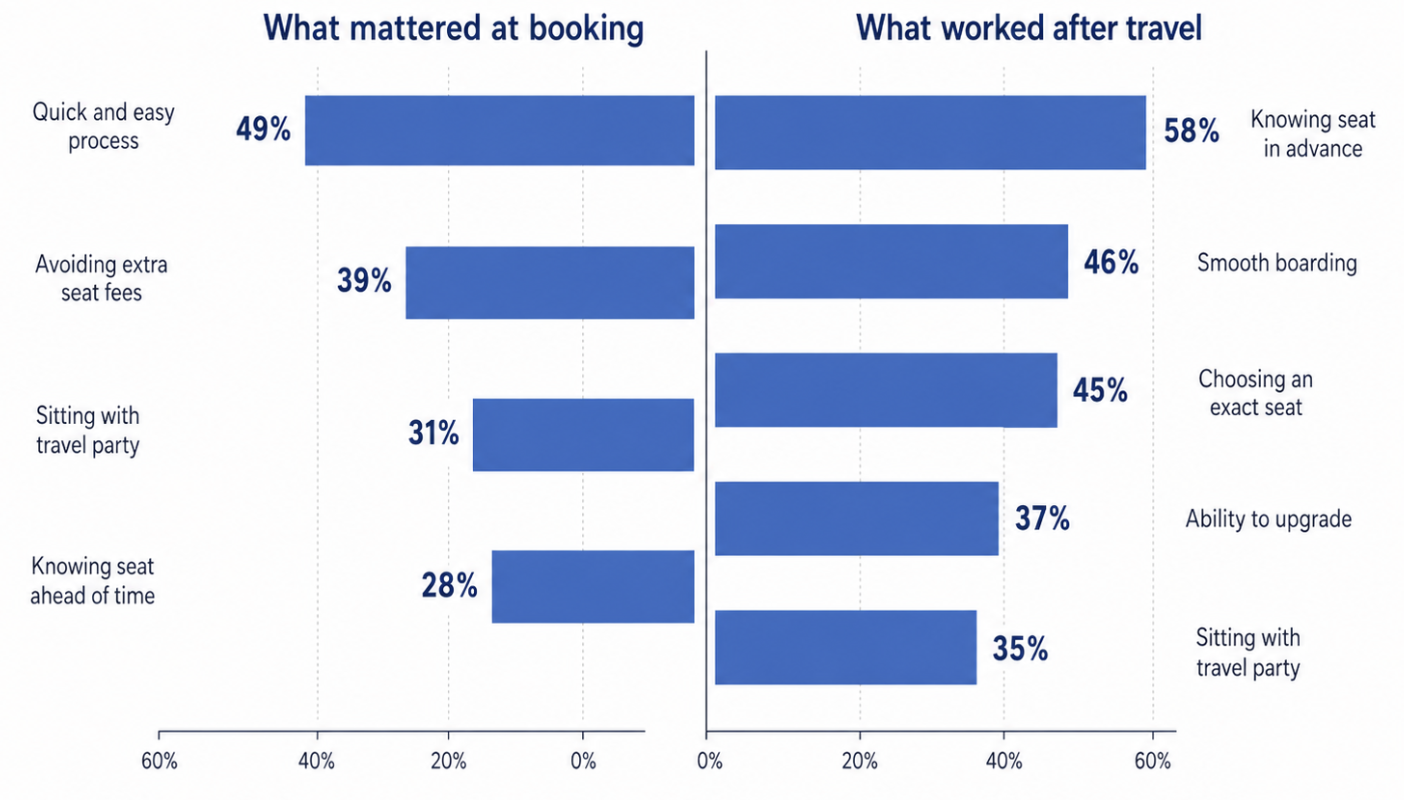
The stronger finding was what customers were responding to. At booking, they prioritized a quick and easy process, avoiding extra seat fees, sitting with their travel party, and knowing their seat ahead of time. After the trip, the most common things customers said worked well were knowing the seat in advance, experiencing a smooth boarding process, and choosing an exact seat.
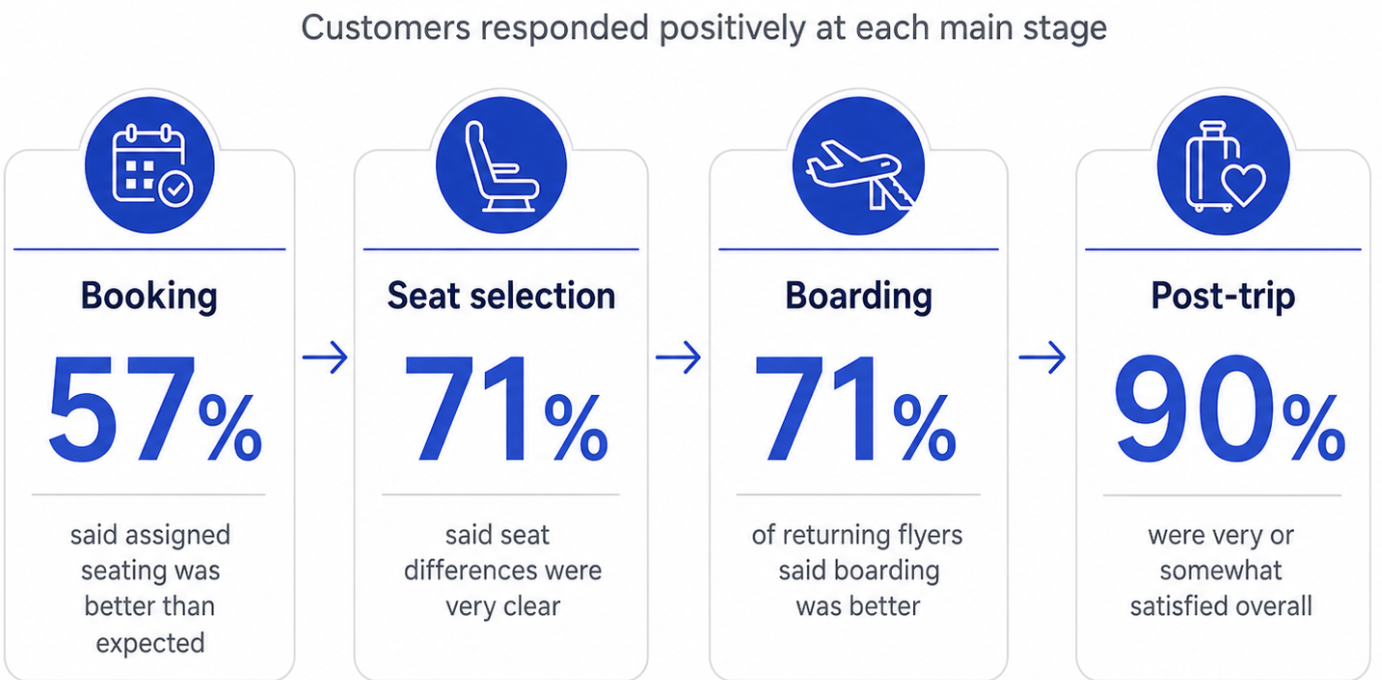
The core value of assigned seating was certainty. Customers were no longer trying to optimize boarding position without knowing the seat outcome. They could see the seat earlier, plan around it, and move through the journey with less ambiguity.
2. Boarding and family travel were the clearest experiential wins.
Boarding was the strongest proof point for the new model. Among returning Southwest flyers, 71% said boarding felt better than the old open-seating process, while only 9% said it felt worse. Boarding also showed up directly in advocacy: among promoters, the top reason for their score was that boarding felt smooth and organized.
Family travel showed a similar pattern. At booking, 68% of travelers with children said assigned seating made the booking process less stressful than the old open-seating system. After the trip, 71% said it made the trip itself less stressful. Among travelers with at least one child under 13, 81% were seated directly together or across the aisle, 91% were very or somewhat satisfied overall, and 57% were promoters.
The group-travel story was more nuanced. Most groups were seated acceptably close: 49% directly next to one another and 33% across the aisle. Ninety-two percent rated the group seating arrangement very or somewhat satisfactory. Some groups still had one member sit alone, but in the broader group sample, that appeared to affect the seating-arrangement rating more than overall satisfaction or advocacy..
3. The seat experience was strong, but the value ladder was fragile.
Customers generally understood the new seat model. Seventy-one percent said the differences between Extra Legroom, Preferred, and Standard were very clear, and 95% said they were at least somewhat clear. Nearly half said nothing about the seat options was unclear.
The in-flight seat experience was also broadly positive. Extra Legroom, Preferred, and Standard all performed reasonably well on comfort and overall satisfaction. Standard still delivered an acceptable experience for many customers, while Preferred performed close to Extra Legroom on several measures.
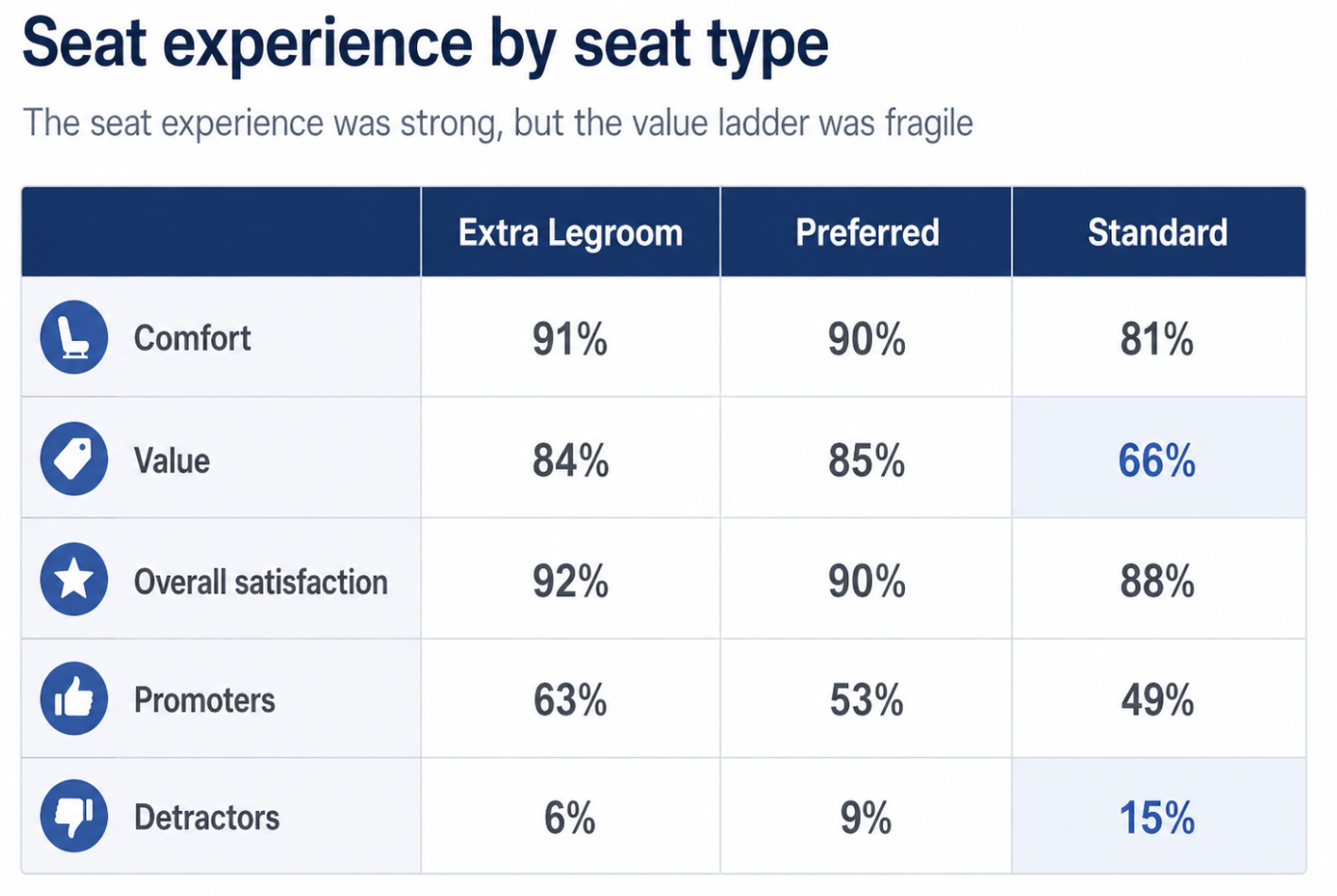
That created the central value tension. If Standard remains acceptable and Preferred feels close to Extra Legroom, customers need a clearer reason to pay more. The top improvement theme after travel was pricing of seat options, and among lower scorers, one of the strongest negative drivers was that the extra cost for better seats did not feel worth it.
4. The system worked best when customers could manage changes early; friction grew around price, flexibility, and brand fit.
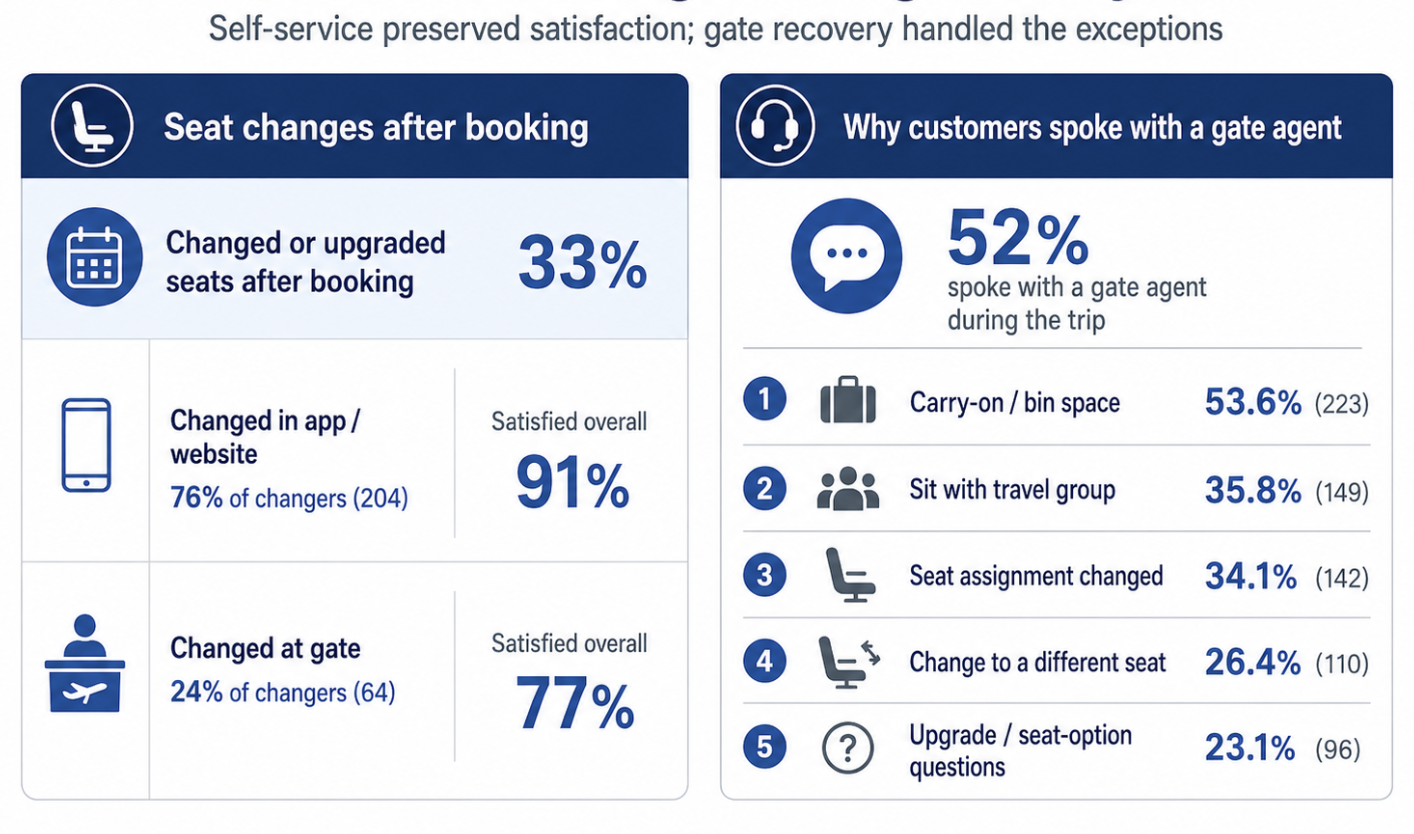
Assigned seating remained active after booking. Thirty-three percent of post-trip respondents changed or upgraded seating after the initial booking process. Among those who changed, outcomes were strongest when the change happened digitally: travelers who changed seats in the app or website were 91% satisfied overall, compared with 77% for those who changed seats at the gate.
Gate agents also played an important recovery role. Fifty-two percent of respondents spoke with a gate agent during the trip. Those interactions were often tied to carry-on/bin space, sitting with a travel group, seat assignment changes, moving to a different seat, or upgrade questions. Speaking with a gate agent was not itself a negative signal; customers who did so had a higher promoter rate than those who did not. The issue was what created the need for recovery in the first place.
The remaining resistance centered on price, flexibility, and brand fit. Customers often described the new model as more organized, more convenient, and more predictable. But some also described it as more expensive, more like other airlines, or less like the Southwest they were used to. The change improved predictability, but it also made Southwest feel more conventional for some customers.
Strategic Impact
The study gave United a competitive read on one of the most significant customer-experience changes in the U.S. airline market. The findings clarified that assigned seating can succeed when it creates a more predictable journey, particularly at booking and boarding. Customers valued knowing where they would sit, having more control over the outcome, and moving through boarding with less scramble.
The research also showed that seat strategy cannot be evaluated only through uptake or topline satisfaction. The value ladder, the standard-seat experience, group adjacency, post-booking changes, and gate-agent recovery all shaped how customer-friendly the model felt. The research reframed the competitive lesson: the strongest value of assigned seating was not the seat category itself. It was the sense of certainty the model created across the journey.
Immediate Implications
The first implication was that certainty should be treated as a core product benefit. Customers responded to assigned seating when it helped them understand what would happen, where they would sit, and how boarding would unfold. This suggests that seat strategy should be evaluated not only as a merchandising system, but as an orientation system that reduces ambiguity during moments of travel pressure.
The second implication was that premium value must be legible. Customers did not show broad dissatisfaction with the physical seat experience, but the perceived difference between seat types was not always strong enough to remove price sensitivity. If premium feels like a charge to avoid an undesirable outcome, rather than a clearly better experience, resistance grows.
The third implication was that exception handling matters. Seat changes, group adjacency, carry-on concerns, and gate-agent interactions all shaped how the new model landed after booking. The experience was strongest when customers could manage changes digitally and early. Gate agents played an important recovery role, but gate-based seat changes were associated with lower satisfaction than digital changes.
Future Directions
The next area for investigation is how seat value is formed across customer segments. Loyalty status, fare rules, seat benefits, and prior expectations may meaningfully change whether a customer experiences the model as empowering or restrictive. Higher-status customers may be insulated from some of the price and access friction that lower-status customers feel more directly.
A second area is group and family adjacency. The current research showed that families were broadly positive and that groups often tolerated near-adjacent outcomes, but the boundary between “good enough” and unacceptable seating deserves closer study. The most important question is not only whether passengers are seated together, but which kinds of separation create stress, trigger recovery needs, or lower trust in the system.
A third area is AI-supported seat management. Customers are already navigating a complex set of seat choices, pricing tradeoffs, assignment rules, upgrade options, and day-of-travel contingencies. Future research should explore how intelligent guidance could help customers understand tradeoffs, manage seating changes, preserve group adjacency, and anticipate downstream issues without making the experience feel more complex or more transactional.